
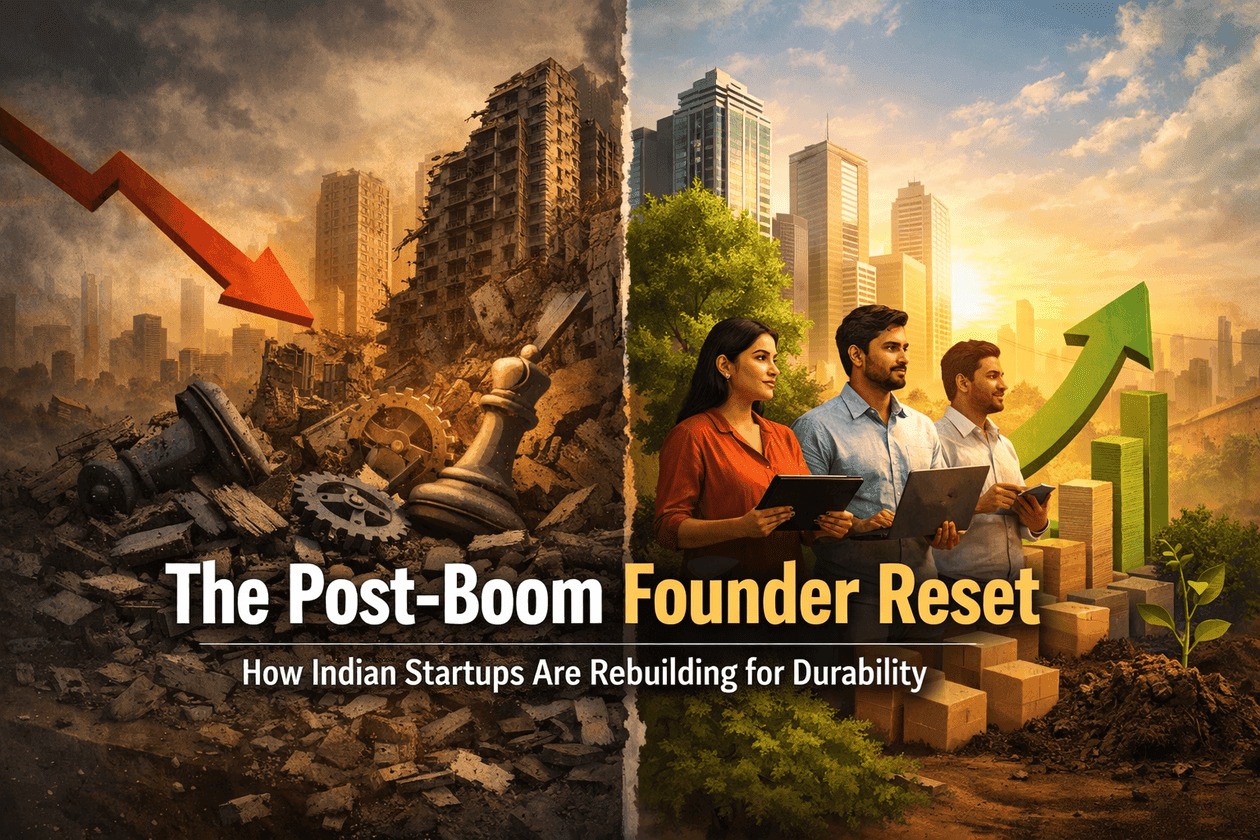
Analysis: Why adaptability, not acceleration, is shaping the next phase of Indian startups
India’s startup boom did not end suddenly. It slowed just enough to reveal what actually matters.
After India’s startup boom cooled, founders began resetting how companies were built, not how fast they grew. The post-boom phase exposed a shift from momentum-driven growth to durability-led decision making.
Fundraising announcements slowed. Expansion plans were reconsidered. Hiring became selective again. What remained was quieter, less performative, and more deliberate. For many founders, this phase marked not an ending, but a reset in how companies were built, evaluated, and led.
The boom revealed why capital efficiency matters.
The correction revealed why rigidity is fatal.
Together, they explain why the next generation of Indian startups is being built very differently. That difference is not louder ambition, but quieter discipline.
The End of Momentum as a Proxy for Progress
During the boom years, momentum became a substitute for proof. Funding rounds, headcount growth, and geographic expansion were treated as validation that a business model was working.
But momentum is not the same as durability.
As capital became abundant, many startups shifted from learning to executing too early. Structures solidified before assumptions were tested. What looked like confidence often masked unresolved uncertainty.
When market conditions changed, momentum lost its signaling power. Companies that had optimized for visibility rather than adaptability found themselves unable to respond quickly.
Capital efficiency can explain why certain companies commanded premium valuations, as seen in recent AI-driven success stories. But efficiency alone never explains why well-funded startups still fail. The missing piece was organizational flexibility.
What the Survivors Understood Differently
The startups that survived the post-boom phase did not do so by luck. They shared a fundamentally different understanding of scale.
They recognized that:
-
- Speed amplifies mistakes when learning is incomplete
-
- Scale magnifies assumptions, not certainty
-
- Fixed structures reduce the ability to change course
Instead of asking how fast they could grow, these founders asked how easily they could adapt.
That shift in thinking proved decisive.
A New Operating Logic Is Taking Shape
Across sectors, a quieter and more disciplined operating philosophy is emerging. It does not reject growth. It reorders it.
Smaller Teams, Clearer Accountability
Hiring has slowed, not because ambition has faded, but because coordination costs are better understood. Smaller teams move faster, communicate more clearly, and surface problems earlier.
Senior roles are justified by responsibility, not optics. Organizational depth is added only when complexity demands it, not when external signaling encourages it.
This restraint preserves alignment and learning velocity.
Expansion as a Test, Not a Commitment
Market expansion is no longer treated as a one-way decision. New cities, customer segments, and channels are tested with limited exposure before meaningful resources are committed.
This approach preserves optionality. It allows companies to gather real-world data without locking themselves into fixed cost structures that are difficult to unwind.
Expansion has become iterative again, reversing the rigidity trap that broke many startups during the boom.
Boards That Focus on Reversibility
One of the most consequential changes has occurred in boardrooms.
Rather than focusing exclusively on growth metrics, boards are increasingly examining structural risk. Questions that were once secondary now shape strategic discussions:
-
- What assumptions are embedded in this decision?
-
- How difficult is it to reverse if conditions change?
-
- What learning does this unlock relative to its cost?
This shift does not slow companies down. It prevents confident movement in the wrong direction.
The absence of these conversations was one of the silent failure modes of the boom era, when spending was correct but timing was not.
Capital Efficiency as a Strategic Capability
Capital efficiency has returned to prominence, but with a different meaning, especially as India enters a phase where startups are being judged less on momentum and more on long-term resilience.
It is no longer framed as restraint or austerity. It is understood as a defensive capability. Efficient companies buy time. They preserve options. They absorb shocks without panic.
This is why investors now look beyond topline growth. Metrics such as revenue density, learning cycles, and decision discipline are gaining importance.
Efficiency is not about spending less.
It is about maintaining control.
The Quiet Shift in Founder Psychology
Perhaps the most important reset is psychological.
Founders are redefining what progress feels like. Growth is no longer the only validation. Discipline, responsiveness, and clarity now carry equal weight.
This shift manifests in subtle but meaningful ways:
-
- Ideas are killed earlier, without sunk-cost attachment
-
- Assumptions are revisited more frequently
-
- Uncertainty is acknowledged sooner, not hidden behind narratives
This approach does not attract headlines. It does not trend well on social platforms. But it produces organizations that are harder to destabilize.
Why This Reset Strengthens the Ecosystem
Every startup ecosystem goes through cycles. What determines its long-term strength is not the absence of failure, but the quality of learning that follows it.
India’s startup ecosystem is emerging from this phase with:
-
- More grounded growth expectations
-
- Stronger governance norms
-
- Founders better attuned to incentive design
-
- Investors more focused on resilience than rhetoric
The next generation of startups will not be less ambitious.
They will be more intentional.
They are no longer optimizing for the next funding round.
They are optimizing for longevity.
Completing the Editorial Arc
This article completes a three-part analysis of India’s startup cycle.
First, capital efficiency explained why certain companies earned premium valuations.
Second, rigidity explained why many well-funded startups still failed.
Finally, adaptability explains why some companies survived the correction and emerged stronger.
This is not a moral story.
It is a systems story.
Capital did not break startups.
Misaligned incentives and premature rigidity did.
The correction did not end innovation.
It refined what sustainable innovation requires.
Final Take
The post-boom era feels quieter not because founders have lost confidence, but because confidence is now grounded in evidence rather than momentum.
The startups that succeed next will not be defined by speed or scale alone. They will be defined by their ability to remain flexible as markets evolve.
In an uncertain environment, adaptability is not a secondary advantage.
It is the core asset.
Editorial Note: This article is an independent analysis of systemic patterns observed in India’s startup ecosystem. It does not reference or evaluate any specific company or individual.