
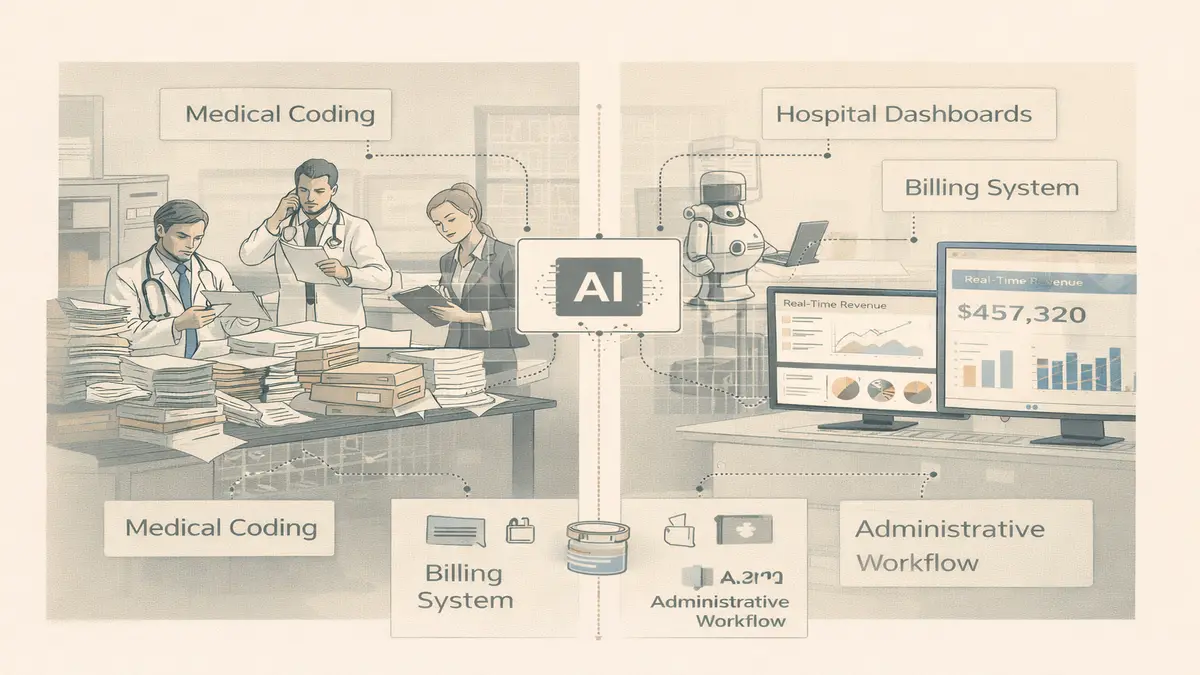
Subheadline: With $20M led by Index Ventures, Parallel is embedding AI agents directly into hospital workflows—marking a shift from experimental automation to revenue-critical healthcare infrastructure.
The Moment AI Agents Became Hospital Infrastructure
Parallel, a Paris-based healthcare AI startup building agentic systems for hospital administration, has raised a $20 million Series A led by Index Ventures—signaling a broader shift as enterprise AI adoption accelerates from assistive tools to execution-layer infrastructure inside high-cost systems.
This transition places Parallel at the center of a structural realignment across the AI stack:
from model-driven capability to embedded systems that directly operate economic workflows.
This evolution mirrors patterns already visible in AI capital flowing into infrastructure, agents, and robotics, where investment is increasingly targeting execution layers rather than standalone models.
Healthcare provides the clearest entry point. Administrative overhead consumes up to 30% of total spending, creating a structurally inefficient layer where automation delivers immediate and measurable financial impact.
Hard Facts: Speed, Capital, and Deployment
Parallel’s trajectory compresses traditional healthcare deployment cycles into months:
- $20M Series A (Index Ventures, Y Combinator, Frst, Hexa)
- Raised within ~12 months of a $3.5M seed round
- Deployed across dozens of hospitals (primarily France)
- Millions in ARR
- Tens of millions in recovered revenue for clients
- Team size: ~10–15
This combination of capital efficiency, deployment velocity, and direct ROI visibility is atypical in healthcare, where implementation timelines often exceed product development cycles.
The Shift From Integration to Execution
Most healthcare AI systems depend on deep integration with electronic health record (EHR) platforms—requiring APIs, structured data pipelines, and extended IT coordination.
Parallel bypasses this model entirely.
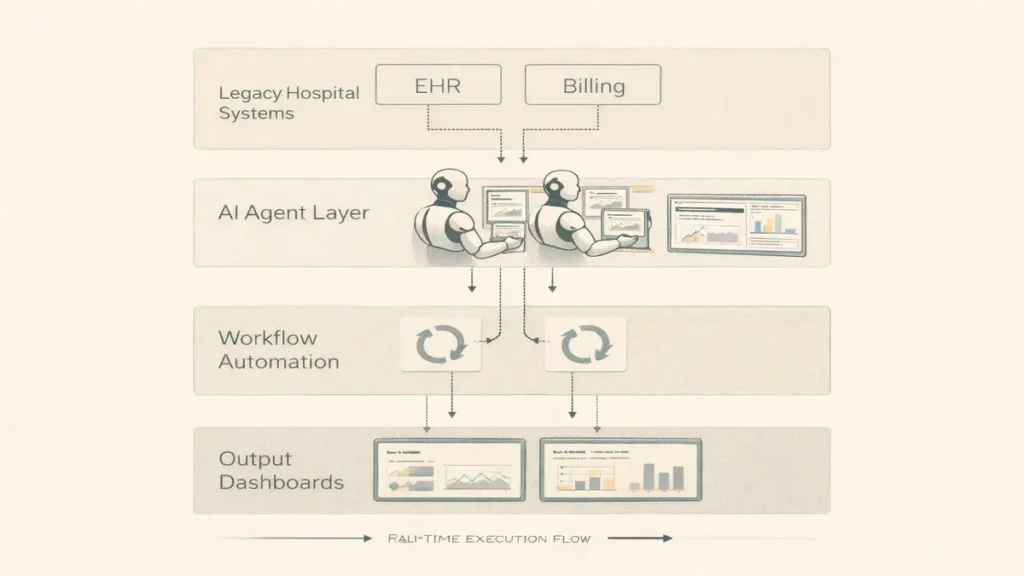
Its agents operate using execution-layer architecture:
- Navigate software interfaces like human operators
- Read, interpret, and act on live system data
- Execute workflows via secure remote environments (VPN + RPA)
- Require no backend integration or system replacement
This reflects a broader infrastructure transition similar to the rise of AI control plane systems, where orchestration and execution layers are becoming central points of value capture.
This shifts enterprise AI from:
integration-dependent software → execution-native systems
Deployment cycles compress from:
12–24 months → ~1 week
The broader implication extends beyond healthcare:
AI is evolving from connecting systems to operating them directly.
Why Medical Coding Is the Strategic Entry Point
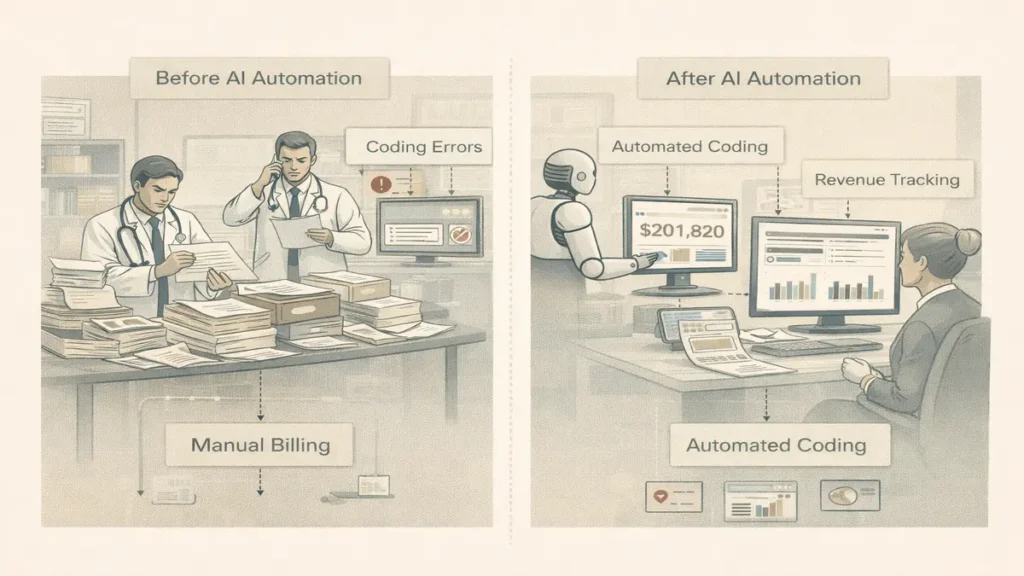
Medical coding is not simply administrative—it is the financial backbone of hospital operations:
- Converts clinical activity into billable outputs
- Directly determines reimbursement flows
- Errors produce systemic revenue leakage
Parallel’s entry point reflects a precise strategic positioning:
- Immediate ROI visibility
- Alignment with financial stakeholders
- Expansion pathway across adjacent workflows
This follows a repeatable enterprise pattern also visible in AI systems reshaping enterprise workflows:
enter through revenue → expand across operational layers
Capital Is Repricing AI Around Economic Output
Parallel’s funding reflects a broader shift in how capital is being allocated across AI systems.
Investors are increasingly prioritizing:
- Direct financial outcomes (revenue recovery, cost reduction)
- Workflow ownership over tool usage
- Speed of deployment over technical novelty
- Domain-specific defensibility
This aligns with a structural transition highlighted in recent AI valuation analysis:
model capability is commoditizing; execution control is accumulating value
Parallel is not positioned as an AI provider.
It is positioned as:
revenue infrastructure embedded inside hospital systems.
The Competitive Divide: Data Systems vs Execution Systems
The healthcare AI landscape is bifurcating into two distinct architectures:
Data-Centric Systems (Nym, Fathom, CodaMetrix)
- Depend on EHR integrations
- Operate on structured datasets
- Proven at scale in US enterprise environments
- Slower deployment cycles
Execution-Layer Systems (Parallel)
- No integration required
- Operate directly on existing software interfaces
- Faster rollout in fragmented environments
- Strong alignment with legacy-heavy systems
This is not a product differentiation.
It is a shift in system design philosophy.
Over time, execution-layer systems may compress integration-heavy competitors—not through superior models, but through faster deployment, lower friction, and tighter alignment with existing infrastructure constraints.
The Constraint No One Is Pricing In
Despite early traction, the model introduces structural constraints that remain underpriced:
- Regulatory exposure (HIPAA, EU data frameworks)
- Near-perfect accuracy requirements (financial sensitivity)
- Enterprise procurement friction
- Trust in autonomous execution systems
Healthcare operates under a different threshold:
systems must be operationally reliable, not statistically acceptable
A Broader Pattern: AI Is Moving Into Execution Layers
Parallel reflects a cross-industry transition already visible in finance, developer tooling, and enterprise automation.
This mirrors shifts seen in agentic systems transforming enterprise AI, where software is moving from interface-driven interaction to autonomous execution.
Across these sectors, AI systems are moving beyond copilots into execution layers that directly control workflows and economic output.
Healthcare is not unique.
It is simply earlier in exposing how quickly value shifts once AI moves inside operational systems.
From:
- Interfaces
- Copilots
- Assistive tools
To:
- Autonomous agents
- Workflow execution systems
- Revenue-linked infrastructure
The pattern is structural:
AI is migrating from the interface layer to the execution layer of the stack
Strategic Implications
For Founders
The opportunity is no longer horizontal AI tooling.
It is:
- Identifying high-friction, high-value workflows
- Embedding execution directly into them
- Delivering measurable economic outcomes
For Investors
Parallel reinforces a clear allocation thesis:
- Vertical AI
- Immediate ROI
- Fast deployment
→ capital-efficient scaling systems
For Healthcare Systems
Hospitals are not simply adopting new tools.
They are:
reconstructing operational infrastructure around automation layers
System-Level Insight: The Real Moat Is Execution Control
The defining shift is not Parallel’s funding or growth rate.
It is where defensibility is relocating.
AI moats are moving away from:
- Model performance
- Benchmark differentiation
- Interface design
Toward:
control over high-value execution layers tied to economic output
Parallel’s agents are valuable because they:
- Sit inside revenue-critical systems
- Operate continuously
- Generate measurable financial outcomes
This is the point where:
AI stops being software and becomes part of the system’s operating layer.
Editorial Close
Healthcare has resisted digital transformation not due to lack of software, but due to deep operational fragmentation and system inertia.
Parallel’s model avoids that constraint.
It does not replace systems.
It operates on top of them.
It does not require behavioral change.
It aligns with existing workflows.
That architectural shift—more than the technology itself—may define how AI scales across every legacy industry in the next phase of adoption.
Research Context: Synthesis of funding disclosures, investor positioning, healthcare AI deployment patterns, and enterprise automation trends as of March 2026.
Editorial Note: This article reflects independent analysis of publicly available information and broader AI ecosystem dynamics.