

Subheadline: 8VC’s $16 million investment in PointOne positions the company within the execution layer of legal infrastructure, where AI is shifting from productivity enhancement to control over how work is captured, priced, and monetized.
A Rapid Capital Signal in an Overlooked Layer
PointOne, an AI-native legal infrastructure company operating in the economic layer of professional services, has raised $16 million in Series A funding, bringing its total capital to approximately $20 million.
The round — led by 8VC with participation from Bessemer Venture Partners, General Catalyst, and Y Combinator — reflects more than investor confidence in a product.
It signals recognition of a structural gap:
the absence of reliable, high-fidelity data systems governing how legal work translates into revenue.
Unlike surface-level AI tools focused on acceleration, PointOne targets a deeper constraint — one that sits beneath workflows and determines economic outcomes.
The Structural Deficit: Time as Unreliable Infrastructure
Legal services remain anchored to a legacy mechanism:
manual time entry.
This system underpins:
- billing
- pricing
- staffing allocation
- profitability measurement
Yet it remains fundamentally unreliable.
Time is forgotten, reconstructed, inconsistently categorized, and often non-compliant with client billing rules. The result is not merely operational friction.
It is a persistent distortion of:
how value is measured inside a trillion-dollar industry.
This is the layer PointOne is rebuilding.
From Timekeeping to Economic Signal Processing
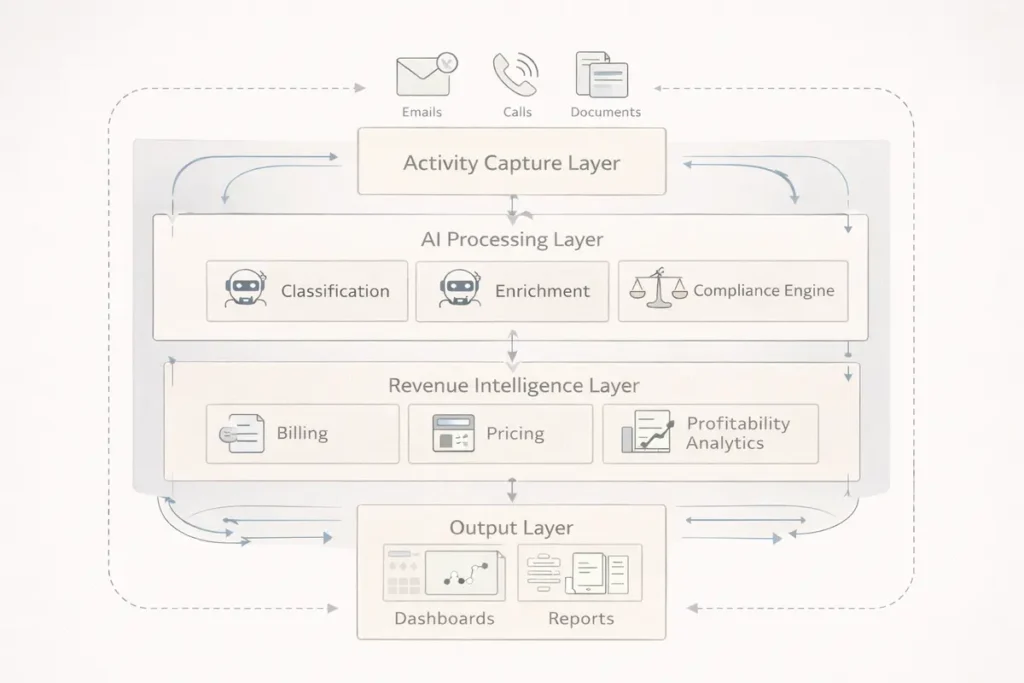
PointOne replaces manual input with passive, AI-driven activity capture, transforming unstructured work into structured economic data.
Instead of requiring participation, the system continuously observes:
- communication streams (email, meetings, calls)
- document workflows
- application-level activity across environments
- historical work patterns (retroactive reconstruction)
This data is then converted into:
- billable entries aligned with client and matter structures
- automated Outside Counsel Guidelines (OCG) compliance
- pricing and profitability intelligence
The shift is not incremental.
It is architectural.
Traditional systems record time.
PointOne constructs a continuous economic signal layer that explains how revenue is actually generated.
Why This Matters: AI Is Moving Into the Value Layer
Much of legal AI has focused on cognitive augmentation:
- research acceleration
- drafting automation
- document analysis
These systems improve output speed.
They do not define value.
As explored in AI execution-layer systems in enterprise workflows, the trajectory of AI is shifting away from interfaces and toward systems that directly shape outcomes.
PointOne operates within this emerging layer.
It does not change what lawyers do.
It changes how their work is:
captured → structured → monetized
Passive Infrastructure and the End of User-Driven Input
The most consequential innovation is not automation.
It is the removal of interaction.
PointOne eliminates:
- timers
- manual entries
- retrospective reconstruction
In their place, it introduces:
continuous, ambient data capture
This aligns with broader infrastructure evolution seen in AI infrastructure control planes like Kluisz, where systems increasingly operate as background layers rather than user-facing tools.
The implication is structural:
Software is transitioning from something users operate
to something that operates continuously on behalf of users.
Traction as an Indicator of Infrastructure Adoption
The company’s momentum suggests this shift is already underway:
- 10× revenue growth in six months
- 100+ law firms deployed
- adoption across both boutique firms and global enterprise practices
- enterprise clients including Sony, Stripe, and Morgan Stanley
Internally, the positioning is evolving.
PointOne is no longer perceived as a tool.
It is increasingly treated as:
core infrastructure for revenue visibility and control
This distinction is critical.
Tools optimize workflows.
Infrastructure defines systems.
The Market Divide: Productivity vs Control Systems
Legal AI is often framed as a single category.
In reality, it is splitting into two distinct layers:
1. Productivity Layer (Surface AI)
- research systems
- drafting assistants
- document automation
These reduce effort.
2. Economic Control Layer (Infrastructure AI)
- time capture
- billing compliance
- pricing intelligence
These define outcomes.
PointOne sits decisively in the second.
Even within time-tracking tools, differentiation is clear:
- lightweight tools (Billables AI, MagicTime) simplify workflows
- broader platforms (Laurel) extend into operational analytics
PointOne’s architecture integrates:
- full passive capture
- retroactive reconstruction
- embedded compliance systems
- pricing intelligence
This positions it not as a feature, but as a:
system of record for legal economic activity
The Investment Thesis: Owning the Data Layer
8VC’s lead — following prior participation — reflects a consistent infrastructure thesis:
The highest-value AI companies are not those that sit on top of workflows.
They are those that:
own the data layer that defines those workflows
This mirrors broader capital movement analyzed in AI funding shifts toward infrastructure and control layers, where investment is concentrating around:
- execution layers
- system intelligence
- data ownership
PointOne fits squarely within this pattern.
The Economic Transition: From Hours to Measurable Systems
The legal industry is entering a structural transition.
Clients are increasingly demanding:
- alternative fee arrangements
- outcome-based pricing
- cost predictability
This shifts the requirement from tracking time
to understanding it with precision.
High-quality time data becomes essential for:
- pricing strategies
- staffing efficiency
- profitability forecasting
PointOne transforms time from:
a compliance burden
into a:
strategic economic asset
Execution Risks in a Conservative Industry
Despite strong signals, adoption is not guaranteed.
Privacy Constraints
Continuous monitoring raises concerns in highly sensitive environments.
Cultural Inertia
Legal workflows are historically resistant to structural change.
Model Evolution Risk
A long-term shift away from billable hours could reshape the role of time data.
However, even in alternative models:
measurement does not disappear — it becomes more critical.
System-Level Shift: AI Moves Beneath the Interface
PointOne is part of a broader reconfiguration across AI infrastructure.
Across layers:
- orchestration → becoming autonomous
- applications → becoming agent-driven
- observability → becoming actionable
Now:
economic systems are becoming programmable
This marks a deeper transition. AI is no longer just augmenting work.
It is redefining:
how value is created, measured, and captured
Conclusion
PointOne’s $16 million raise is not a bet on time tracking.
It is a bet on control.
Control over how work is recorded.
Control over how value is quantified.
Control over how revenue is realized.
As AI systems grow more autonomous, the most critical layer will not be where work is performed.
It will be where:
work is translated into economic reality in real time.
If that layer consolidates, companies like PointOne will not compete within legaltech.
They will define its underlying structure.
Research Context
Based on company disclosures, investor commentary, and analysis of legal AI and infrastructure trends (March 2026).
Editorial Note
This article reflects independent analysis and is intended to examine structural shifts in AI infrastructure and enterprise software.