

Moda’s founders aren’t trying to improve AI design. They are fixing where it actually breaks: between generation and execution.
Moda, a design infrastructure startup operating at the execution layer of AI workflows, has raised $7.5 million in seed funding led by General Catalyst and Pear VC — signaling a structural shift in how AI systems are being built: from output generation toward workflow execution embedded directly inside enterprise operations. While most of the generative design market continues to optimize for better visuals, faster prompts, and improved stylistic control, Moda is built on a fundamentally different premise: that the real constraint is not generation, but what happens immediately after.
This distinction is not incremental. It is structural. Because the failure point in AI design was never creativity. It was execution.
More broadly, this reflects a turning point across enterprise AI, where value is migrating away from surface-level outputs toward systems that can reliably operate inside real workflows and directly influence outcomes.
The Founder Insight: Where AI Actually Breaks
For the past two years, the dominant assumption in AI design has been that improving outputs would solve the problem. As a result, tools have focused on model quality, prompt accuracy, and visual fidelity.
In practice, however, the constraint does not appear during generation. It appears immediately after.
A marketer generates an asset. The text is slightly wrong. The brand color is off. The layout needs adjustment.
The system breaks.
Outputs are static. Workflows reset. Iteration collapses.
This is not a usability issue. It is a structural failure in how AI integrates with production environments.
Moda’s founders identified this gap early: AI was producing results. It was not producing systems.
The Decision: Build for Execution, Not Output
Rather than continuing to compete on generation quality — the default trajectory across the market — Moda’s founders made a more difficult and less visible decision: to move AI into the workflow layer itself, where outputs are not endpoints but components within an operational system.
Move AI into the workflow layer.
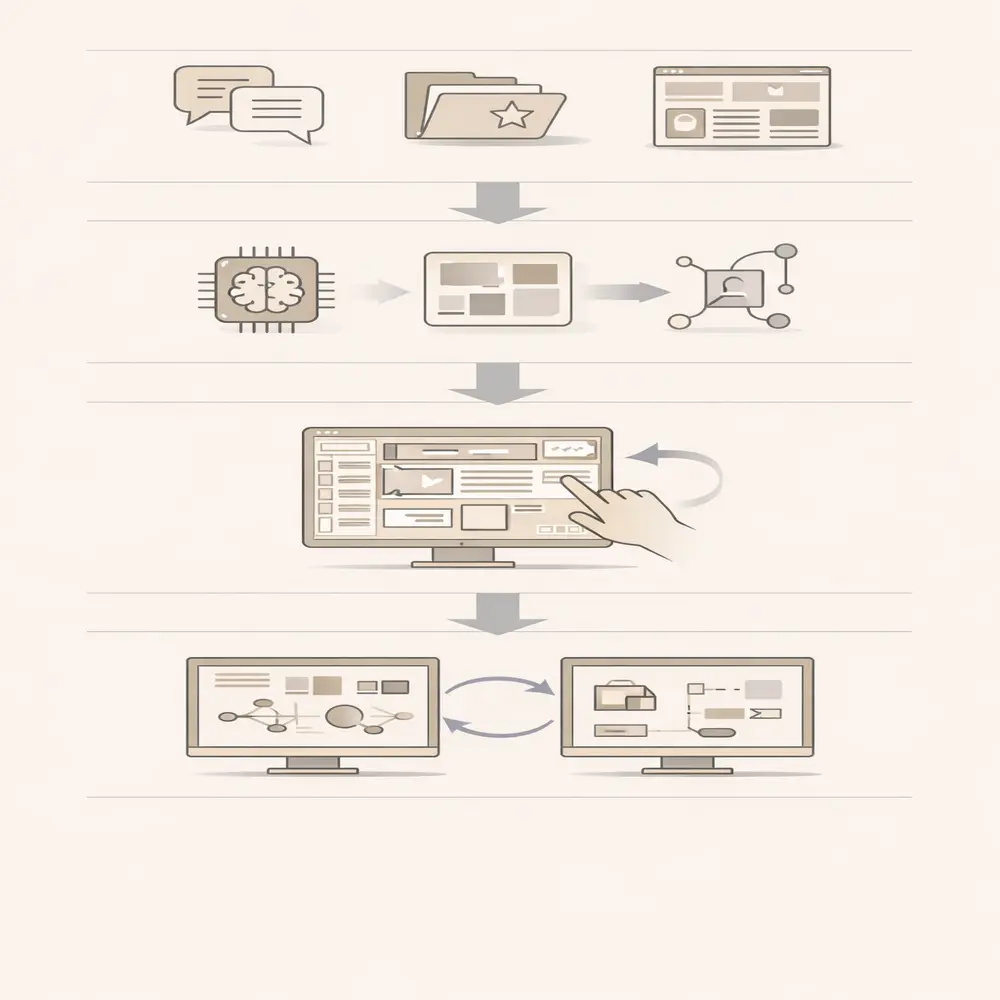
Instead of generating flat images, Moda produces structured, editable design systems — vectors, text layers, and layout components — inside a live execution environment.
- from creator → to collaborator
- from output → to system
- from suggestion → to execution layer
The shift appears subtle. It is not.
Because once outputs become editable and persistent, AI stops behaving like a tool and starts functioning as infrastructure — embedded within workflows rather than sitting outside them.
The Product as a System, Not a Tool
Moda’s architecture reflects this thesis most clearly in how it treats brand context, transforming what is typically a manual constraint into a programmable system.
Instead of relying on prompts or templates, the platform ingests company websites and design assets, extracting structured signals such as color systems, typography rules, logo constraints, and layout patterns. These signals are then applied consistently across every generated output.
Generation becomes constrained. Repeatable. Reliable.
More importantly, outputs remain fully editable, allowing continuous refinement without resetting the workflow — a requirement that becomes critical at enterprise scale.
Because workflows do not tolerate static outputs. They require control.
Founder Psychology: Choosing the Hard Layer
The decision to build at the workflow layer reflects a deeper founder orientation — one that prioritizes long-term system leverage over short-term visibility in a market that often rewards surface-level iteration.
Building generation tools is fast. Building workflow systems is slow.
It requires deeper product architecture, tighter alignment with real-world constraints, and a willingness to operate in a less visible layer of the stack during early stages.
Moda’s founders have deliberately chosen that path.
Not because it scales faster. But because it compounds differently.
Instead of optimizing for output quality, they are optimizing for dependency — embedding the product into workflows where replacement becomes difficult.
And dependency is what defines infrastructure.
The Competitive Layer Most Founders Ignore
At a surface level, Moda enters a crowded market dominated by incumbents with strong distribution and product depth.
- Canva controls template-driven design
- Adobe dominates professional workflows
- Tome and Gamma own presentation formats
- Midjourney and DALL-E define generation
But Moda is not competing within these layers.
It is operating in a segment that remains underbuilt: the translation layer between AI-generated outputs and real-world execution systems — a gap increasingly visible across AI systems where execution matters more than surface capability, as seen in AI Is Replacing Dental Front Desks — Inside Patientdesk’s Execution-Layer Bet.
This is where systems fail.
And where incumbents are structurally weakest.
Because:
- Canva is template-first
- Adobe is complexity-first
- AI tools are generation-first
Moda is execution-first.
The Real Moat: Owning Brand as Infrastructure
The long-term strategy is not centered on design. It is centered on control.
If Moda becomes the system where companies define, enforce, and operationalize brand logic — not just visually but structurally — it evolves into a system of record.
At that point:
- every team depends on it
- every asset flows through it
- every output is validated by it
The moat shifts accordingly.
Not feature-based. System-based.
This mirrors how infrastructure companies are building defensibility at deeper layers of the stack, similar to Spade Raises $40M to Own the Data Layer That Financial AI Cannot Function Without.
The Constraint Layer
The same factors that create Moda’s opportunity also define its limits.
Incumbents with massive distribution can extend into workflow execution over time. Enterprises may choose to internalize brand systems as AI becomes a core operational layer. And execution systems, by definition, are harder to build, scale, and maintain than surface-level tools.
The outcome depends on a single variable:
Whether Moda’s system advantage compounds faster than competitors can replicate it.
In infrastructure markets, that determines category leaders.
Early Signals: Unlocking the Non-Designer Layer
Moda’s early traction reflects a deliberate targeting strategy.
It is not built for designers. It is built for operators.
Because most enterprise design work is not creative. It is operational.
- pitch decks
- social assets
- sales materials
- internal communication
This is where the bottleneck exists.
And where execution matters more than creativity.
The Structural Shift: From Generation to Workflow
Moda is part of a broader transition across AI, where the focus is moving away from isolated outputs and toward integrated systems capable of executing real-world tasks.
The first phase of AI was: text → prompt → output
The next phase is: text → system → workflow
This is not an isolated shift. It reflects a structural reordering of the AI stack, where execution layers are becoming more valuable than generation layers — a transition also reflected in Dash0 Hits $1B — Why AI Observability Is Becoming a Control Layer and Inside Kluisz.ai: The Startup Rebuilding Cloud Infrastructure for the AI-Native Era.
Moda represents this transition in design.
Design is becoming execution infrastructure.
What the Founders Are Actually Building
Moda is not a design tool.
It is an attempt to build a control layer for visual workflows.
Where:
- AI generates
- systems constrain
- users control
- outputs execute
This is not a feature set.
It is a system architecture.
Editorial Close
The clearest way to understand Moda is to look at what it is deliberately not doing.
It is not competing in the generation race. It is not optimizing templates. It is not replicating legacy tools.
Instead, it is addressing the gap most founders ignored:
What happens after AI generates something.
Because that is where systems either integrate — or fail.
And the founders building in that layer are not improving AI.
They are defining where it actually works.
Research Context
Based on Moda funding disclosures, founder backgrounds, product analysis, and broader trends in generative AI, design systems, and enterprise workflow automation.
Editorial Note
This article reflects independent analysis of publicly available information and emerging patterns in AI infrastructure and product design systems.