
Global AI investment now exceeds $50B annually as regions specialize. From U.S. agent frameworks to Europe’s regulated AI stack, capital is splitting across geographies.
AI is not moving in one direction anymore.
It is pulling apart.
The AI race is no longer a single race.
It is a geographic realignment of capital, talent, and infrastructure.
The uncomfortable reality is that AI leadership is starting to depend less on model breakthroughs and more on where compute and regulation sit.
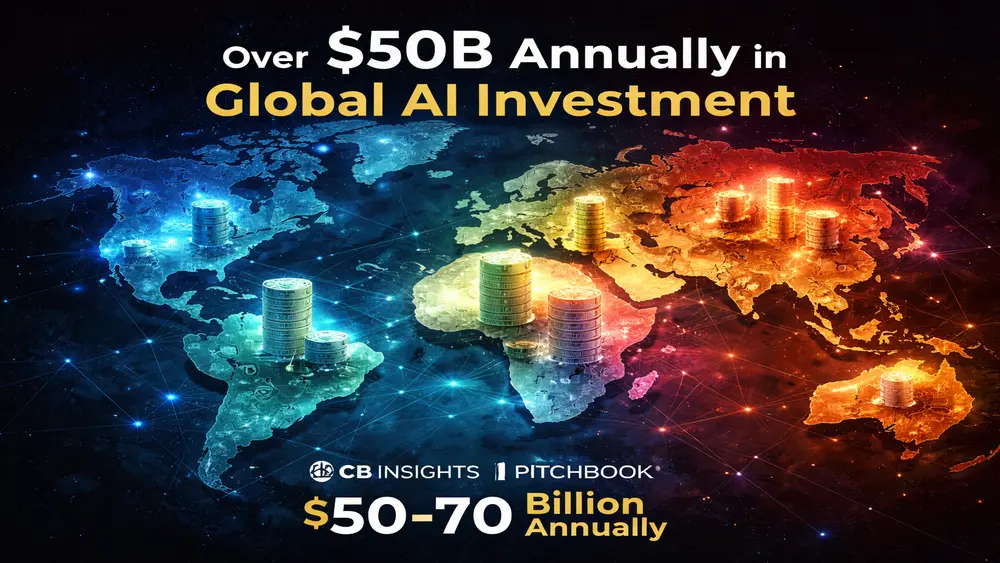
Over $50 billion annually in private and strategic capital is now flowing into artificial intelligence across regions, according to CB Insights and PitchBook reporting ranges. That money is not landing evenly. It is clustering. It is choosing models, regulation styles, compute strategies, and labor structures differently depending on geography.
What looks like a unified global boom is quietly becoming a continental specialization map.
And capital is reinforcing it.
Capital Is Choosing Geography in the Global AI Market
Investment patterns tell the story before strategy documents do.
This capital dispersion reflects the broader structural reset shaping the 2026 startup cycle.
North America continues to absorb the largest share of frontier AI funding. In 2025, North America accounted for roughly 60 percent of global private AI funding, according to CB Insights and PitchBook data ranges, while Europe captured an estimated 15 to 20 percent and Asia’s share continued expanding through state-backed and strategic capital flows. Europe is tightening its compliance infrastructure. China is embedding AI into industrial and civic systems. India is leaning into workflow automation. Japan is fusing AI with robotics. South Korea is optimizing hardware and edge compute. The Middle East is building sovereign AI capacity. Latin America is concentrating AI inside fintech and financial access layers.
According to Reuters reporting, Anthropic secured over $4 billion in committed investment from Amazon. OpenAI expanded strategic backing through Microsoft. These are infrastructure-level bets, not app-level experiments.
Contrast that with Europe. Germany’s Aleph Alpha raised over €500 million across rounds to build sovereign large language models. The emphasis is not scale at any cost. It is compliance, explainability, and data protection.
Same technology, entirely different economic thesis.
North America: Agent Frameworks and Model Infrastructure
The United States is concentrating power around frontier models and orchestration layers.
OpenAI, Anthropic, Perplexity, Runway, Hugging Face. Each sits inside the expanding agent ecosystem. The push is toward reasoning engines, multi-step task execution, and developer-accessible model infrastructure.
Large language model infrastructure is the core battleground.
This is not only about better chat interfaces. It is about embedding autonomous reasoning inside enterprise stacks.
The bet is simple. Whoever controls the orchestration layer controls the API economy built on top of it. History suggests that once dominant platforms consolidate infrastructure control, competitive dynamics shift quickly.
Europe: Regulated AI and Compliant Systems
Europe is not trying to win the raw model scale contest.
It is building compliant AI rails.
The AI Act is shaping deployment rules. Enterprises operating across EU jurisdictions require explainable systems, auditability, and traceability. Startups like Aleph Alpha and UK-based synthetic data companies such as Hazy position themselves inside that regulatory architecture.
The European approach focuses less on spectacle and more on contract durability.
That shift is already influencing how enterprise AI agreements are structured.
In a heavily regulated future, the friction of compliance becomes a competitive moat.
China: Applied Integration Over Narrative
China’s strategy emphasizes integration inside existing ecosystems.
SenseTime and Megvii built computer vision platforms deeply embedded in surveillance, mobility, and smart city systems. Baidu continues expanding its ERNIE ecosystem through internal capital allocation.
Chinese AI rarely markets itself as a universal assistant. It embeds. Logistics networks, public administration systems, mobility grids. Scale emerges from ecosystem control rather than brand visibility.
Scale emerges quietly through system integration rather than public narrative.
India: Workflow AI and Service Automation
India’s capital flows reflect its services-heavy economy.
Voice AI company Uniphore surpassed a $2 billion valuation following growth rounds, according to Reuters archives. Enterprise workflow automation platforms and SaaS copilots are drawing increasing funding.
The focus is not consumer spectacle.
It is process optimization.
AI agents in India are appearing inside customer support, banking operations, industrial IoT systems, and cross-border enterprise workflows.
Efficiency becomes the growth driver. For founders operating across regions, this creates a tension between global ambition and local capital logic.
Japan and South Korea: Hardware, Edge, and Embodied Systems
Japan continues merging AI with robotics and manufacturing precision.
Preferred Networks maintains backing from industrial partners including Toyota. Robotics startups blend machine learning with physical automation in structured environments.
South Korea, meanwhile, concentrates on AI semiconductor investment and edge deployment. Enterprise copilots are emerging alongside hardware optimization strategies.
These markets do not separate AI from physical infrastructure.
They treat intelligence as an industrial extension.
Middle East and Latin America: Sovereign Infrastructure and Financial AI
In the United Arab Emirates, G42 is expanding sovereign AI infrastructure partnerships, according to Financial Times and Reuters coverage. National-level AI compute capability is treated as strategic capacity.
Latin America is seeing AI embed inside fintech growth. Brazilian NLP companies such as NeuralMind focus on regional language models. Financial automation layers are becoming the entry point.
These are not frontier model races.
They are sector-driven AI adoption cycles.
The Unexpected Fragmentation Effect
Here is the structural shift few acknowledge.
Fragmentation reduces direct competition.
North America optimizes for reasoning engines. Europe optimizes for compliance frameworks. China optimizes for ecosystem integration. India optimizes for service efficiency. Japan optimizes for embodied systems.
Each region is building around its economic DNA.
A fragmented AI world may advance faster than a coordinated one, because capital stops competing head-to-head and begins reinforcing regional strengths. Valuation durability increasingly depends on infrastructure positioning rather than feature velocity.
It also makes regulatory harmonization harder.
Global AI is no longer one stack.
It is several partially interoperable ones.
Long-Term Implications
Over $50B to $70B annually in AI capital is now geographically distributed.That figure now exceeds the annual GDP of several mid-sized economies.
North America still captures the largest share, but Europe and Asia are increasing their proportional influence. Talent migration patterns are adjusting accordingly. Cloud providers are investing regionally. Sovereign compute capacity is becoming political.
This is less about model benchmarks and more about industrial positioning.
In five years, AI competitiveness may not be measured by who built the smartest system, but by who integrated it deepest into economic infrastructure.
Fragmentation increases resilience.
It also increases complexity.
Final Take
The global AI expansion is no longer uniform.
Capital is drawing borders.
Regions are choosing different versions of the future.
Some are betting on reasoning engines. Others on compliance. Others on robotics. Others on financial automation.
The AI race did not slow down.
It split.
Research Context: Funding figures referenced from Reuters, Financial Times, Bloomberg reporting and CB Insights and PitchBook annual AI investment ranges.
Editorial Note: Independent structural analysis of publicly reported capital flows and regional AI strategies.