

The multiples echo the dot-com era. The capital architecture beneath them does not.
If this were 1999, AI stocks would already be collapsing.
Revenue multiples have expanded rapidly. Private funding rounds are crossing into tens of billions. Public markets are rewarding AI exposure with premium pricing. Commentators are asking the same question they asked a generation ago: is this another bubble?
The comparison is emotionally convenient.
Structurally, it is incomplete.
Valuations can look similar across eras. Capital architecture rarely does.
The Surface Parallel: Multiple Expansion
The dot-com bubble was defined by forward pricing.
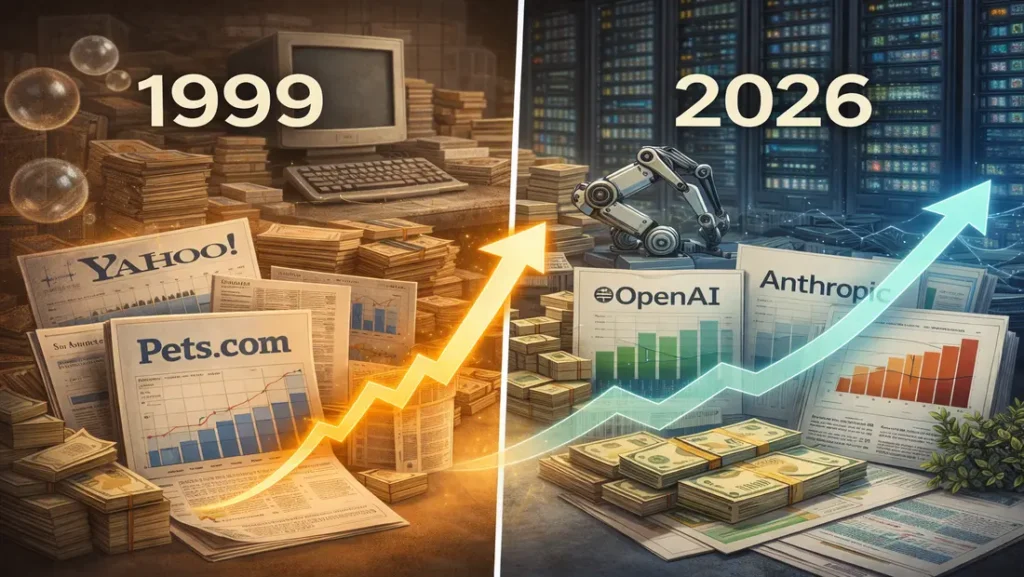
Companies like Cisco traded above 40× revenue at peak multiples. Yahoo commanded extraordinary public market valuations despite unstable monetization. Pets.com and Webvan reached IPO markets with thin revenue visibility and collapsed within years.
Capital priced narrative acceleration over operational durability.
Today, leading AI firms command premium revenue multiples. Private valuations for companies such as OpenAI and Anthropic have surged within compressed timeframes. Nvidia’s market capitalization expansion reflects concentrated AI infrastructure exposure.
On the surface, the resemblance is obvious.
But valuation multiples alone do not determine systemic fragility.
Capital composition does.
The Macro Capital Layer Most Comparisons Ignore
The late-1990s boom was heavily retail- and IPO-driven.
Public market enthusiasm amplified valuations. Venture capital funded rapid experimentation. But sovereign wealth funds, hyperscaler balance sheets, and private equity megafunds were not anchoring infrastructure deployment at industrial scale.
Today’s AI cycle is underwritten differently. As outlined in AI Venture Capital Outlook 2026: Why Startups Are Entering a More Disciplined Era, institutional capital now dominates funding architecture.
Three capital anchors dominate:
• Hyperscaler balance sheets deploying hundreds of billions annually in capital expenditure
• Sovereign and strategic funds allocating long-duration capital into compute infrastructure
• Private equity participation in AI data center and enterprise deployment cycles
Anthropic’s valuation progression illustrates this shift. Within months, private funding rounds repriced the company significantly upward following strategic institutional participation. These increases reflected institutional layering, not retail momentum.
In 1999, capital chased traffic growth.
In 2026, capital builds physical compute.
That difference changes correction mechanics.
Infrastructure Intensity Changes Cycle Behavior
The dot-com era overbuilt fiber networks and server capacity ahead of proven monetization. When pricing assumptions collapsed, capital fled.
Today, AI infrastructure expansion is responding to immediate compute saturation.
Hyperscaler capital expenditure in 2024–2025 exceeded $200–250 billion annually across leading cloud providers, according to company earnings disclosures. By contrast, late-1990s global internet infrastructure investment is generally estimated in the tens of billions annually at peak expansion. The scale differential is not incremental. It is an order-of-magnitude shift in capital intensity.
Amazon, Microsoft, Alphabet, and Meta have all signaled sustained elevated capital expenditure through 2026 in earnings guidance, reinforcing that AI infrastructure expansion is balance-sheet committed rather than speculative.
This is industrialization.
Not speculative layering.
Capital misallocation remains possible.
Demand illusion is less obvious.
The Harder Numeric Contrast
The structural math clarifies the divergence.
Below is a high-level comparison of notable valuation peaks and current AI benchmarks:
Dot-Com Era Benchmarks
| Company | Peak Period | Approx. Valuation | Revenue Context |
|---|---|---|---|
| Cisco | 2000 peak | ~$550B market cap | Strong revenue, extreme multiple |
| Yahoo | 2000 peak | ~$125B market cap | Advertising-heavy, early monetization |
| Pets.com | 2000 IPO | ~$300M valuation | Minimal sustainable revenue |
| Webvan | 1999 IPO | ~$4.8B valuation | Revenue immature, infrastructure-heavy |
AI Cycle Benchmarks
| Company | Recent Valuation | Capital Context |
|---|---|---|
| Nvidia | >$1T market cap | Infrastructure revenue surge tied to AI compute demand |
| OpenAI | Reported ~$80B+ private valuation | Multi-billion annualized revenue, enterprise & API monetization |
| Anthropic | Reported ~$18B → ~$30B+ within funding cycles | Strategic institutional capital layering |
| Frontier AI Data Centers | Multi-billion deployment clusters | Hyperscaler-backed capex |
Now the contrast becomes clearer:
• Late-1990s global internet infrastructure investment: tens of billions
• Current hyperscaler annual capex: several hundred billion
• Frontier AI private rounds: multi-billion-dollar capital stacks within single cycles
• Enterprise AI contracts: increasingly structured across three to five years
Performance gaps between frontier models compress into low single-digit benchmark deltas.
Capital deployment, however, compounds into exponential scale.
Performance advantage is incremental. This divergence mirrors the capital repricing dynamics analyzed in The Week AI Capital Repriced Itself at $380B and 27x Revenue.
Capital commitment is industrial.
Markets are pricing institutional permanence, not page-view acceleration.
Revenue Maturity vs Traffic Speculation
In 1999, traffic was treated as revenue in waiting.
Today, enterprise AI firms generate multi-billion-dollar annualized revenue before peak valuation acceleration. The infrastructure premium seen in Harvey’s $11B Valuation Signals Legal AI Is Becoming Infrastructure reflects this embedment-driven valuation shift.
OpenAI’s API monetization reflects embedded enterprise channels. Anthropic’s positioning inside regulated environments reflects governance-aligned revenue. Nvidia’s expansion is tied to infrastructure demand rather than speculative consumer growth.
Revenue multiples may appear stretched.
But they are attached to cash-flow engines, not abstract user metrics.
That distinction materially alters fragility.
Where Risk Actually Resides
AI is not immune to repricing.
But the fragility vectors differ from 1999:
• Model commoditization compressing differentiation
• Open-source diffusion lowering pricing power
• Compute efficiency gains reducing workload demand
• Regulatory constraint slowing deployment
• Infrastructure margin compression under hyperscaler leverage
The risk is structural compression.
Not demand disappearance.
That is a fundamentally different correction dynamic.
Competitive Architecture: Concentration vs Proliferation
The AI cycle is capital-concentrated within a geopolitical landscape that is increasingly fragmented, as explored in The Global AI Map Is Fragmenting: How Each Continent Is Betting on a Different AI Future.
The AI cycle is capital-concentrated.
A smaller cluster of firms — frontier model providers, hyperscalers, and sovereign-backed compute initiatives — command disproportionate infrastructure budgets.
In 1999, capital fragmented across experimentation.
In 2026, capital concentrates into infrastructure control.
Fragmented ecosystems collapse chaotically.
Concentrated ecosystems consolidate.
That distinction shapes post-correction outcomes.
The Structural Insight That Defines This Cycle
The dot-com era monetized access to the internet.
The AI era monetizes compute control and workflow embedment.
Access businesses are sentiment-sensitive.
Control businesses are capital-sticky.
Valuations can resemble 1999.
Ownership dynamics do not.
Long-Term Systemic Takeaway
AI multiples may compress.
Capital discipline may tighten.
Speculation may cool.
But this cycle rests on:
• Industrial-scale infrastructure
• Embedded enterprise revenue
• Sovereign strategic backing
• Hyperscaler balance-sheet anchoring
Those pillars did not anchor 1999.
They anchor this cycle.
The resemblance is aesthetic.
The architecture is not.
Research Context: Comparative analysis of late-1990s internet capital cycles and current AI infrastructure funding patterns, drawing on historical market capitalization data, hyperscaler capital expenditure disclosures, and publicly reported AI company valuations.
Editorial Note: This article reflects independent analysis of publicly available financial data and broader capital architecture trends shaping the AI ecosystem.