

Nscale’s latest funding round signals the emergence of a new generation of AI infrastructure hyperscalers competing to build the compute backbone of the global artificial intelligence economy.
Nscale, a British artificial intelligence infrastructure startup backed by Nvidia, has raised $2 billion in a Series C funding round, valuing the company at $14.6 billion and positioning it among the fastest-growing AI infrastructure companies globally.
The investment, announced Monday and led by Norwegian industrial investment firm Aker ASA, highlights the accelerating global race to build the compute infrastructure powering artificial intelligence systems.
As large language models and enterprise AI platforms grow increasingly complex, demand for specialized data centers, GPU clusters, and AI-optimized cloud infrastructure is expanding rapidly.
Companies capable of controlling this infrastructure layer may ultimately occupy the most strategic position in the emerging AI economy.
Nscale is betting that a new generation of AI-native hyperscalers can emerge alongside traditional cloud providers by focusing specifically on the unique computational demands of artificial intelligence.
The company’s rapid rise reflects a broader shift across the technology industry: the realization that control of the AI compute layer may become one of the most valuable strategic positions in the global technology stack.
This transformation is already reshaping investment patterns across the sector — a trend explored in The $189B AI Funding Surge Is Reshaping the Deep Tech Venture Map.
The AI Stack Is Reorganizing Around Compute
For much of the past decade, the technology industry focused primarily on software innovation — building new models, developer tools, and AI applications.
But the rapid expansion of generative AI is reshaping the architecture of the entire technology ecosystem.
The modern AI economy increasingly resembles a multi-layer infrastructure stack:
- Applications – enterprise copilots, automation tools, and AI-powered services
- Models – large language models and multimodal systems
- AI infrastructure platforms
- GPU compute clusters
- energy and data-center capacity
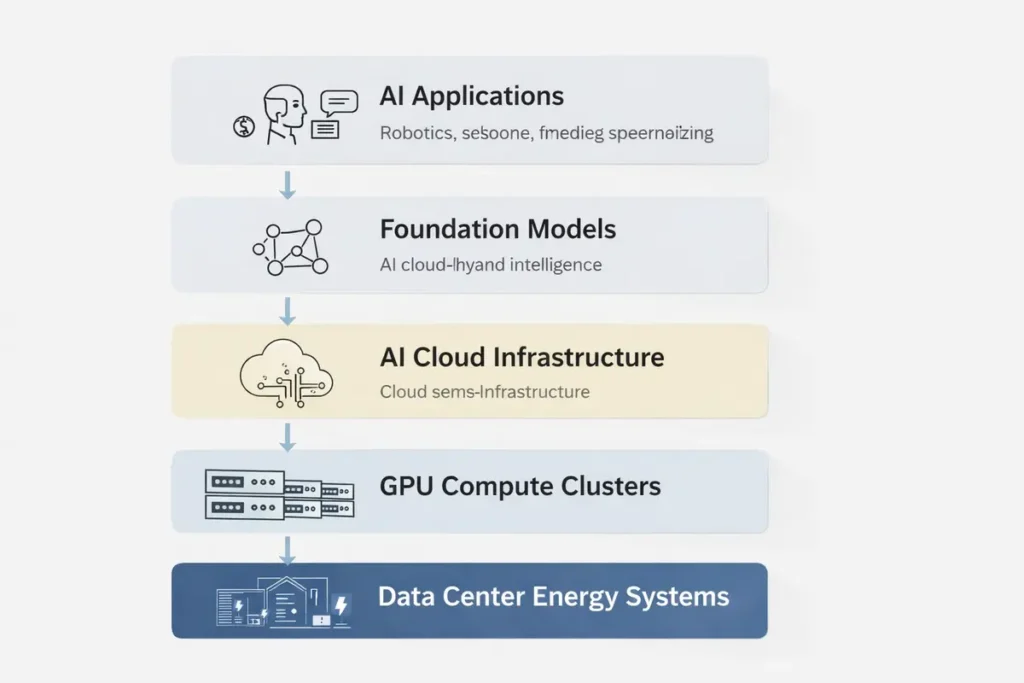
As model sizes expand and inference workloads scale globally, the compute layer has become one of the most constrained resources in the ecosystem.
This shift is driving massive investment in infrastructure companies capable of building the data centers and compute platforms required to run large AI systems.
Nscale’s emergence reflects this structural transformation.
Building an AI Hyperscaler From Scratch
Nscale was incorporated on May 29, 2024, in London as Nscale Ltd., with a clear objective: build a vertically integrated AI infrastructure platform capable of supporting the next generation of large-scale artificial intelligence systems.
The company was founded by CEO Josh Payne, whose unconventional path into the technology sector includes early work in energy infrastructure and cryptocurrency mining.
That background has strongly influenced Nscale’s strategy.
Instead of offering conventional cloud services, the company focuses on AI-native infrastructure designed specifically for machine learning workloads.
Nscale’s architecture integrates:
- GPU-accelerated compute clusters
- AI-optimized networking
- large-scale data storage
- orchestration software
- renewable-powered data centers
By controlling these layers internally, Nscale aims to deliver high-efficiency AI infrastructure at hyperscale.
This approach reflects a growing industry belief that compute infrastructure is becoming a critical bottleneck for AI innovation — a shift explored in The Invisible Infrastructure Layer Reshaping Enterprise AI.
The Sovereign AI Infrastructure Strategy
One of Nscale’s most distinctive strategic positions centers on sovereign AI infrastructure.
As governments and enterprises increasingly deploy artificial intelligence in sensitive domains — including finance, healthcare, and national security — concerns around data sovereignty and regulatory compliance have intensified.
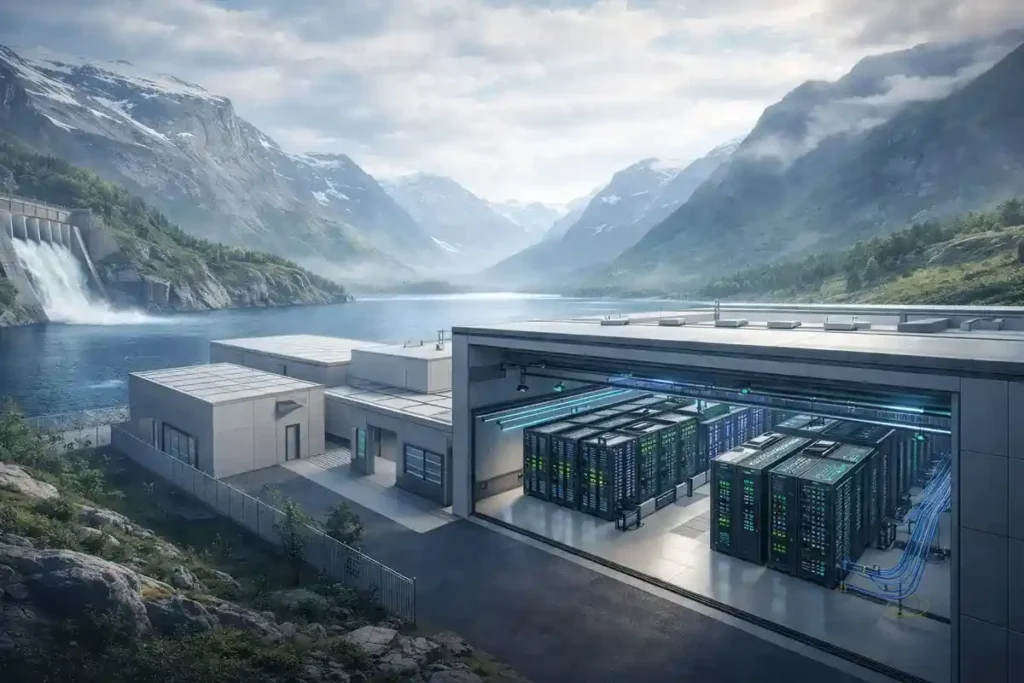
Nscale’s solution is to build regionally anchored AI infrastructure powered by renewable energy and designed to comply with local data regulations.
One of the company’s flagship facilities is located in Glomfjord, Norway, where hydroelectric power provides a sustainable energy source for large-scale AI compute operations.
This model aligns closely with Europe’s broader ambition to develop independent AI infrastructure ecosystems, reducing reliance on American hyperscalers such as AWS, Microsoft Azure, and Google Cloud.
In this sense, Nscale is attempting to position itself as a European counterpart to the AI infrastructure platforms emerging in the United States and China.
The Infrastructure Stack Behind Nscale
Nscale’s technology platform is built around a Kubernetes-native architecture optimized for AI workloads.
GPU Compute Infrastructure
The platform integrates NVIDIA GPUs, including H100 and next-generation Blackwell accelerators, enabling large-scale training and inference workloads.
These processors remain central to the global AI ecosystem — a dynamic explored in Jensen Huang: The Architect of Nvidia’s AI Infrastructure.
Serverless AI Inference
Nscale also provides autoscaling inference endpoints, allowing developers to deploy AI models without managing infrastructure clusters.
This approach reduces operational complexity and accelerates production deployments.
AI Studio and Orchestration
The company also offers orchestration tools designed to manage the full lifecycle of AI systems, including:
- model training
- fine-tuning
- deployment
- scaling
Together these capabilities create a vertically integrated AI platform that allows developers to move from model experimentation to production deployment without leaving the Nscale ecosystem.
Funding the AI Infrastructure Race
Investor interest in Nscale reflects the growing importance of AI infrastructure across the technology industry.
The company’s funding history illustrates how rapidly capital is flowing into the compute layer of the AI stack.
Series B — September 2025
Nscale raised $1.1 billion, one of the largest venture rounds in European history.
Investors included:
- Nvidia
- Dell
- Fidelity
- Nokia
- Point72
Series C — March 2026
The latest round raised $2 billion, bringing the company’s valuation to $14.6 billion.
New investors include:
- Aker ASA
- Citadel
- Jane Street
- Lenovo
- Astra Capital
Beyond equity financing, Nscale also secured a $1.4 billion GPU-backed infrastructure loan to accelerate the deployment of AI data centers across Europe.
This financing structure highlights a broader trend toward capital models tailored specifically for AI infrastructure expansion.
Strategic Partnerships With Big Tech
Nscale’s growth has also been supported by partnerships with several major technology companies.
These include:
Microsoft
A multi-year infrastructure agreement reportedly worth $14 billion.
Nvidia
A core hardware partner providing GPUs used in Nscale’s compute infrastructure.
Nokia
The preferred networking partner for global data-center deployments.
Lenovo and AMD
Additional hardware providers supporting hyperscale infrastructure deployments.
These partnerships position Nscale as a bridge between hardware manufacturers and AI developers, enabling enterprises to deploy AI infrastructure without building their own data centers.
Competition in the AI Cloud Market
Despite its rapid growth, Nscale faces formidable competition.
The global AI cloud market is currently dominated by hyperscalers including:
- Amazon Web Services
- Microsoft Azure
- Google Cloud
These companies possess enormous advantages in infrastructure scale, capital resources, and developer ecosystems.
However, Nscale is betting that AI-specific infrastructure optimization and regional sovereignty requirements will create space for new infrastructure providers.
Energy efficiency and sustainable compute may also become increasingly important as AI workloads continue to grow more power-intensive.
The Road Toward an IPO
Nscale is reportedly targeting a public listing in late 2026, potentially on Nasdaq or the London Stock Exchange.
If successful, the IPO could become one of the largest AI infrastructure listings in Europe.
The company plans to expand data-center capacity across:
- Asia
- North America
- the Middle East
As demand for AI infrastructure continues to accelerate globally, Nscale aims to position itself as a next-generation hyperscaler built specifically for the AI era.
Editorial Takeaway
The artificial intelligence boom is often framed as a competition between models and algorithms.
But beneath the surface, the real battle may be unfolding in the infrastructure layer.
As AI systems scale toward global deployment, the companies that control the compute platforms powering those systems could become some of the most strategically important players in the technology industry.
Nscale’s rapid rise illustrates how quickly new infrastructure companies can emerge when technological shifts create new bottlenecks.
Whether the company ultimately becomes a global hyperscaler or remains a specialized infrastructure provider will depend on its ability to scale data centers, secure GPU supply chains, and compete against the massive cloud platforms already dominating the industry.
What is already clear is that the next phase of artificial intelligence will not be defined only by software.
It will be defined by who controls the machines that run it.
Research Context
This analysis synthesizes publicly available information from corporate announcements, infrastructure reports, venture financing disclosures, and industry coverage published through March 2026.