
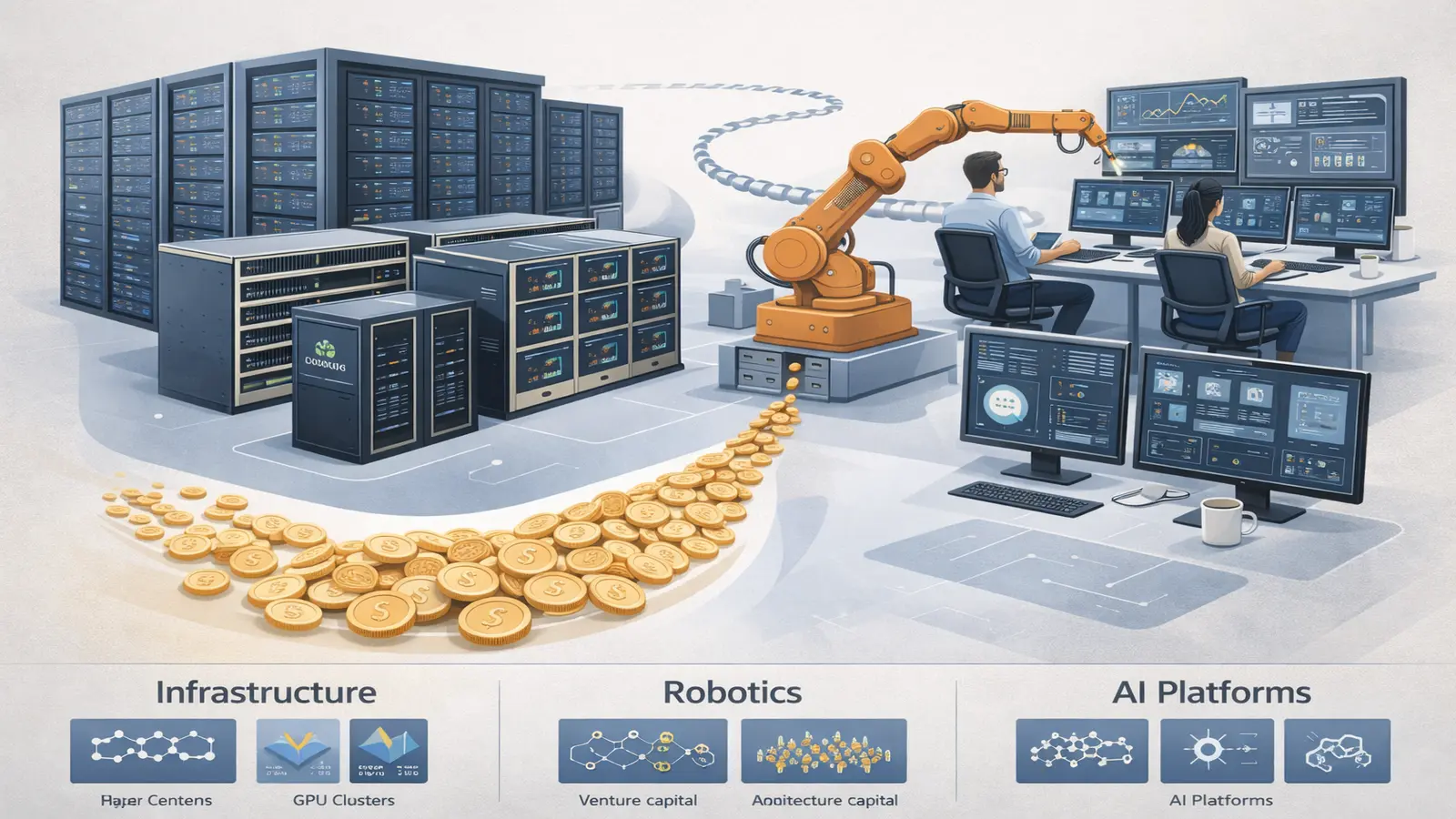
Inside the week when more than $3 billion flowed into the next layer of the AI economy.
The Intelligence Briefing
- Capital surge: Over $3B in AI funding across 10+ startups between March 7–15
- Largest rounds: AMI Labs ($1.03B), Nscale ($2B Series C), Nexthop AI ($500M)
- Key trend: Investors shifting from chatbots toward infrastructure, world models, and industrial AI
- Top founders: Yann LeCun, Mira Murati, Rivian robotics engineers
- Strategic signal: The AI arms race is expanding beyond software into physical systems, robotics, and compute infrastructure
The Week AI Funding Went Nuclear
The past week delivered one of the largest surges of venture capital into artificial-intelligence startups since the generative-AI boom began, signaling a structural shift in how investors are financing the next generation of the AI economy.
More than ten startups across infrastructure, robotics, coding platforms, and scientific AI collectively raised billions of dollars in new funding.
The largest rounds included:
- AMI Labs, founded by Meta’s former chief AI scientist Yann LeCun, raising $1.03 billion in seed funding
- Nscale, a European AI hyperscaler, securing $2 billion in Series C funding
- Nexthop AI, which builds networking switches for GPU clusters, raising $500 million
- Mind Robotics, a Rivian spin-out focused on industrial automation, securing $500 million in Series A funding
Additional rounds flowed into companies building coding agents, formal verification AI, industrial autonomy systems, and manufacturing intelligence platforms.
Individually, none of these startups dominated headlines.
Collectively, they reveal something more significant:
the AI capital flood is expanding into nearly every layer of the technology stack.
The surge also reflects a broader shift explored in The $189B AI Funding Surge Is Reshaping the Deep Tech Venture Map, where capital is increasingly flowing toward foundational infrastructure rather than consumer AI applications.
Founder Pedigree Is Driving Billion-Dollar Seeds
One of the clearest signals from the week’s funding wave is the return of founder premium.
AMI Labs raised more than $1 billion in seed funding largely on the strength of Yann LeCun’s reputation as one of the pioneers of modern deep learning.
LeCun’s startup is pursuing a radically different vision of artificial intelligence centered on “world models”—systems capable of understanding the physical environment through sensor and video data.
Rather than relying on transformer architectures that dominate language models, AMI Labs is exploring Joint Embedding Predictive Architectures (JEPA), which aim to model abstract representations of the world rather than individual pixels or tokens.
The company’s ambition is not to build another chatbot.
It is to develop AI systems capable of reasoning about how the physical world evolves over time.
If successful, such models could become foundational infrastructure for robotics, autonomous vehicles, and scientific simulation platforms.
For investors, the logic is straightforward: when the founder helped invent the field itself, the cost of entry rises accordingly.
Infrastructure Is Becoming the Real AI Battlefield
While public attention often focuses on new AI models, the largest capital flows this week targeted something less visible: infrastructure.
Two companies illustrate the shift.
Nscale, which operates hyperscale GPU data centers for AI training, raised $2 billion in one of the largest European venture rounds ever recorded.
Meanwhile Nexthop AI, which designs networking hardware for GPU clusters, secured $500 million to expand production.
The reason is structural.
As AI models grow larger, the primary bottleneck is no longer algorithmic innovation.
It is compute infrastructure.
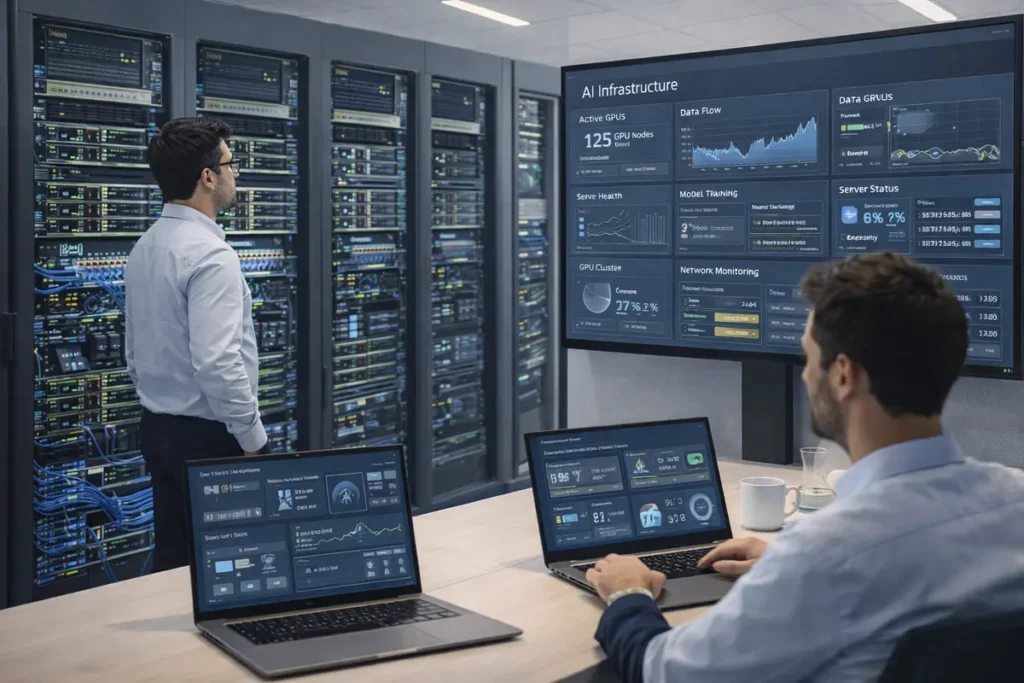
Training frontier AI systems now requires clusters containing tens of thousands of GPUs, consuming megawatts of electricity while generating enormous volumes of networking traffic between nodes.
Modern AI training runs therefore depend on:
- massive GPU clusters
- ultra-high-bandwidth networking fabrics
- enormous power capacity
- sophisticated orchestration software
Without these systems, even the most advanced models cannot scale.
For venture investors, infrastructure startups increasingly resemble the “picks and shovels” companies of the AI gold rush.
Once hyperscalers and governments commit to specific infrastructure providers, switching costs become extremely high—creating long-term technology moats.
This infrastructure layer is rapidly becoming the backbone of the enterprise AI stack, similar to the systems explored in The Invisible Infrastructure Layer Reshaping Enterprise AI.
The Rise of Agentic Software Platforms
Another major category attracting investor capital is agentic software platforms.
One of the largest rounds this week went to Replit, which raised $400 million at a $9 billion valuation.
Originally launched as a coding education tool, Replit has evolved into an AI-driven software creation platform capable of writing, debugging, and deploying applications with minimal human input.
The company already reports significant enterprise adoption and has previously disclosed more than $150 million in annual recurring revenue.
Investors increasingly view agentic development platforms as one of the first areas where AI can directly replace entire categories of human work, rather than simply augment productivity.
If successful, platforms like Replit could reshape the $100-billion global developer tools market.
The rise of these systems mirrors the broader transformation of developer infrastructure explored in Cursor’s $2B ARR Explosion Signals the Arrival of Agentic Developer Infrastructure.
Robotics Is Returning to the Spotlight
The funding surge also signals a renewed focus on AI-powered robotics.
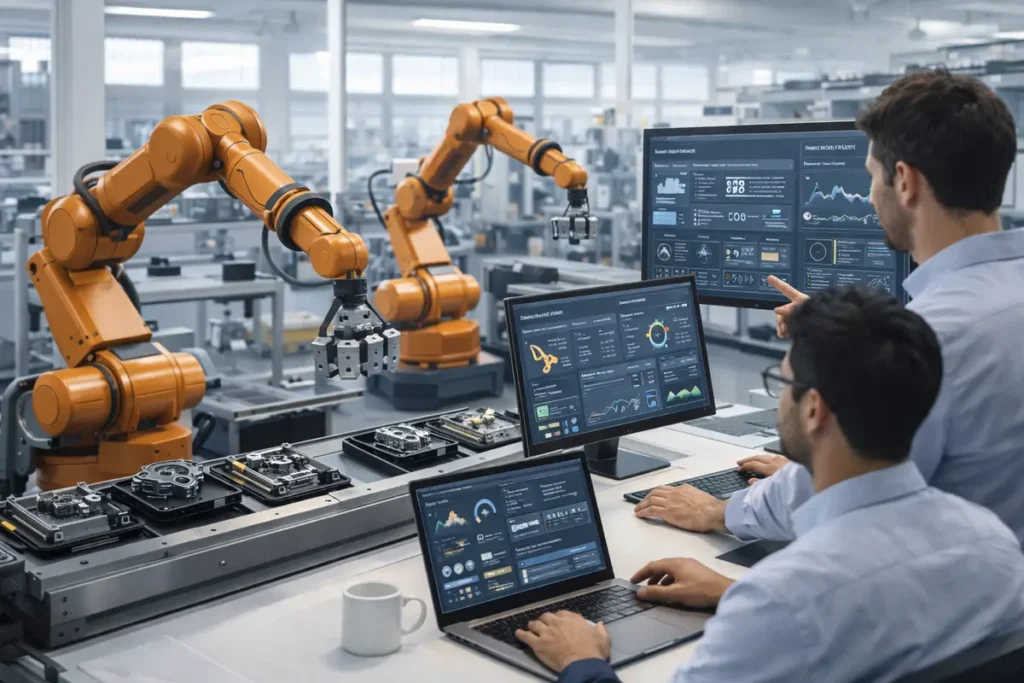
Mind Robotics, a startup spun out of electric-vehicle maker Rivian, raised $500 million in Series A funding to develop AI systems for industrial automation.
Another robotics company, Oxa, secured more than $100 million to expand its industrial autonomy platform for ports, airports, and logistics hubs.
Unlike the robotaxi sector—which has struggled with regulatory hurdles and safety challenges—industrial robotics operates in bounded environments.
Factories, warehouses, and ports provide predictable conditions where autonomous systems can deliver measurable efficiency gains.
That makes industrial autonomy one of the most commercially viable applications of AI-powered robotics.
The emergence of these systems reflects the broader industrial robotics transformation explored in Apptronik’s Humanoid Robots and the Next Industrial Automation Wave.
A Parallel AI Ecosystem Is Emerging in China
The week’s funding activity also highlights the growing strength of China’s AI ecosystem.
Moonshot AI, the company behind the rapidly growing Kimi chatbot platform, is reportedly raising nearly $1 billion at an $18 billion valuation.
The company’s revenue growth has accelerated rapidly, with monthly sales now exceeding its entire revenue from the previous year.
Despite U.S. export controls on advanced chips, Chinese AI startups continue to build frontier models while attracting major investment from domestic technology companies including Alibaba and Tencent.
The result is a parallel global AI ecosystem operating alongside Western labs.
For investors and policymakers alike, this development carries significant geopolitical implications—part of the broader technological fragmentation explored in The Global AI Map Is Fragmenting Into Competing Technology Blocs.
The New Stack of the AI Economy
Taken together, the week’s funding announcements reveal a clearer picture of the emerging AI industry structure.
Three distinct layers are attracting the majority of venture capital.
1. Infrastructure
Companies building the physical systems required to train AI models, including GPU hyperscalers, networking platforms, and data-center orchestration software.
Examples include Nscale, Nexthop AI, and Eridu.
2. Autonomous Software Platforms
Startups developing agentic AI systems capable of executing complex workflows, including coding agents and enterprise automation platforms.
Replit is one of the leading examples.
3. Embodied AI
Companies applying AI to physical systems, including robotics, industrial automation, and scientific discovery.
Examples include Mind Robotics, Oxa, and AMI Labs.
Taken together, these funding rounds suggest the AI economy is reorganizing itself into a new industrial stack where infrastructure providers, autonomous software platforms, and embodied AI companies form the foundation of the next computing cycle.
The Capital Tap Is Still Wide Open
Despite persistent concerns about an AI bubble, the latest funding surge suggests investor appetite remains extremely strong.
In many cases, venture firms are investing not only in technology but also in founder pedigree and strategic positioning.
Startups founded by former researchers from OpenAI, Anthropic, DeepMind, and Meta continue to command enormous valuations—even at the earliest stages.
For AI founders, the message is clear.
Capital remains available—but expectations are rising.
Investors increasingly expect startups to either:
- control critical infrastructure
- solve fundamental technical bottlenecks
- automate high-value human workflows
Anything less may struggle to attract attention.
The Road Ahead
If the past week is any indication, the AI funding boom is not slowing down.
It is evolving.
The first wave of generative AI focused on language models and chat interfaces.
The next wave is expanding into infrastructure, robotics, scientific discovery, and autonomous software systems.
That shift reflects a deeper transformation in how the technology industry thinks about artificial intelligence.
The most valuable AI companies of the next decade may not be those that generate the most convincing text.
They may be the ones that reshape the physical systems powering the global economy.
Research Context
This analysis synthesizes venture funding disclosures, industry reporting from technology publications, venture databases, and investor commentary on AI infrastructure, robotics, and agentic software platforms. Funding figures reflect announcements between March 7 and March 15, 2026.
Editorial Note
TechFront360 covers artificial intelligence infrastructure, startup ecosystems, venture capital flows, and the strategic technology shifts shaping the global AI economy.
Our reporting focuses on the systems, founders, and capital shaping the next generation of computing.