
Subheadline:
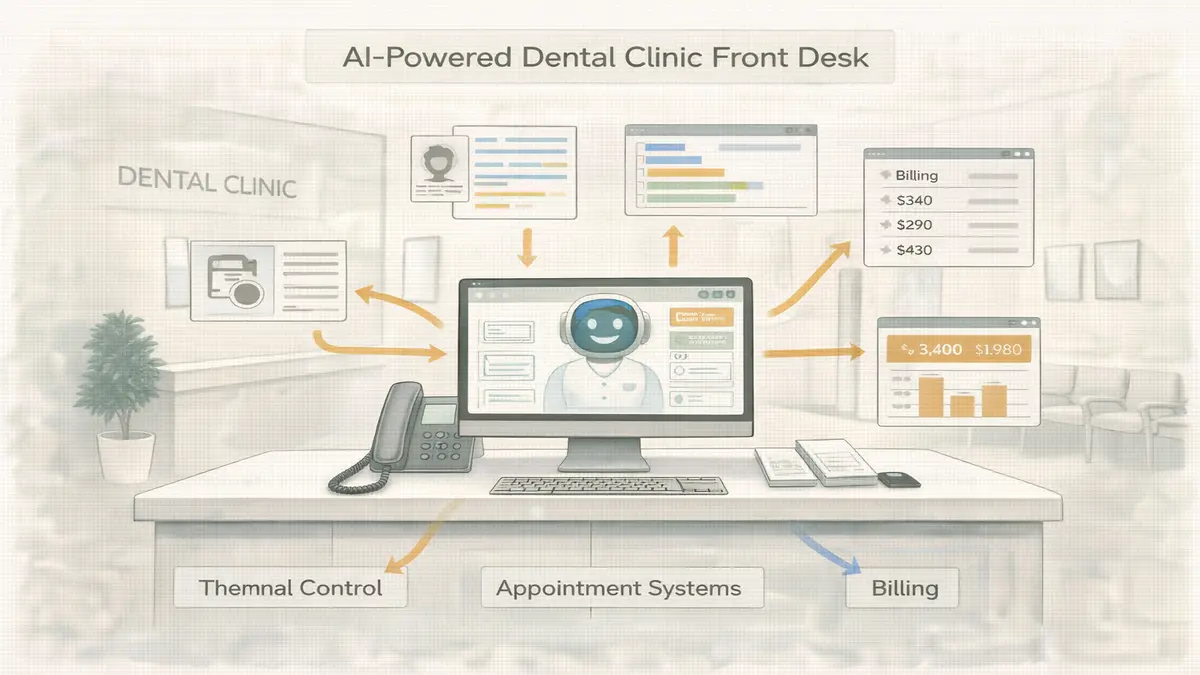
YC-backed Patientdesk is deploying AI systems that verify insurance, process payments, and execute revenue workflows in real time—reshaping how dental clinics operate.
The Startup Turning Dental Clinics Into Autonomous Revenue Systems
Patientdesk.ai, a Y Combinator Winter 2026 startup operating in AI agents for healthcare operations, is building what it describes as an AI-native execution layer for dental practices, positioning itself within the structural shift from software interfaces to systems that directly control operational workflows.
Patientdesk operates within the emerging category of execution-layer AI systems in healthcare infrastructure, where software does not merely assist work but directly executes it.
Its platform manages patient interaction and administrative execution across:
- inbound and outbound communication
- appointment scheduling
- real-time insurance verification
- claims submission and follow-up
- billing and collections
The system is already deployed across more than 60 clinics in the United States, the United Kingdom, and Australia, and has expanded from $17,000 to $50,000 in monthly recurring revenue within eight weeks, while attributing over $1.8 million in incremental revenue to customer clinics, based on company-reported data.
This positioning reflects a broader transition underway in enterprise software:
from tools that assist workflows to systems that execute them, a shift also examined in
how AI agents are moving beyond interfaces into operational systems
A Structural Problem, Not a Staffing One
Dental practices operate within a fragmented administrative stack in which scheduling, insurance verification, billing, and communication systems are typically disconnected.
The consequences are measurable:
- approximately 15 per cent of insurance claims are denied, the majority of which are preventable
- roughly 65 per cent of denied claims are never resubmitted
- staff often spend more than 20 hours per week on manual verification processes
More consequential, however, is the revenue lost before these processes begin.
Missed calls, delayed responses, and incomplete verification frequently result in patient drop-off before conversion.
The constraint is not labour capacity.
It is a coordination failure across systems.
From Interface Layer to Execution Layer
Patientdesk’s differentiation lies not in voice automation alone, but in system-level execution within existing infrastructure.
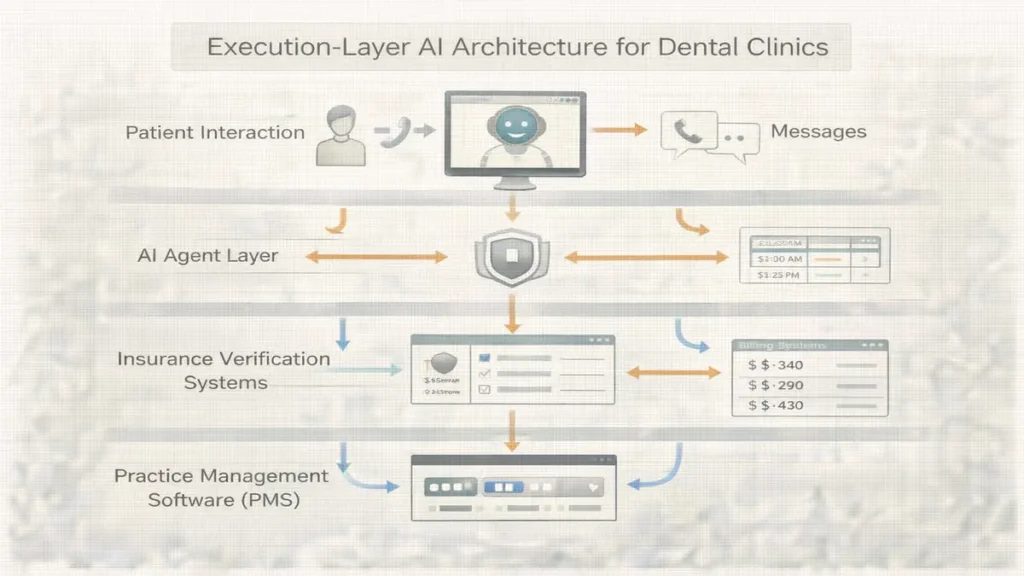
By integrating directly with practice management systems, the platform accesses:
- patient histories
- treatment protocols
- scheduling constraints
- clinic-specific rules
During a live interaction, the system can:
- verify insurance eligibility in real time
- calculate expected patient costs
- schedule appointments directly within the clinic’s system
This eliminates the need for follow-up calls or manual intervention.
The front desk, historically a coordination layer, becomes:
a continuously operating execution system embedded within the workflow
This shift aligns with a broader industry transition in which
AI infrastructure is moving toward execution-layer control
The Importance of Real-Time Insurance Verification
Insurance verification remains one of the most consequential bottlenecks in dental operations.
In conventional workflows:
- verification occurs after booking
- pricing remains uncertain
- patient drop-off rates increase
Patientdesk relocates this process to the point of interaction.
By verifying coverage and costs during the call, it enables:
- immediate decision-making
- higher conversion rates
- more accurate scheduling of high-value procedures
This is not a marginal improvement.
It shifts the moment at which revenue is secured.
Reframing the Economics of Practice Management
Dental practices typically rely on multiple software tools, with combined costs reaching approximately $15,000 per month.
Patientdesk positions itself as a consolidated system, with pricing beginning at roughly $7,500 per month, supplemented by usage-based components.
The economic logic is not primarily cost reduction.
It is revenue optimisation.
By:
- reducing missed demand
- improving booking conversion
- automating collections
the system aligns directly with income generation.
This reframes the category from:
software infrastructure to revenue infrastructure
A similar transition is visible across enterprise AI, where
systems such as Glean are evolving into context-aware infrastructure layers
Early Traction and Embedded Usage
Patientdesk’s growth metrics are notable, but the more meaningful signal is usage depth.
Across current deployments:
- call coverage approaches full utilisation
- booking rates have increased
- collections processes are partially automated
The system is not being tested at the margins.
It is embedded within core operational workflows.
A Market Dividing Along Architectural Lines
The dental AI market has expanded rapidly, with tools focused on:
- call handling
- scheduling
- patient communication
Most remain at the interface layer, facilitating interaction without controlling outcomes.
Patientdesk represents a different architectural approach.
Rather than enabling tasks, it executes them:
- verifying insurance
- booking appointments
- processing payments
- managing claims
This reflects a broader divergence in software design:
from interaction systems to execution systems
Why Vertical AI Is Gaining Ground
Healthcare workflows are:
- highly structured
- regulation-intensive
- economically sensitive
Horizontal AI systems often struggle in such environments.
Patientdesk’s approach is explicitly vertical:
- deeply integrated into domain-specific systems
- aligned with existing workflows
- structured around measurable economic outcomes
This reflects a broader pattern:
vertical AI systems outperform general-purpose tools in high-friction operational environments
The Constraint Ahead: Trust and Reliability
Despite early adoption, the constraints remain significant.
Errors in:
- insurance verification
- billing
- scheduling
carry immediate operational and financial consequences.
Healthcare systems do not tolerate approximation.
For Patientdesk, scaling will depend less on expanding capability than on maintaining:
consistency, accuracy, and trust under real-world conditions
AI as Operational Infrastructure
Patientdesk reflects a broader shift across industries:
- AI systems managing financial workflows
- automated compliance systems
- software agents executing enterprise processes
Across these domains, the pattern is consistent:
From:
- tools and dashboards
- human-led execution
To:
- integrated systems
- autonomous operation
- outcome ownership
As explored in
AI funding moving toward execution-layer systems
value is concentrating in systems that control execution
Strategic Implications
For Startups
The opportunity is no longer confined to improving interfaces.
It lies in:
owning complete workflows within operational systems
For Investors
Capital is increasingly directed toward:
- vertical AI infrastructure
- execution-layer systems
- revenue-linked products
For Healthcare Providers
The shift is structural:
From:
- labour-driven administration
To:
- system-driven execution
System-Level Insight: Control Defines Value
Patientdesk’s defensibility is not rooted in its models alone.
It lies in its position within the operational stack.
By controlling:
- booking
- verification
- billing
- claims
the system captures the full execution cycle.
This is where value—and leverage—are accumulating.
Editorial Close
For decades, healthcare software has been designed to record and organise information, leaving execution to human operators.
Patientdesk challenges that model.
By embedding AI within the execution layer, it transforms administrative workflows into systems aligned directly with revenue outcomes.
If this model proves durable, the implications extend beyond dentistry.
the next generation of startups will not build software to assist work—
they will build systems that perform it
Research Context:
Synthesis of YC disclosures, company data, and healthcare workflow analysis as of March 2026.
Editorial Note:
This article reflects independent analysis of publicly available information and broader AI infrastructure trends.