DENVER / SAN FRANCISCO — March 17, 2026
CometChat, an enterprise communication infrastructure platform operating at the intersection of real-time messaging and AI agents, has raised $6.5 million in strategic funding from Run Ventures to expand its AI Agent Platform, according to company disclosures released Tuesday.
The round brings total funding to $21.1 million and underscores a broader shift within enterprise software: communication systems are evolving from passive infrastructure into active decision layers.
This positions CometChat within the emerging category of AI communication infrastructure platforms — systems that do not simply enable communication, but determine how and when it occurs. The transition reflects a deeper architectural change — from messaging infrastructure to autonomous customer interaction systems.
In effect, the company is moving up the stack — from transporting messages to orchestrating the decisions that generate them.
On the surface, the round appears incremental.
In reality, it signals a structural transition: chat is no longer the product — it is becoming the execution layer for AI agents.
From Messaging Infrastructure to Decision Systems
For nearly a decade, companies such as CometChat, Sendbird, and Stream competed along a familiar set of technical benchmarks:
- latency
- scalability
- reliability
The objective was straightforward: deliver messages faster and more reliably.
That layer is now commoditizing.
The constraint has shifted.
The central question is no longer how messages are delivered — it is what should be said, when, and by whom.
This is the layer CometChat is now targeting.
The New Layer: Proactive AI Communication
At the core of the company’s strategy is its AI Agent Platform (launched in 2025), which has begun entering enterprise pilot deployments.
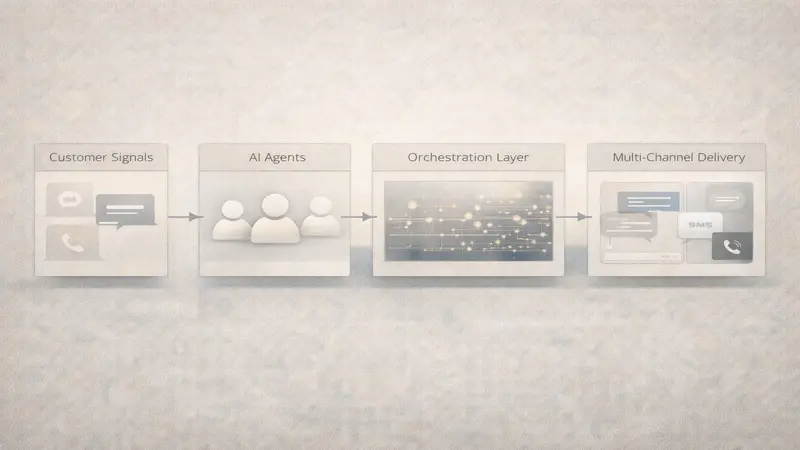
The system is structured around three tightly coupled components:
1. Proactive Outbound Intelligence
AI agents monitor operational signals — such as refunds, inventory changes, and missed appointments — and initiate communication before user intent is expressed.
This represents a shift from reactive support to anticipatory engagement.
2. Multi-Agent Orchestration
A visual, no-code interface enables businesses to coordinate multiple specialized agents across functions such as:
- billing
- scheduling
- recommendations
Rather than operating as a single chatbot, the system functions as a distributed decision network.
3. Customer Intelligence Layer
A continuously learning system builds persistent customer profiles across channels, including:
- web
- SMS
- voice
Each interaction contributes to a broader context graph of the customer relationship, enabling more precise and adaptive communication over time.
Why This Matters: The Interface Is No Longer the Product
The implications extend beyond product design.
Chat interfaces — once treated as end products — are increasingly becoming thin execution surfaces layered on top of autonomous systems.
This reflects a broader transition across AI:
- copilots → agents
- tools → orchestration systems
- interfaces → execution layers
CometChat is not attempting to build a more advanced chat interface.
It is positioning itself to control the decision layer that governs communication itself.
A Familiar Pattern Across AI Infrastructure
This transition is not unique to communication systems.
A similar structural shift is visible in enterprise AI infrastructure platforms:
https://techfront360.com/glean-context-infrastructure/
And in broader market realignments:
https://techfront360.com/ai-startups-market-power-shift/
As outlined in The Next AI Breakthrough Is Expertise, Not Models, the bottleneck is moving away from raw model capability toward execution, coordination, and context alignment.
CometChat’s evolution aligns with this pattern: from messaging infrastructure to customer interaction infrastructure.
The Competitive Landscape: Convergence at the Control Layer
The market remains fragmented, but the direction of travel is converging.
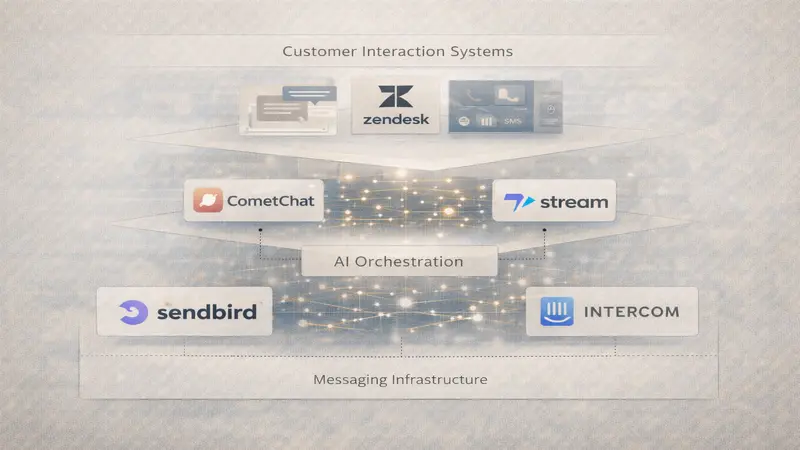
Different companies are approaching the same control layer from distinct entry points:
- Sendbird → omnichannel AI with memory and orchestration
- Intercom → AI-driven customer support automation
- Zendesk → enterprise-grade resolution systems
- Stream → developer-first messaging infrastructure
The convergence is clear: different architectures, same destination — control over customer interaction workflows.
CometChat’s differentiation lies not in scale, but in integration.
It combines:
- real-time communication infrastructure
- agent orchestration
- multi-channel delivery
- embedded guardrails and analytics
The result is a system designed not merely to respond, but to operate continuously across the customer lifecycle.
The Strategic Bet: Owning the “Last Mile” of AI
Large language models can generate responses.
But they do not:
- deliver messages across channels
- manage retries and failure states
- enforce moderation and compliance policies
- coordinate workflows across systems
This “last mile” — where AI systems intersect with real-world operations — remains one of the least solved layers in enterprise AI.
CometChat’s thesis is that this layer will become a critical control point in the AI stack.
In that context, competitive advantage shifts from generating responses to controlling the systems that initiate them.
Why This Round Matters
The size of the round is modest.
Its structure, however, is instructive.
Run Ventures, an existing investor, is increasing its exposure — not based on narrative expansion, but on early execution signals from enterprise pilots.
The capital is allocated toward:
- scaling enterprise deployments
- expanding go-to-market operations
- deepening vertical penetration
This is not exploratory capital.
It is execution funding tied to a defined architectural shift.
The Constraints Ahead
The opportunity is substantial.
The constraints are equally clear.
1. Reliability in Production
AI agents operating in live environments must handle:
- ambiguity
- edge cases
- failure recovery
This remains an unresolved challenge at scale.
2. Competitive Compression
Larger players — particularly Sendbird — are moving aggressively into the same layer with greater resources and distribution.
3. Commercial Conversion
With approximately $6 million in annual recurring revenue, CometChat must convert pilot deployments into repeatable, enterprise-grade contracts.
Execution — rather than technical capability — will determine outcomes.
The Bigger Shift
What is unfolding is not a company pivot.
It is a category transition.
From: → communication tools
To: → AI-driven customer operating systems
In this emerging model:
- messages are outputs
- workflows are the product
- context determines value
The Next 12 Months
The key signal will not be product announcements, but deployment depth within specific verticals:
- e-commerce
- hospitality
- wellness
- SaaS
If CometChat can demonstrate:
- measurable revenue uplift
- reduced churn
- operational efficiency gains
It may evolve from: → infrastructure provider
To: → system of record for customer interaction
The Bottom Line
CometChat’s $6.5 million round is unlikely to dominate headlines.
But it marks a precise shift in where value is accruing.
The future of enterprise communication will not be defined by faster messaging or improved interfaces.
It will be defined by which systems control the flow of decisions across customer interactions.
In that model, communication is no longer the product.
It is the execution layer of autonomous systems that determine outcomes.
Live Update Signal
This article will be updated as CometChat expands enterprise deployments, releases product benchmarks, or discloses additional platform metrics.
Research Context
This report synthesizes primary-source disclosures from
https://www.prnewswire.com/, investor statements, and verified operational data from company materials and industry datasets.