

Inside the Bengaluru startup building an agentic automation platform designed to reshape enterprise customer engagement.
Enterprise AI adoption is entering a new structural phase. While the first wave of generative AI focused on increasingly powerful foundation models, a second layer is now emerging: applied AI systems designed to automate real business workflows rather than simply generate content.
Bengaluru-based Cheerio AI sits squarely inside this shift. The company is building an agentic enterprise automation platform designed to orchestrate customer engagement across communication channels while embedding AI agents directly into the operational layer of enterprise software.
The startup’s core thesis is straightforward but increasingly influential: specialized AI agents powered by smaller, domain-specific models can automate complex business workflows more efficiently than both traditional SaaS tools and large general-purpose AI models.
The Problem: Fragmented Enterprise Communication
Most enterprises today operate across a wide range of communication channels including WhatsApp, email, SMS, Instagram, and in-app messaging.
These channels rarely operate as a unified system.
Marketing automation platforms manage outbound campaigns. Customer support tools handle inbound tickets. CRM systems track leads and conversions.
The result is a fragmented customer lifecycle where data, messaging, and decision-making are distributed across disconnected tools.
This fragmentation creates operational inefficiencies that directly affect revenue outcomes, particularly around customer acquisition cost (CAC) and lifetime value (CLTV).
Cheerio AI was built to address this structural inefficiency.
The platform acts as a unified automation layer that orchestrates interactions across multiple communication channels while integrating directly with existing enterprise infrastructure.
Rather than forcing companies to replace their existing stack, the system overlays automation across thousands of integrations, allowing businesses to coordinate messaging, engagement, and customer actions through a single AI-driven workflow engine.
This growing shift toward automation infrastructure mirrors a broader trend explored in TechFront360’s analysis of the emerging AI infrastructure investment cycle reshaping enterprise software.
From Chatbots to Agentic AI Workflows
While many AI startups have focused on conversational chatbots, Cheerio AI’s architecture is designed around a different paradigm: agentic workflows.
Instead of simply responding to messages, the platform’s AI agents can execute structured tasks across enterprise systems.
Examples include:
- qualifying inbound leads
- scheduling meetings
- processing payments
- updating CRM records
- generating personalized responses
- triggering follow-up campaigns
These actions occur within a single automated workflow.
The company refers to this system as its Prompt-to-Workflow engine.
Users describe a business objective in natural language—for example, re-engaging customers who abandoned a purchase—and the platform generates a structured automation flow connecting relevant tools and communication channels.
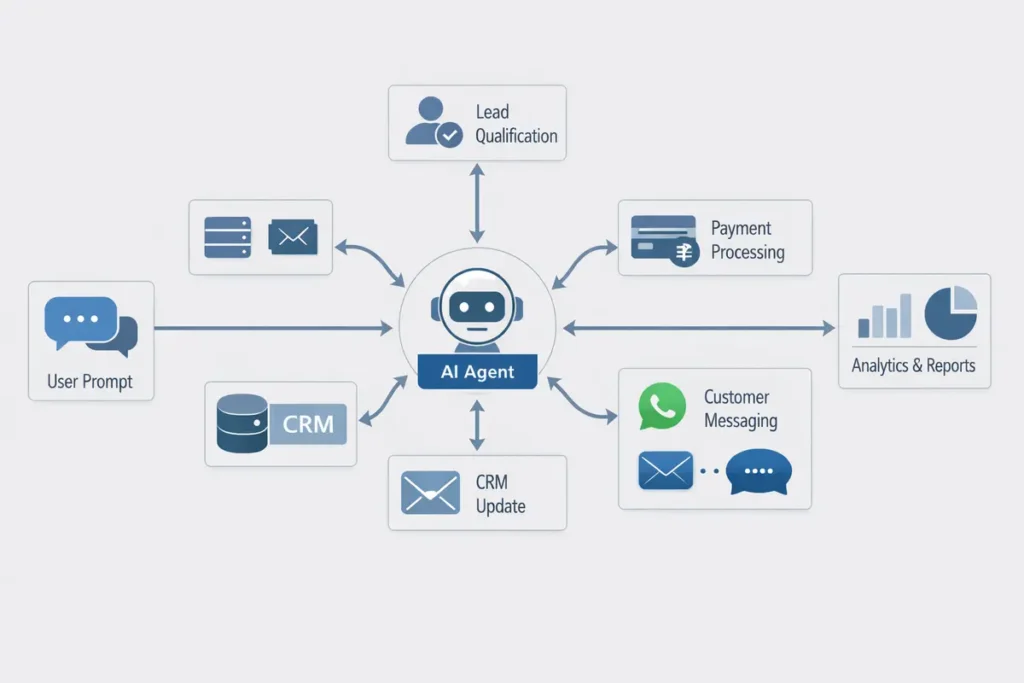
The system then executes that workflow autonomously.
For enterprise teams, the impact is operational speed.
Marketing, sales, and customer success teams can deploy new automation systems within minutes, avoiding the typical delays associated with engineering resources or IT development cycles.
The rise of such orchestration platforms reflects the broader emergence of enterprise AI infrastructure layers that sit above traditional SaaS tools.
The Small Model Strategy
One of Cheerio AI’s more distinctive technical decisions is its focus on small language models (SLMs) rather than relying exclusively on large frontier models.
The company is developing specialized models in the 1B to 14B parameter range, trained specifically on marketing, engagement, and customer interaction datasets.
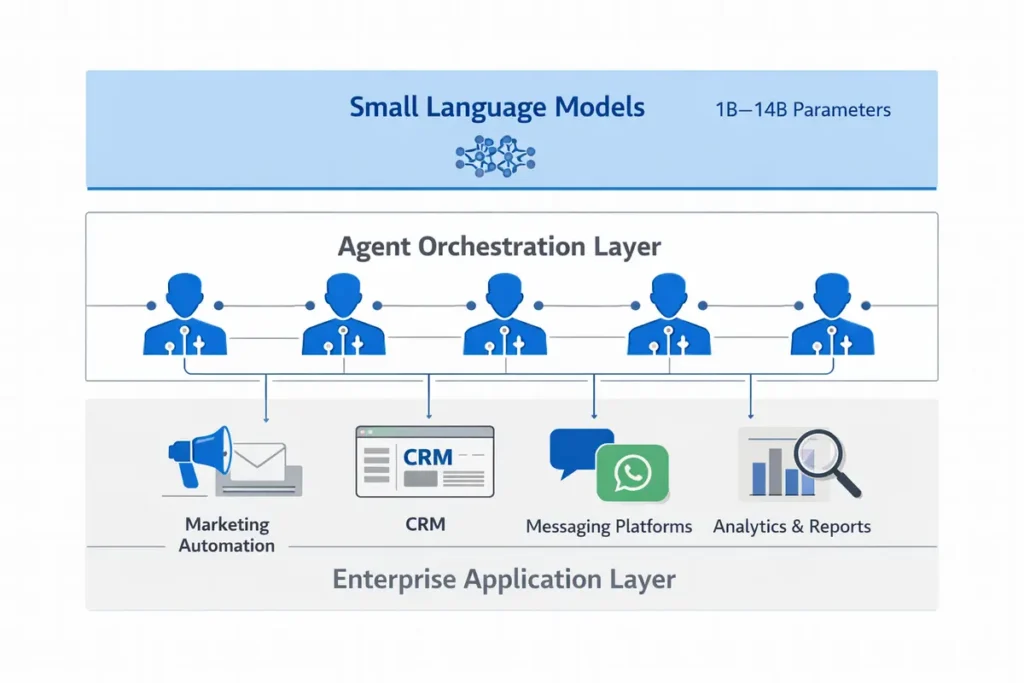
This strategy reflects a broader shift emerging across the AI industry.
Large frontier models provide powerful general reasoning capabilities but often introduce higher latency, infrastructure costs, and operational complexity.
For enterprise workflows operating at scale—where thousands of automated actions may occur every minute—these trade-offs become critical.
Smaller domain-specific models can deliver comparable performance for narrowly defined tasks while operating at significantly lower cost.
Cheerio AI uses LoRA fine-tuning techniques to adapt base models to specific brands, enabling AI systems to replicate company voice, tone, and messaging strategies without requiring full model retraining.
The result is an AI stack optimized not for maximum model size but for operational efficiency and enterprise deployment at scale, a pattern increasingly visible across the emerging AI application and agent stack.
Early Market Traction
Despite being an early-stage company, Cheerio AI reports strong early adoption.
The platform currently serves more than 150 enterprise customers across six industries, including e-commerce, finance, and automotive.
The company claims to have achieved 450% revenue growth over the past two years, while enabling clients to generate more than ₹500 crore in additional revenue through automated retention workflows.
One of the most visible deployments occurred during Royal Enfield’s Evolve ’24 event.
Using WhatsApp-based automation, the platform facilitated more than ₹1 crore in motorcycle sales within six hours, booking over 1,100 test rides in the first 15 minutes while processing more than 600,000 messages during the campaign.
High-velocity engagement environments such as product launches or marketing events highlight where agentic automation platforms can produce measurable commercial impact.
The Funding Signal
On March 6, 2026, Cheerio AI raised ₹8 crore (approximately $1 million) in seed funding.
The round was led by Artha Venture Fund II, with participation from Hyderabad Angels, TiE Angels, LetsVenture, VCMint, and Invention Engine.
Angel investors included entrepreneurs such as Arjun Vaidya and Ajeet Khurana.
The capital will support expansion of the company’s engineering and AI teams while accelerating development of its proprietary small-model infrastructure.
Cheerio AI also plans to expand beyond text-based messaging by introducing voice and video automation capabilities, pushing the platform into multimodal engagement systems.
For investors, the opportunity lies in the rapidly expanding enterprise AI automation market, which analysts estimate could exceed $50 billion globally by 2030.
The funding momentum also reflects a wider surge in capital flowing toward applied AI startups, a trend highlighted in TechFront360’s recent analysis of the AI funding surge reshaping venture capital.
Competition in a Crowded Market
Cheerio AI enters a competitive category.
Companies such as Intercom, Drift, Yellow.ai, and Gupshup already provide conversational automation tools for businesses.
However, many of these platforms were built during the chatbot era, focusing primarily on message handling rather than full workflow orchestration.
Cheerio AI’s differentiation lies in positioning itself as an automation infrastructure layer rather than a messaging interface.
Instead of simply answering customer questions, the platform coordinates the entire customer lifecycle—from lead acquisition to post-purchase engagement.
This approach reflects the broader rise of AI agents capable of executing multi-step operational processes across enterprise systems.
Still, scaling globally will require navigating several structural challenges.
Data privacy regulations such as India’s Digital Personal Data Protection Act impose strict compliance requirements on customer data usage.
Meanwhile, expansion into voice and video automation will introduce new engineering challenges related to infrastructure latency and compute costs.
The “Three-Employee Company” Vision
One of the more provocative ideas associated with Cheerio AI comes from its long-term automation thesis.
Co-founder Nishant Das has described a future in which a billion-dollar company could theoretically operate with only three core participants:
- a founder responsible for strategic direction
- a technical founder managing infrastructure
- an AI platform executing operational workflows
In this scenario, AI agents would replace large operational teams responsible for marketing automation, customer support, and sales engagement.
While the idea remains aspirational, it captures the broader ambition of the emerging agentic AI economy, where software systems increasingly act as autonomous operational layers inside organizations.
Strategic Implication
Cheerio AI’s approach highlights a deeper transition happening across enterprise AI.
The first phase of generative AI centered on building increasingly powerful foundation models.
The second phase now emerging is about embedding AI agents directly into business operations.
If that shift continues, platforms capable of orchestrating workflows across enterprise systems may become one of the most important layers of the modern software stack.
In that future, the most valuable AI companies may not be those building the largest models—but those that successfully integrate AI into the operational infrastructure of the global economy.
For Cheerio AI, the challenge now is execution.
If its small-model strategy proves effective at enterprise scale, the company could position itself at the forefront of the applied AI movement reshaping enterprise software.
Research Context
This analysis is based on publicly available startup disclosures, venture capital data, company statements, and industry reporting published between March 5 and March 8, 2026, covering developments in enterprise AI automation and applied artificial intelligence platforms.
Editorial Note
TechFront360 publishes independent analysis on emerging technology companies and the infrastructure shaping the global AI, startup, and deep technology ecosystem.