

Sri Viswanath isn’t building another AI tool. He is attempting to define how enterprises will operate autonomous systems.
Sycamore, a Palo Alto–based startup founded by former Atlassian CTO and Coatue partner Sri Viswanath, has raised $65 million in one of the largest seed rounds in enterprise AI — signaling a deeper shift toward building a full-stack operating system for AI agents rather than fragmented tools layered on top of workflows.
Led by Coatue and Lightspeed, with participation from some of the most influential figures in AI and enterprise software, the round reflects a specific conviction: that the next major platform in enterprise computing will not be models, but agent orchestration systems that control how those models act inside real-world environments.
This is not a product story. It is a founder thesis about infrastructure, a shift already visible across enterprise AI systems as explored in Anthropic’s Enterprise Infrastructure Strategy — Why AI Is Moving Beyond Models.
The Founder: From Enterprise Scale to Agent Systems
Sri Viswanath’s trajectory does not follow the typical AI startup pattern of early technical experimentation or academic research; instead, it is rooted in decades of building large-scale enterprise systems where reliability, integration, and operational complexity define success.
Over more than 20 years, he has:
- built systems at Sun Microsystems and VMware
- scaled engineering at Groupon
- led Atlassian’s cloud transformation as CTO
- expanded engineering to 7,000+ employees
He then moved into venture at Coatue, where he gained a front-row view of how rapidly enterprises were adopting AI — and where those systems were breaking.
That perspective shaped the core insight behind Sycamore.
The problem was not intelligence. It was operationalization.
The Founder Insight: AI Breaks at Deployment, Not Creation
The current wave of enterprise AI is dominated by tools that enhance workflows, automate tasks, or generate outputs.
But these systems share a structural limitation.
They operate on top of existing systems, rather than replacing or re-architecting them.
Viswanath’s thesis is fundamentally different.
Instead of layering agents onto workflows, Sycamore starts with the problem itself and builds the entire system required to solve it — including agents, infrastructure, integrations, and execution logic.
This reflects a deeper shift:
- from tools → to systems
- from copilots → to autonomous execution
- from assistance → to orchestration
That distinction defines the category Sycamore is entering, aligning with the broader execution-layer transformation outlined in Why AI Startups Are Moving From Tools to Systems.
The Product: An Operating System for AI Agents
Sycamore is positioning itself not as a feature or platform extension, but as a full lifecycle operating system for enterprise AI agents.
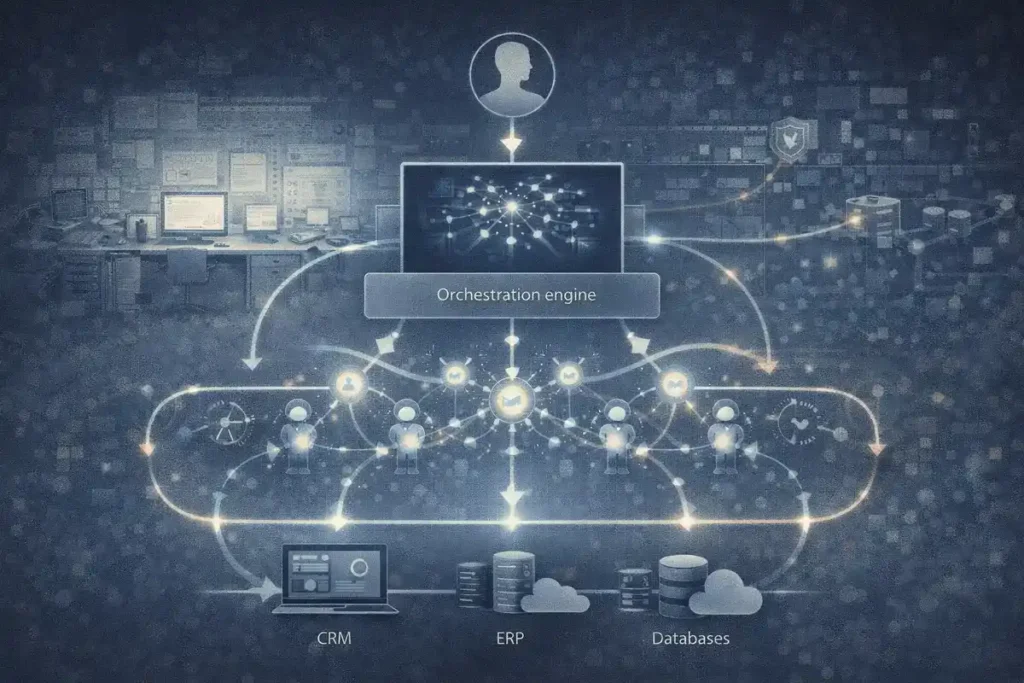
The system spans:
- discovery of use cases
- system generation from natural language intent
- deployment across enterprise environments
- observability and control
- continuous evolution through feedback
This transforms AI from isolated outputs into persistent, adaptive systems embedded inside enterprise operations.
At the core of the architecture are several defining principles:
Trust as a System Constraint
Agents do not act immediately. They earn autonomy through demonstrated reliability, moving from observation to execution within controlled boundaries.
System Generation, Not Tooling
Instead of providing pre-built workflows, Sycamore generates full systems tailored to enterprise environments, including integrations and infrastructure layers.
Continuous Learning Loops
Agents improve over time based on real-world outcomes, effectively capturing institutional knowledge across deployments.
Multi-Agent Coordination
The platform enables multiple agents to operate in coordinated systems rather than isolated tasks, reflecting the shift toward distributed execution architectures — a trend increasingly central to orchestration layers like Portkey — The Control Plane for AI Systems.
This is not incremental. It is a redefinition of how enterprise software is built and operated.
Why Investors Backed the Founder, Not Just the Idea
The size of the round — $65 million at seed — reflects more than market excitement around AI agents.
It reflects confidence in the founder’s ability to build at the infrastructure layer.
Unlike many startups in the space led by early-stage founders, Viswanath brings:
- deep enterprise system experience
- proven execution at scale
- prior exposure to infrastructure complexity
- long-standing relationships with investors
This explains the composition of the round.
Backers include:
- Coatue and Lightspeed (lead investors)
- Dell Technologies Capital, 8VC, Abstract Ventures
- angels such as Bob McGrew, Lip-Bu Tan, and Ali Ghodsi
This is not typical seed-stage capital. It is infrastructure-level conviction capital.
The Market: A Crowded Category Without a Defined Winner
Despite the strong backing, Sycamore is entering one of the most competitive layers in AI.
The enterprise agent space is rapidly filling with:
- early-stage startups experimenting with agent workflows
- well-funded entrants like Isara and Airia
- infrastructure players building orchestration layers
- model providers expanding into agent platforms
- hyperscalers launching native agent systems
This creates a fragmented landscape where:
- tools focus on narrow use cases
- platforms compete on integration depth
- infrastructure players attempt to control execution
Sycamore’s position is distinct. It is attempting to own the orchestration layer end-to-end, a layer increasingly recognized as critical in the broader AI stack evolution described in The AI Infrastructure Split — Who Controls the Next Layer of AI.
The Real Bet: Agents Need an Operating System
The core thesis behind Sycamore is not that AI agents will grow. That is already widely accepted.
The thesis is that: Agents cannot scale without a governing system
Enterprises require:
- security and isolation
- auditability and compliance
- lifecycle management
- coordination across systems
- control over autonomy
Without this, agents remain experimental. With it, they become infrastructure. This is the gap Sycamore is targeting.
The Constraint Layer
The opportunity is large, but the constraints are equally structural.
- enterprise adoption cycles are slow
- trust requirements are extremely high
- integration complexity is significant
- incumbents are expanding into the same layer
- hyperscalers control distribution channels
Most importantly: The category itself is not yet fully defined
Which means execution, not positioning, will determine outcomes.
Why This Founder Matters Now
Sri Viswanath represents a specific type of founder that is becoming increasingly important in AI.
Not model builders.
Not prompt engineers.
But system architects.
The next phase of AI will not be defined by who builds better models alone.
It will be defined by who can:
- integrate them
- control them
- operationalize them at scale
That requires a different skill set. And a different kind of founder.
What Sycamore Is Actually Building
Sycamore is not building another AI product.
It is attempting to build:
the operating system for autonomous enterprise AI
Where:
- agents are governed, not just deployed
- systems are generated, not configured
- intelligence is coordinated, not isolated
- execution is controlled, not improvised
This is not a feature layer. It is an infrastructure layer.
Editorial Close
The enterprise AI market is rapidly filling with tools, platforms, and models competing for attention.
But the layer that ultimately determines value is not where intelligence is created.
It is where it is controlled. Sri Viswanath is building in that layer. Not because it is easier. But because it is where systems become infrastructure.
Research Context
Based on company disclosures, Business Wire announcement, TechCrunch reporting, and analysis of enterprise AI agent infrastructure trends.
Editorial Note
This article reflects independent analysis of publicly available information and broader structural shifts in enterprise AI systems and infrastructure.