

Subheadline: A16z backs an agentic system converting CPG deductions into a compounding financial control layer
Glimpse, an AI-native platform operating in the financial operations layer of consumer packaged goods (CPG), has raised $35 million in a Series A round — marking a structural shift in enterprise AI from assistive tooling to outcome-driven infrastructure embedded directly in revenue flows.
The round, led by Andreessen Horowitz with participation from 8VC and Y Combinator, brings total funding to roughly $50 million. More critically, it validates a category that has remained operationally broken despite its scale: deductions management — a layer where billions in revenue quietly fragment, delay, or disappear.
The Structural Leak No System Owned
In the CPG supply chain, deductions are not anomalies — they are a parallel financial system.
Retailers routinely subtract amounts from invoices for damages, promotions, compliance fees, or alleged discrepancies. While theoretically reconciliations, in practice they introduce systemic opacity. A meaningful share of these deductions are invalid, misapplied, or never disputed.
For brands, this is not just inefficiency — it is structural revenue leakage.
Deductions often account for 7–15% of gross sales, with a non-trivial portion permanently unrecovered due to process friction. The bottleneck is not visibility. It is execution across fragmented systems: retailer portals, emails, PDFs, ERP records, and supply chain data.
No single system historically owned this layer end-to-end.
That absence is precisely where Glimpse positions itself — not as a reporting interface, but as a system of financial resolution.
From Insight to Enforcement
Glimpse’s core thesis is not that AI should explain operations, but that it should complete them.
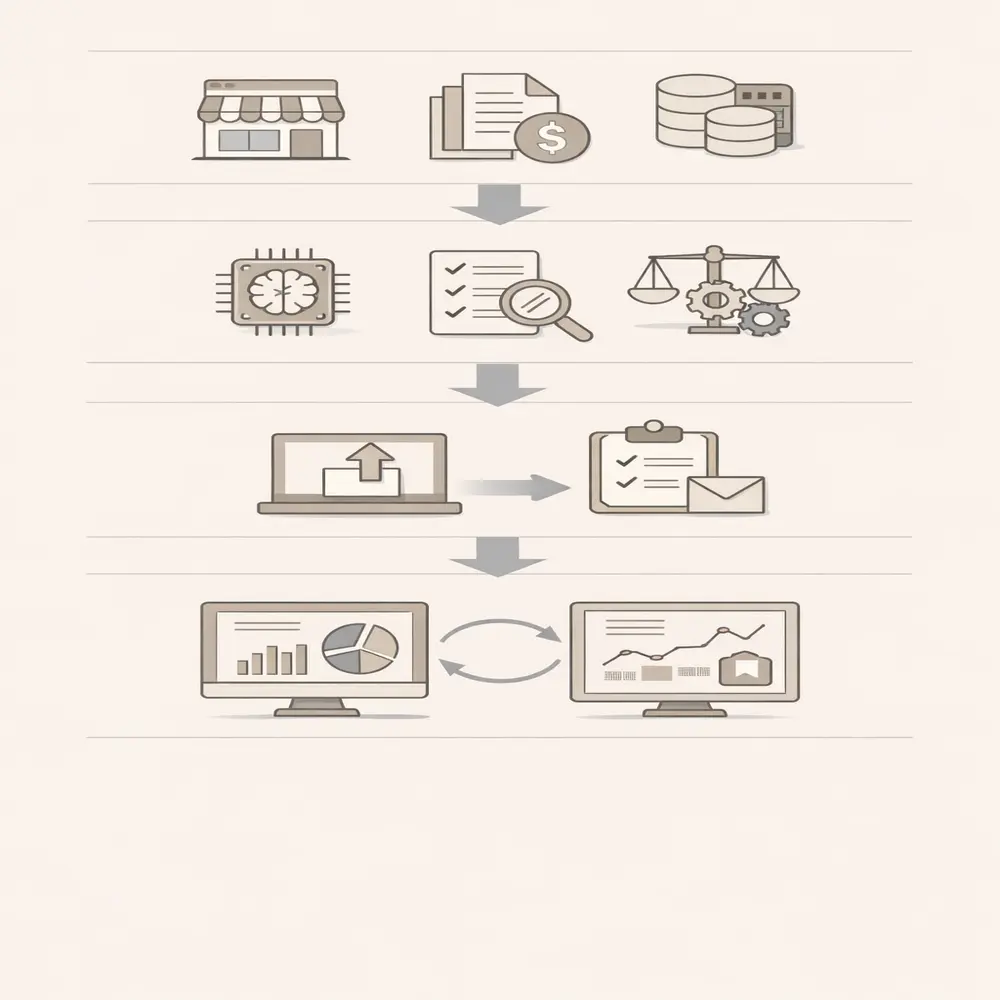
Instead of dashboards or copilots, the platform deploys AI agents across the full deductions lifecycle:
- Accessing retailer portals and aggregating fragmented data
- Classifying deductions across SKU, reason codes, and contractual context
- Validating claims against internal records and trade agreements
- Filing disputes and persistently following through to resolution
- Reconciling outcomes directly into accounting systems
This shift — from insight to enforcement — is where the economic value concentrates.
Most enterprise AI products improve awareness. Few directly influence cash flow. Glimpse operates precisely at that boundary.
This mirrors a broader infrastructure pattern already emerging across TechFront360 coverage — from Accounts Receivable Is Breaking — Cleavr’s AI Is Rebuilding It as Infrastructure to PointOne Raises $16M — Why AI Is Rebuilding the Revenue Layer of Legal Infrastructure.
In each case, the winning layer is not informational — it is transactional.
Glimpse extends that principle into one of the least modernized parts of enterprise finance.
Capital Is Following Execution, Not Models
The rapid progression from a $10 million round in 2025 to a $35 million Series A less than a year later signals more than investor enthusiasm — it reflects alignment with a new capital thesis.
Investors are increasingly prioritizing AI systems that:
- Produce direct, measurable financial outcomes
- Replace labor-intensive workflows rather than augment them
- Embed deeply into operational systems
- Improve with scale through data compounding
Glimpse fits this profile cleanly.
Its value proposition is not abstract productivity — it is recovered cash. This positions it closer to revenue infrastructure than traditional SaaS.
Andreessen Horowitz’s involvement reinforces a broader shift toward what can be described as AI-native services infrastructure — platforms that unbundle legacy BPO functions using agentic execution rather than human labor arbitrage.
In this model, software does not just assist work. It completes it — and captures value accordingly.
The Pivot That Revealed the Real Market
Glimpse’s current trajectory is defined less by its origin and more by its pivot.
The company initially pursued a consumer-oriented distribution model. That approach failed to achieve product-market fit. The inflection came when the founders encountered the operational complexity of CPG finance — specifically the fragmentation of deductions workflows.
What appeared as back-office noise revealed itself as a structurally unowned layer with direct financial consequences.
This shift — from consumer surface to operational depth — is consistent with a broader pattern among successful AI infrastructure companies: moving closer to economic friction rather than user engagement.
The result is a product aligned not with usage, but with outcomes.
Execution Is the Only Differentiator That Matters
The competitive landscape includes players such as Confido, Revya, TrewUp, and Vividly. All address deductions in some form. Few operate at the same level of execution depth.
The divide is increasingly clear:
- Visibility platforms organize data
- Workflow tools assist human operators
- Agentic systems execute and resolve
Glimpse positions itself in the third category.
This reflects a broader transition captured in Dash0 Hits $1B — Why AI Observability Is Becoming a Control Layer — where value shifts from monitoring systems to controlling outcomes.
However, the strategic risk remains. Broader platforms offering integrated finance stacks — particularly those combining deductions with trade promotion and forecasting — may appeal to enterprises seeking consolidation over specialization.
The question is whether execution depth can outcompete platform breadth.
Risk Is Embedded in the Same Layer as Opportunity
The very factors that create Glimpse’s opportunity also define its constraints.
Enterprise adoption in CPG is inherently slow, shaped by procurement cycles, compliance requirements, and integration complexity. Access to retailer portals — often inconsistent and unstructured — introduces technical fragility.
The hybrid human-in-the-loop model, while improving accuracy, raises questions about scalability without reintroducing cost structures.
And the absence of disclosed revenue metrics limits visibility into retention, expansion, and long-term unit economics.
These are not incidental risks. They are structural to the category.
The Emergence of Revenue Infrastructure as a Category
Glimpse is not an isolated case. It is part of a broader realignment in enterprise AI.
The highest-value insertion points are no longer horizontal tools, but vertical layers directly tied to revenue movement — billing, collections, pricing, and now deductions.
These layers share common characteristics:
- Fragmented data environments
- Manual, repetitive processes
- Direct financial impact
AI systems operating here do not need to be perfect. They need to be economically effective.
This aligns with the capital dynamics explored in AI Funding Is Splitting Into Infrastructure and Physical Intelligence Bets — where capital is concentrating in foundational layers that control outcomes rather than interfaces that describe them.
From a Single Workflow to a Financial Operating System
The long-term significance of the $35 million raise lies in expansion, not scale alone.
Deductions management functions as an entry point — a narrow but high-impact wedge into the broader financial operations stack. From there, adjacency expansion into trade spend optimization, forecasting, and reconciliation becomes structurally plausible.
The trajectory is clear:
From tool → workflow → system → infrastructure layer
If executed correctly, Glimpse does not remain a deductions platform. It becomes a control layer for retail financial operations.
Final Take
Glimpse is not competing on model sophistication or interface design. It is competing on its ability to capture lost revenue in a system where no one previously owned the outcome.
That positioning matters.
The shift underway in enterprise AI is not about intelligence alone. It is about control — over workflows, over decisions, and increasingly, over financial results.
In that transition, the companies that embed themselves closest to revenue — and can reliably move it — are not just building software.
They are building infrastructure.
Research Context: Based on company disclosures, funding data, product documentation, case studies, and comparative analysis of enterprise AI infrastructure trends in financial operations.
Editorial Note: This article reflects independent analysis of publicly reported information and broader AI ecosystem trends.