

Subheadline: Greenoaks’ $25M bet on Kluisz signals a structural shift: cloud infrastructure is being redesigned not for software, but for autonomous AI systems that think, plan, and execute.
The Moment Cloud Infrastructure Broke
The cloud was designed for human operators. AI is now breaking that assumption.
Kluisz.ai, a Bengaluru-based AI infrastructure startup building execution-layer control systems for private and sovereign cloud environments, is in advanced discussions to raise ~$25 million led by Greenoaks Capital—signaling a structural shift from deterministic cloud architecture to autonomous, agentic infrastructure.
From deterministic cloud infrastructure → to AI-native, agentic control systems.
At first glance, Kluisz is described as an “AI data center startup.” That framing is incomplete.
Rather than building physical infrastructure, the company is attempting to redesign the control plane of the cloud itself—a distinction that defines both the scale of the opportunity and the depth of execution risk.
The Core Problem: Infrastructure Was Built for Humans, Not AI
Modern cloud systems—from AWS to Kubernetes—are built on a foundational assumption:
Humans reason. Systems execute.
This model works when:
- workflows are deterministic
- inputs are structured
- decisions are predefined
It begins to break when:
- systems become probabilistic
- decisions are dynamic
- execution is autonomous
AI agents—particularly LLM-driven systems—operate differently. They:
- reason across incomplete information
- adapt to changing environments
- operate through continuous feedback loops
But the infrastructure they depend on:
- exposes discrete objects (VMs, clusters, policies)
- requires manual orchestration
- assumes static control logic
This creates a fundamental mismatch:
AI systems reason in relationships; infrastructure exposes rigid primitives.
The result is predictable:
- planning drift
- self-consistent but incorrect execution paths
- scaling failures in production environments
This is the failure mode Kluisz is designed to address—one that is increasingly visible in AI systems moving beyond interfaces into execution environments.
.
The Architectural Shift: From Infrastructure-as-Code to Infrastructure-as-Intelligence
Kluisz introduces a different paradigm:
Infrastructure that understands context, constraints, and intent.
Instead of defining:
- instances
- clusters
- network rules
Users define:
- performance objectives
- cost constraints
- compliance requirements
The system executes against those goals.
This represents a departure from traditional automation models. It is execution-layer intelligence embedded directly into infrastructure—a shift aligned with how AI funding is splitting into infrastructure and physical intelligence bets.
How Kluisz Actually Works
At its core, Kluisz is a redesigned control plane built around three architectural principles:
1. Context-Aware State Model
Rather than exposing the entire system state, Kluisz selectively surfaces only the relevant slice of infrastructure required for a decision.
This reduces:
- cognitive overload
- planning errors
- systemic drift
2. Explicit Constraint Encoding
Security, compliance, and operational policies are embedded directly into the system’s reasoning layer—not added post hoc.
This enables:
- real-time validation
- policy-aware execution
- bounded autonomy for probabilistic systems
3. Continuous World Model Feedback
The platform maintains an evolving internal representation of infrastructure state, incorporating:
- performance signals
- security events
- resource utilization
This enables:
- self-healing systems
- continuous optimization
- adaptive scaling under real-world conditions
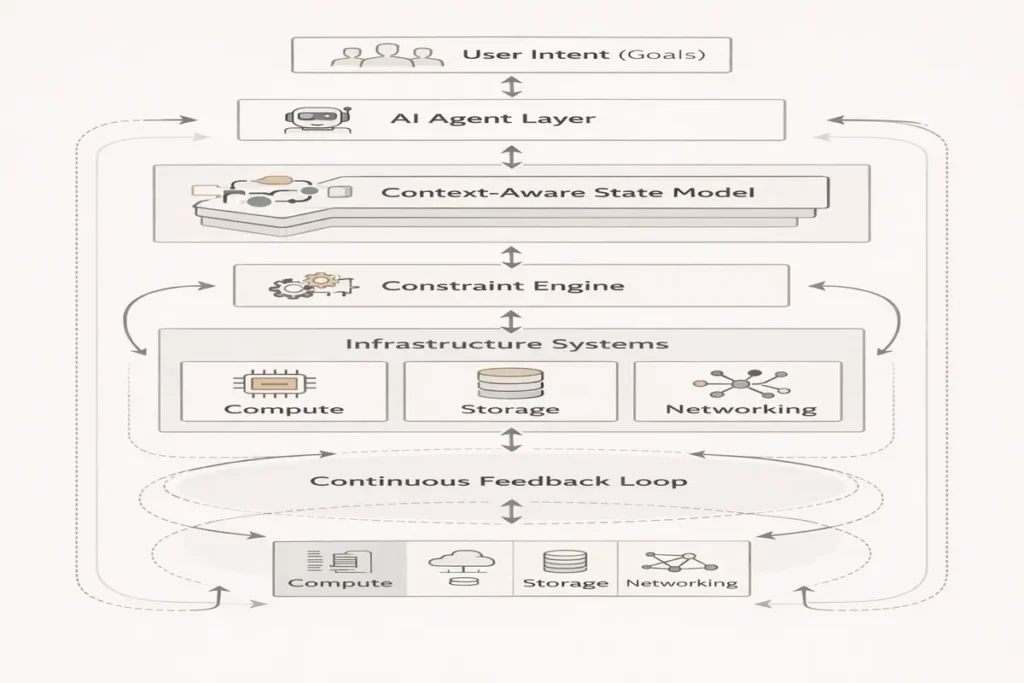
Why This Is an Execution-Layer Innovation
Most infrastructure companies optimize components:
- compute
- storage
- networking
Kluisz operates at a higher abstraction layer:
control over system behavior.
This aligns with a broader shift across AI markets:
- AI agents replacing interfaces
- systems replacing workflows
- infrastructure becoming autonomous
As seen across enterprise AI:
Value is moving from capability → to control.
This mirrors the evolution of platforms where context-aware systems are becoming infrastructure layers rather than tools.
The Market Context: India’s AI Infrastructure Supercycle
The timing is structural.
India’s data center market is expanding rapidly:
- ~$10.5B (2025) → ~$27B+ by 2032
- Large-scale capex from Reliance, Adani, Tata, and global operators
But this growth is concentrated in physical infrastructure.
The missing layer is:
intelligent orchestration.
This is the same structural transition already visible in enterprise AI, where execution—not interface—is becoming the dominant layer of value creation.
Enterprises—particularly in:
- BFSI
- healthcare
- government
face hard constraints:
- data sovereignty
- regulatory compliance
- latency requirements
Public cloud struggles to meet these requirements. Private cloud restores control—but introduces operational complexity.
Kluisz positions itself in that gap:
private cloud without operational overhead.
Greenoaks’ Bet: Why This Matters
Greenoaks does not invest in incremental improvements.
Its portfolio—Databricks, Wiz, and Scale AI—reflects a consistent pattern:
infrastructure layers that redefine system behavior.
A ~$25M lead at this stage signals:
- conviction in category creation
- belief in long-term control-layer value
- alignment with global AI infrastructure trends
This is not a regional investment.
It is a control-plane thesis applied to AI infrastructure.
The Competitive Divide: Two Philosophies Emerging
The market is beginning to bifurcate:
1. Extension Model (Incumbent Path)
- Kubernetes + AI wrappers
- Infrastructure-as-code with AI assistance
- incremental automation
Examples:
- Rafay
- Run:ai
- StackGuardian
2. Reconstruction Model (Emerging Path)
- redesigned control planes
- AI-native state representation
- intent-driven execution
Examples:
- Kluisz
- VAST Polaris (partial overlap)
The distinction is not at the feature level.
It reflects a philosophical divergence in system design.
The Real Moat: Representation Layer
Kluisz’s defensibility is not in:
- GPU orchestration
- deployment tooling
- automation features
It lies in:
how infrastructure is represented to AI systems.
If successful, this creates:
- control-layer lock-in
- feedback-driven optimization loops
- system-level compounding advantages
Comparable shifts:
- Kubernetes standardized container orchestration
- Databricks redefined data infrastructure
The Constraint: Execution Risk at Scale
The ambition is non-trivial.
The constraints are equally significant:
- building a stable autonomous control plane is technically complex
- infrastructure errors have cascading consequences
- no public benchmarks or large-scale deployments yet
The challenge is not conceptual.
It is operational:
making autonomous infrastructure reliable under real-world conditions.
Strategic Implications
For Startups
The opportunity is no longer building better tools.
It is:
owning system-level behavior in constrained environments.
For Investors
Capital is concentrating around:
- execution-layer infrastructure
- technically complex systems
- platforms tied to measurable outcomes
For Enterprises
The shift is structural:
From:
- managing infrastructure
To:
- defining outcomes
System-Level Insight: The Cloud Is Becoming Autonomous
The deeper shift is not AI adoption.
It is control.
In the previous paradigm:
- software-defined workflows
- humans executed them
In the emerging paradigm:
- systems define workflows
- systems execute them
Infrastructure transitions from a passive layer to an autonomous system.
Editorial Close
Kluisz is not building a better cloud.
It is attempting to answer a more fundamental question:
What does infrastructure look like when machines—not humans—are the primary operators?
If that model proves viable, the implications extend beyond India.
Because in the next phase of computing:
The decisive layer will not be where software runs, but where systems decide.
Research Context
Synthesis of Moneycontrol, NewsBytes, Entrackr, company disclosures, and AI infrastructure analysis as of March 2026.
Editorial Note
This article reflects independent analysis of publicly available information and broader AI infrastructure trends.