

Isara isn’t just another AI startup. It is a capital signal that venture markets are now funding research labs as infrastructure bets.
Isara, a San Francisco-based AI startup building multi-agent orchestration systems, has raised $94 million at a $650 million post-money valuation — despite being just nine months old, pre-product, and operating with a team of roughly a dozen researchers. The round, backed by OpenAI, Amity Ventures, Michael Ovitz, and Stanley Druckenmiller, reflects a broader structural shift in venture capital: the emergence of “neolabs,” where funding is deployed not against revenue or products, but against foundational research hypotheses with infrastructure-level upside.
This is not an early-stage funding event in the traditional sense.It is a reclassification of what venture capital is willing to underwrite, a pattern increasingly visible across AI capital markets as explored in AI Venture Capital Outlook 2026 — Where Capital Is Actually Moving.
The Deal: Capital Before Product, Conviction Before Proof
At a surface level, Isara’s raise appears aggressive. A $650 million valuation for a company with no shipped product, minimal headcount, and a research-stage system would have been considered irrational even two years ago.
In the current AI cycle, it is becoming normalized.
The round combines three distinct forms of capital:
- Strategic capital → OpenAI
- Thematic venture capital → Amity Ventures
- High-conviction macro and angel capital → Druckenmiller and Ovitz
This composition matters more than the size of the round itself, because it reflects alignment across multiple layers of the AI ecosystem: research, infrastructure, finance, and narrative.
The capital is not betting on execution today.It is betting on category ownership tomorrow.
The Core Thesis: Orchestration Is the Next Infrastructure Layer
Isara is building orchestration software for AI agent swarms, enabling thousands of specialized agents to coordinate, divide tasks, and synthesize outputs across complex, open-ended problems.
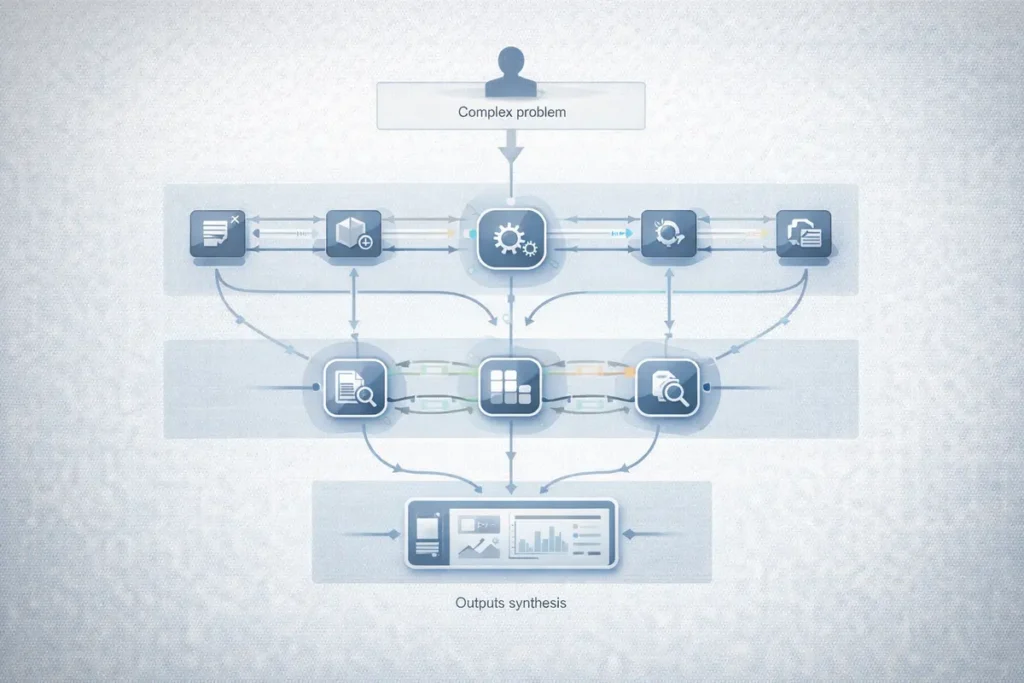
This moves beyond existing frameworks such as LangChain or AutoGen, which operate effectively at small scale but struggle with coordination complexity as agent counts increase.
The underlying bet is clear:
AI is shifting from single-model systems → multi-agent systems
And from there → coordinated swarm intelligence
The technical challenge is no longer generation.It is coordination at scale — a layer increasingly emerging as infrastructure, similar to how control systems evolved in Portkey — The Control Plane for AI Systems.
If that layer is solved, it becomes infrastructure.
Why OpenAI Is Investing
OpenAI’s participation is the strongest signal embedded within the round, particularly given that co-founder Eddie Zhang previously worked as an AI safety researcher inside the organization.
This is not just a founder bet.It is strategic optionality.
OpenAI faces an internal constraint: as systems scale, coordination between agents, tools, and reasoning processes becomes exponentially complex. Building that entirely in-house is costly, slow, and potentially limiting.
By investing externally, OpenAI gains:
- visibility into emerging architectures
- access to alternative coordination paradigms
- optional integration or acquisition pathways
At a ~$300B+ valuation context, a check into a $650M startup is negligible in cost.
But high in leverage.
The Syndicate Logic: Capital Meets Narrative
Each investor in the round represents a different dimension of conviction.
Amity Ventures brings domain expertise in AI-native infrastructure and agent systems, positioning Isara within a broader portfolio of orchestration and automation layers.
Michael Ovitz represents narrative-driven capital — historically backing companies with large TAM, strong founder storytelling, and category-defining ambition.
Stanley Druckenmiller introduces a different signal entirely.
His involvement ties directly to Isara’s initial commercial focus: predictive modeling for financial markets. A system capable of coordinating thousands of agents to forecast macro variables aligns precisely with how hedge funds generate edge.
This is not passive capital.
It is use-case aligned capital.
The Neolab Model: Venture Capital as Research Funding
Isara is part of a broader structural shift in venture markets toward what can be described as neolabs — startups that function more like privately funded research institutions than traditional companies.
These companies share common characteristics:
- no revenue
- no product
- small, elite teams
- large early-stage funding rounds
- deep technical theses
More importantly, they are evaluated differently.
Traditional startups are measured by traction.
Neolabs are measured by intellectual positioning and potential control over future infrastructure layers, a shift reinforced by the broader capital reallocation trends outlined in AI Funding Is Splitting Into Infrastructure and Physical Intelligence Bets.
Since late 2025, over $10 billion has been deployed or discussed across similar entities, with individual seed rounds reaching into the billions.
In that context, Isara’s $94M raise is not extreme.
It is efficient.
Valuation Logic: Why $650M Is “Reasonable” in 2026
By pre-2024 standards, Isara’s valuation would appear disconnected from fundamentals.
In the current cycle, it reflects a different pricing model.
Investors are not valuing:
- current revenue
- existing product
- short-term market share
They are valuing:
- potential ownership of a new infrastructure layer
- position within the AI stack
- probability of becoming a platform dependency
If multi-agent orchestration becomes foundational — similar to how cloud, databases, or APIs became foundational — then early entrants could capture disproportionate value.
Even a 5–10% share of the projected AI agent infrastructure market could justify multi-billion dollar outcomes.
The risk is high.
But the payoff is asymmetric.
Why This Deal Closed Fast
The speed of the round — closed within roughly nine months of founding — reflects convergence across four forces.
1. Founder credibility
An OpenAI safety background combined with ICML research provides immediate technical legitimacy.
2. Strategic urgency
Large AI labs cannot afford to ignore breakthroughs in coordination systems.
3. Capital competition
Multiple investor classes are now competing for exposure to AI infrastructure layers.
4. Narrative timing
The market has shifted from “models” to “agents”, and from agents to “systems of agents.”
Isara sits directly in that narrative inflection.
The Risk Layer
The same factors that make Isara attractive also define its constraints.
The gap between a demonstration — such as coordinating 2,000 agents — and a production-ready system capable of handling real financial or scientific workloads is substantial.
Cost is another constraint.
Running large-scale agent systems remains computationally expensive, and economic viability depends on continued declines in model and inference costs.
Competition is inevitable.
- frontier labs are building internal orchestration
- open-source frameworks are evolving rapidly
- adjacent startups are entering the same layer
And perhaps most critically:
Most neolabs will fail.
Because research success does not guarantee product-market fit.
The Structural Shift: From Models to Systems
Isara reflects a broader reordering of the AI stack.
The first phase of AI was defined by:
models → capability
The current phase is defined by:
agents → interaction
The next phase is emerging as:
systems → coordination
And eventually:
infrastructure → control
This transition mirrors the broader system-level evolution described in The AI Infrastructure Split — Who Controls the Next Layer of AI.
Isara is positioned at the transition between systems and infrastructure.
That is where value compounds.
What Isara Is Actually Building
At its core, Isara is not building a product in the traditional sense.
It is attempting to build:
a coordination layer for intelligence
Where:
- agents operate collectively rather than individually
- tasks are decomposed dynamically
- outputs are synthesized across systems
If successful, this layer becomes invisible.
And indispensable.
Editorial Close
The significance of Isara’s $94M round is not the capital itself, but what that capital represents.
Venture markets are no longer funding companies alone.
They are funding hypotheses about how the AI stack will evolve.
In that transition, the most valuable companies may not be those that build the smartest models, but those that enable systems to work together at scale.
Because intelligence, on its own, is not enough.
It must be coordinated.
And the companies that control that coordination layer are not just building startups.
They are defining infrastructure.
Research Context
Based on reporting from The Wall Street Journal, TechFundingNews, The Next Web, and analysis of venture capital flows into research-first AI startups.
Editorial Note
This article reflects independent analysis of publicly available information and emerging structural patterns in AI funding and infrastructure development.