

Inside the enterprise AI agent platform building the control layer for autonomous workflows across banking, insurance, and global corporations.
Artificial intelligence is rapidly evolving beyond chatbots and copilots into a new class of software systems: autonomous AI agents capable of executing complex workflows across enterprise operations.
As organizations deploy AI across customer service, finance, compliance, and internal knowledge systems, the critical challenge is no longer model capability alone. It is how those models are orchestrated, governed, and deployed across real enterprise environments.
This shift is creating demand for a new infrastructure layer — platforms designed to coordinate networks of AI agents operating across corporate systems, databases, and workflows.
Lyzr AI, a New York–based startup specializing in enterprise AI agent infrastructure, is positioning itself to build that layer.
The company announced a $14.5 million funding round led by Accenture, raising its valuation to $250 million, a fivefold increase from its October 2025 valuation of roughly $50 million.
The investment reflects growing investor conviction that agentic AI platforms could become the operational backbone of enterprise automation.
It also underscores a broader transformation across the technology industry: capital is increasingly flowing toward companies building the infrastructure layer of artificial intelligence, a dynamic explored in The $189B AI Funding Surge Is Reshaping the Deep Tech Venture Map.
The Rise of Enterprise AI Agents
Much of the current AI boom has centered on foundation models.
But as organizations begin deploying artificial intelligence across real business processes, the central challenge increasingly shifts from model intelligence to workflow orchestration.
Enter AI agents — software entities capable of autonomously performing tasks, retrieving data, interacting with systems, and coordinating with other agents.
Lyzr’s platform is built around this concept.
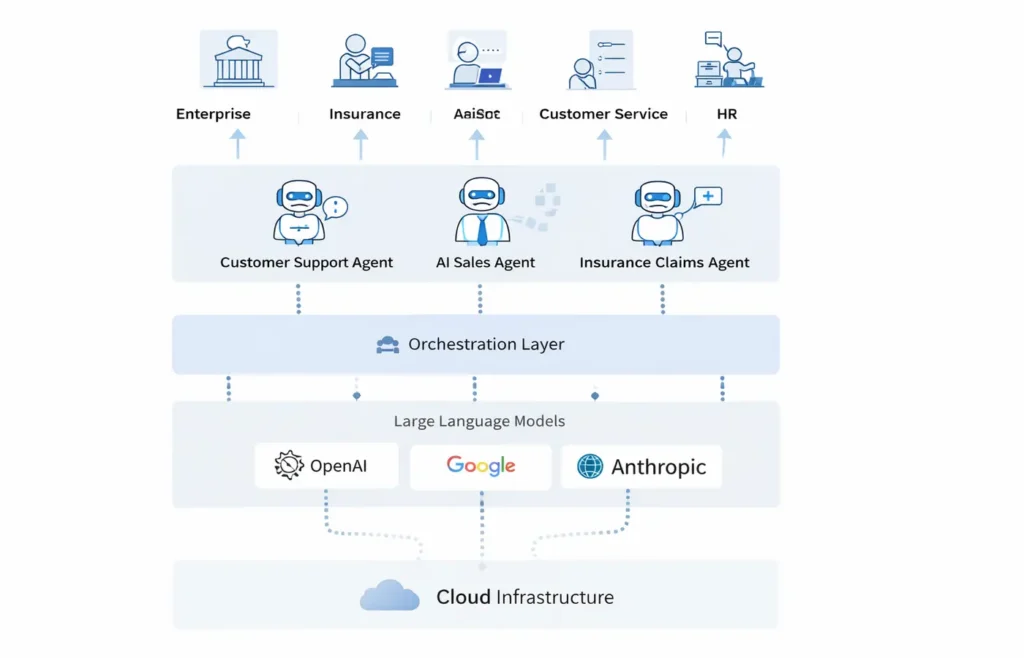
The company describes its architecture as a “control plane for enterprise AI agents,” providing infrastructure that allows organizations to deploy, monitor, and govern agent networks securely across corporate environments.
These agents can automate functions such as:
- customer onboarding
- loan servicing
- insurance claims processing
- internal knowledge retrieval
- marketing and sales automation
- HR training and support operations
Instead of isolated AI applications, enterprises can deploy interconnected networks of agents capable of coordinating complex workflows across departments.
This architecture is increasingly described as agentic AI — systems where multiple specialized agents collaborate autonomously to execute business processes.
The growing importance of agent infrastructure mirrors broader industry shifts toward AI-native developer platforms and automation tools, a trend explored in Cursor’s $2B ARR Explosion Signals the Arrival of Agentic Developer Infrastructure.
From Startup to Enterprise Platform
Lyzr AI was founded in 2023 by Siva Surendira, Anirudh Narayan, and Ankit Garg, with headquarters in Jersey City, New Jersey.
The founders built the company around a central insight: while AI models were advancing rapidly, enterprises lacked infrastructure capable of deploying those models securely and reliably inside regulated environments.
To address that gap, Lyzr developed a platform combining:
- agent orchestration infrastructure
- no-code development tools
- governance and compliance controls
- integrations with multiple large language models
One defining feature of the platform is its model-agnostic architecture.
Enterprises can deploy agents using models from providers including OpenAI, Google, Anthropic, or open-source alternatives — reducing dependency on a single AI vendor.
The platform also supports private cloud and on-premise deployments, an essential capability for companies operating under strict regulatory frameworks.
That flexibility has helped Lyzr attract more than 400 enterprise customers, including organizations such as Accenture, AWS, Hitachi Energy, Publicis, and AirAsia.
The rise of enterprise-focused AI infrastructure startups reflects a broader movement across the AI ecosystem, where companies are building specialized infrastructure layers rather than generic cloud services — a structural shift also visible in Nvidia-Backed Nscale Raises $2B at $14.6B Valuation.
Inside the Lyzr Platform
Lyzr’s product stack is designed to enable organizations to build, deploy, and manage large networks of AI agents.
Agent Blueprints
The platform includes more than 100 pre-built AI agent templates tailored for specific industries.
Examples include:
- AI loan servicing agents for banking
- claims processing agents for insurance
- customer support automation agents
- AI sales development representatives (SDRs)
These templates allow enterprises to deploy production agents without building complex automation systems from scratch.
Agent Studio
Agent Studio provides a no-code and low-code development environment for building custom agents.
Developers and business teams can design workflows, integrate APIs, and connect enterprise data sources without extensive engineering work.
AgentMesh
Lyzr also offers AgentMesh, an orchestration layer enabling multiple agents to collaborate on complex workflows.
This architecture allows organizations to create multi-agent systems capable of executing end-to-end business processes across departments.
The emergence of orchestration layers like AgentMesh signals a shift toward AI operating systems for enterprises, similar to how context platforms and AI workflow engines are reshaping enterprise AI deployment — a transformation explored in The Invisible Infrastructure Layer Reshaping Enterprise AI.
Funding Reflects Growing Demand for Agentic AI
Investor interest in Lyzr reflects rising enthusiasm around enterprise AI infrastructure.
The company’s funding trajectory illustrates how rapidly capital is flowing into the sector.
Early Funding
Lyzr initially raised angel capital using Y Combinator SAFE notes and early venture funding estimated at roughly $2.5 million.
Series A — October 2025
The company raised $8 million led by Rocketship.vc, with participation from:
- Accenture Ventures
- Plug and Play
- BGV
- Arka Venture Labs
The round valued Lyzr at approximately $50 million.
Series A+ — March 2026
The latest round raised $14.5 million, increasing the company’s valuation to $250 million.
Total funding now stands at approximately $37 million.
Accenture’s involvement is particularly significant.
The consulting giant has increasingly invested in companies building the infrastructure required to deploy enterprise AI systems at scale.
Competition in the Enterprise AI Agent Market
Lyzr operates within a rapidly expanding ecosystem of companies building platforms for AI agents.

Competitors span both startups and large technology companies.
Open-source frameworks such as LangChain and CrewAI dominate developer communities building custom agent architectures.
Meanwhile hyperscalers including Google Vertex AI, Microsoft AutoGen, and Salesforce Agentforce offer integrated AI platforms within their cloud ecosystems.
Specialized startups such as StackAI and UnifyApps are also targeting enterprise automation workflows.
Compared with these competitors, Lyzr differentiates itself through:
- open-source architecture
- enterprise security controls
- model-agnostic infrastructure
- private deployment options
This positioning targets regulated industries including banking, insurance, and healthcare.
Pricing and Enterprise Economics
Lyzr’s pricing structure combines subscription-based development tools with usage-based production pricing.
Development tiers range from free plans for experimentation to enterprise subscriptions supporting large-scale deployments.
Once agents move into production, customers pay per “agent run,” representing the execution of a complete AI workflow.
Pricing begins around $0.08 per run in the managed cloud environment, or $0.03 per run for self-hosted deployments.
The company estimates that agent automation can reduce operational costs by 80–95 percent compared with human labor for repetitive workflows.
The Strategic Bet on AI Agents
Industry analysts estimate that the market for enterprise AI agents could reach $50 billion by the end of the decade.
As companies increasingly automate operations, platforms capable of managing thousands of AI agents may become a critical layer of enterprise infrastructure.
This shift parallels broader transformations in the AI ecosystem.
Just as GPU platforms became the foundation of modern AI computing — a transition explored in Jensen Huang: The Architect of Nvidia’s AI Infrastructure — the next phase of enterprise AI may depend on systems capable of orchestrating networks of autonomous agents.
Editorial Takeaway
The artificial intelligence boom is often framed as a race between models.
But for enterprises deploying AI in real-world operations, the core challenge increasingly becomes coordination rather than intelligence.
AI agents capable of executing workflows autonomously may represent the next stage of enterprise automation.
Companies building the infrastructure required to orchestrate those agents could therefore become one of the most strategically important layers in the emerging AI economy.
Lyzr’s rapid valuation increase suggests investors increasingly believe that the future of enterprise software may be built not around applications, but around networks of autonomous agents operating across the digital enterprise.
Research Context
This analysis synthesizes publicly available information from company disclosures, venture capital announcements, enterprise AI infrastructure research, and industry reporting published between 2024 and March 2026. Additional insights were derived from developer ecosystem analysis, enterprise AI adoption trends, and competitive platform comparisons within the emerging agentic AI market.
Editorial Note
TechFront360 publishes independent analysis covering artificial intelligence infrastructure, emerging startups, and the strategic technology shifts shaping the global AI economy. Our editorial focus examines the systems, platforms, and capital flows driving the next generation of AI innovation.