
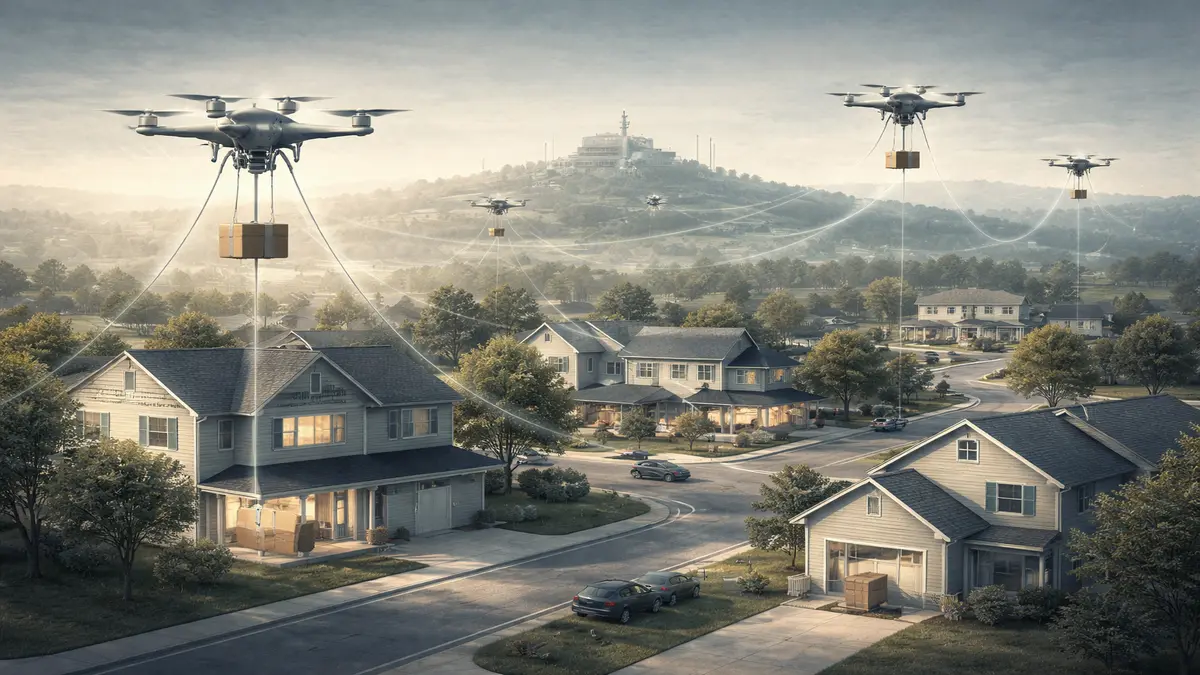
Manna isn’t proving drones can deliver. It is proving they can scale.
Manna Air Delivery, the Irish drone logistics startup founded by serial entrepreneur Bobby Healy, has raised $50 million in a Series B round led by ARK Invest, with participation from the Ireland Strategic Investment Fund, Schooner Capital, and existing backers including Coca-Cola HBC — bringing total funding to roughly $110 million.
The round is not just capital for expansion. It is a validation moment for a category that has struggled for over a decade to move from experimentation to operational reality.
Because the question in drone delivery was never whether it works. It was whether it scales economically.
The Structural Shift: From Pilot Programs to Operational Systems
For years, drone delivery has existed in a state of perpetual testing, with companies running limited pilots, navigating regulatory friction, and struggling to translate technical capability into repeatable, high-frequency operations.
That phase is ending.
Manna represents a different stage of the market — one where drone delivery is no longer positioned as a futuristic concept, but as a functioning logistics layer with real throughput, real revenue, and measurable unit economics, reflecting a broader transition toward execution-layer AI systems outlined in Why AI Startups Are Moving From Tools to Systems.
With over 250,000 commercial deliveries completed across Ireland, Finland, and the United States, the company has already moved beyond experimentation into operational proof.
This is the inflection point the sector has been waiting for.
The Founder Thesis: Logistics Is a Systems Problem, Not a Hardware Problem
Bobby Healy’s approach to Manna reflects a deeper understanding of logistics as a systems-level challenge rather than a hardware innovation problem.
While much of the industry focused on building better drones, Manna focused on building a complete delivery system — integrating aircraft design, software orchestration, operations, and partner ecosystems into a single tightly controlled stack.
This distinction matters. Because in logistics, performance is not defined by individual components. It is defined by system efficiency.
Healy’s background — from building airline-tech firm Eland to scaling CarTrawler into a global mobility marketplace — is visible in this approach.
Manna is not structured like a hardware startup. It is structured like an infrastructure company, similar to patterns seen across AI-driven physical systems such as Apptronik and the Rise of Physical AI Systems.
The Product: Drone Delivery as a Service (DaaS)
Manna’s core offering is not drones. It is delivery capacity.
The company operates a “Drone Delivery as a Service” (DaaS) model, partnering with platforms such as Uber Eats, Deliveroo, Just Eat, and DoorDash, as well as retailers and enterprise partners like Coca-Cola HBC.
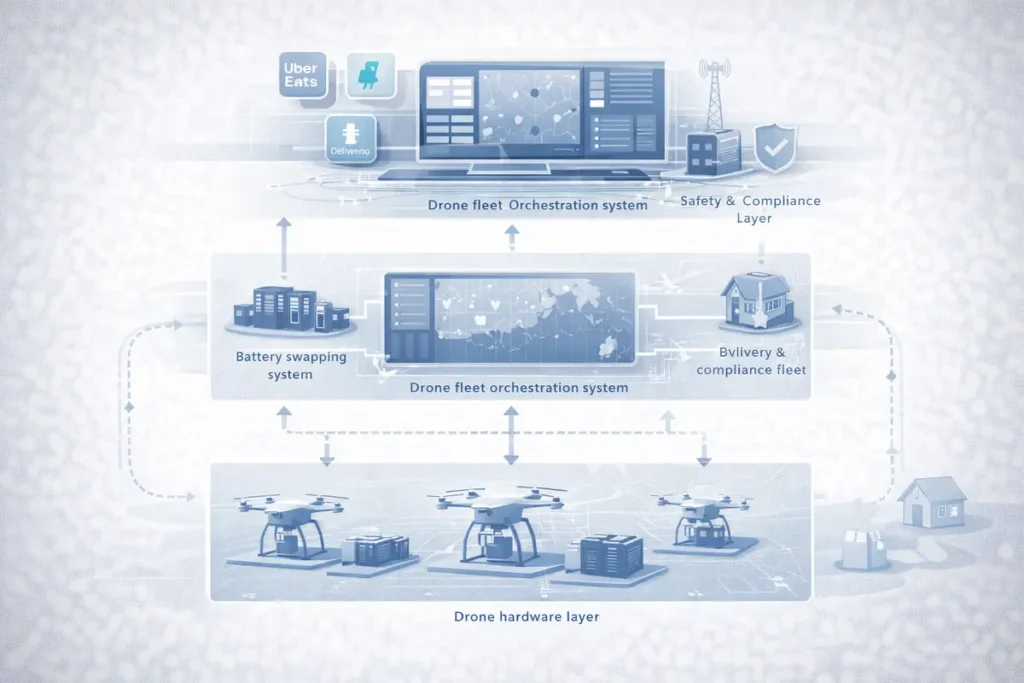
This positions Manna not as a consumer-facing product, but as an embedded logistics layer inside existing commerce ecosystems.
The focus is deliberate:
👉 suburban last-mile delivery
👉 high-frequency, short-radius operations
👉 food, groceries, and retail
Not dense urban cores. Not long-haul logistics. A narrow wedge. But a high-value one.
The Technology Stack: Built for Throughput, Not Novelty
Manna’s technical architecture reflects its operational focus.
The company designs and manufactures its own aerospace-grade drones while building the full software stack in-house, allowing tight integration between hardware, autonomy systems, and fleet orchestration.
Key characteristics include:
- custom multirotor VTOL drones (~23 kg, ~3–4 kg payload)
- tethered winch delivery from hover (no landing required)
- triple-redundant safety systems with parachute deployment
- LiDAR-based precision positioning
- BVLOS (beyond visual line of sight) autonomous operations
But the real differentiator is not the hardware.
It is utilization. With hot-swappable batteries and cargo bays enabling sub-60-second turnaround times, each drone can perform up to 8 deliveries per hour, significantly higher than competitors relying on recharge cycles.
This changes the economics entirely.
The Hidden Advantage: Positive Unit Economics
Most drone delivery companies have struggled to demonstrate viable unit economics at scale, with high costs, low utilization, and operational inefficiencies limiting commercial viability.
Manna has crossed that threshold.
By combining:
- high delivery frequency
- vertical integration
- optimized suburban routing
- minimal ground infrastructure
the company has achieved positive unit economics per flight, a milestone that remains rare in the sector. This is the difference between a demo and a business.
The Market Context: A Category Finally Maturing
The broader drone delivery market is entering a new phase of growth, with estimates suggesting a multi-billion-dollar market expanding rapidly toward the $20 billion range over the next decade.
Key drivers include:
- rising demand for faster e-commerce fulfillment
- labor shortages in last-mile delivery
- sustainability pressures reducing road traffic and emissions
- regulatory progress enabling BVLOS operations
However, the market remains fragmented.
Key players include:
- Zipline — dominant in medical and long-range delivery
- Wing (Alphabet) — strong in select markets with ecosystem advantages
- Amazon Prime Air — heavily funded but operationally constrained
Manna occupies a distinct position.
👉 high-frequency suburban delivery
👉 B2B platform integration
👉 system-level efficiency
This is not a crowded segment. It is an underbuilt one.
The Competitive Landscape: Zipline ($4.2B), Wing (Alphabet), Amazon Prime Air — But Manna Targets Throughput Economics
The drone delivery category is defined by capital intensity and divergent operating models.
- Zipline (~$4.2B valuation) → long-range medical logistics + national infrastructure deployments
- Wing (Alphabet) → ecosystem-integrated delivery within Google’s broader platform strategy
- Amazon Prime Air (~$1T+ parent backing) → vertically integrated logistics tied to Amazon’s fulfillment network
These companies operate across:
- long-range delivery
- dense ecosystem integration
- large-scale logistics networks
Manna operates differently.
👉 high-frequency suburban throughput
👉 unit economics optimization
👉 DaaS integration layer
Where competitors focus on scale breadth, Manna focuses on operational density and efficiency.
This positions it closer to:
- a last-mile infrastructure layer
- not a general logistics network
Why ARK Invest Matters
ARK Invest’s leadership in the round is more than a capital injection.
It is a signal.
ARK has consistently backed companies operating at the intersection of autonomy, AI, and infrastructure, with a focus on technologies that can scale exponentially once economic viability is proven.
Manna fits that profile. This is not a speculative bet on future capability.
It is a conviction bet on a system that is already working, consistent with broader infrastructure-focused capital trends explored in AI Venture Capital Outlook 2026 — Where Capital Is Actually Moving.
The Expansion Strategy: Scaling the Network
The $50 million raise will be deployed across three core areas:
1. Geographic Expansion
Dozens of new operational bases across Ireland and the United States, targeting 2 million annual deliveries by the end of 2026.
2. Workforce Growth
400 new high-skill roles across engineering, aviation operations, and manufacturing, reinforcing Ireland’s position as an autonomous aviation hub.
3. Technology Development
Further improvements in autonomy, fleet efficiency, and system scalability. This is not a pivot. It is a scale phase.
The Constraint Layer
Despite strong momentum, the challenges remain structural.
Regulatory complexity continues to shape expansion timelines, particularly in the United States, where FAA approvals for large-scale BVLOS operations are still evolving.
Local opposition and planning delays in Ireland highlight another constraint:
👉 infrastructure adoption is not purely technical
👉 it is social and regulatory
Operational risks also persist:
- weather variability
- airspace congestion
- fleet scaling costs
And competition remains intense, particularly from well-capitalized players like Amazon and Alphabet. Execution will determine the outcome.
What Manna Is Actually Building
Manna is not building a drone company.
It is building a new layer of logistics infrastructure, aligned with the broader shift toward execution-driven systems across AI and physical infrastructure outlined in The AI Infrastructure Split — Who Controls the Next Layer of AI.
One where:
- delivery is autonomous
- cost structures are fundamentally lower
- speed is measured in minutes, not hours
- and physical movement becomes software-driven
This is not an incremental improvement. It is a system replacement.
Editorial Close
For over a decade, drone delivery has been framed as a future technology, always one step away from real-world adoption.
Manna changes that framing. The technology is no longer the question.
The system is working. Now the question is scale. Because if Manna can expand from hundreds of thousands of deliveries to millions — while maintaining unit economics and navigating regulatory constraints — it does not just validate a company. It validates an entire category.
And in doing so, it shifts drone delivery from possibility to infrastructure.
Research Context
Based on company disclosures, Silicon Republic reporting, industry data, and comparative analysis of autonomous logistics systems.
Editorial Note
This article reflects independent analysis of publicly available information and broader structural shifts in autonomous delivery and logistics infrastructure.