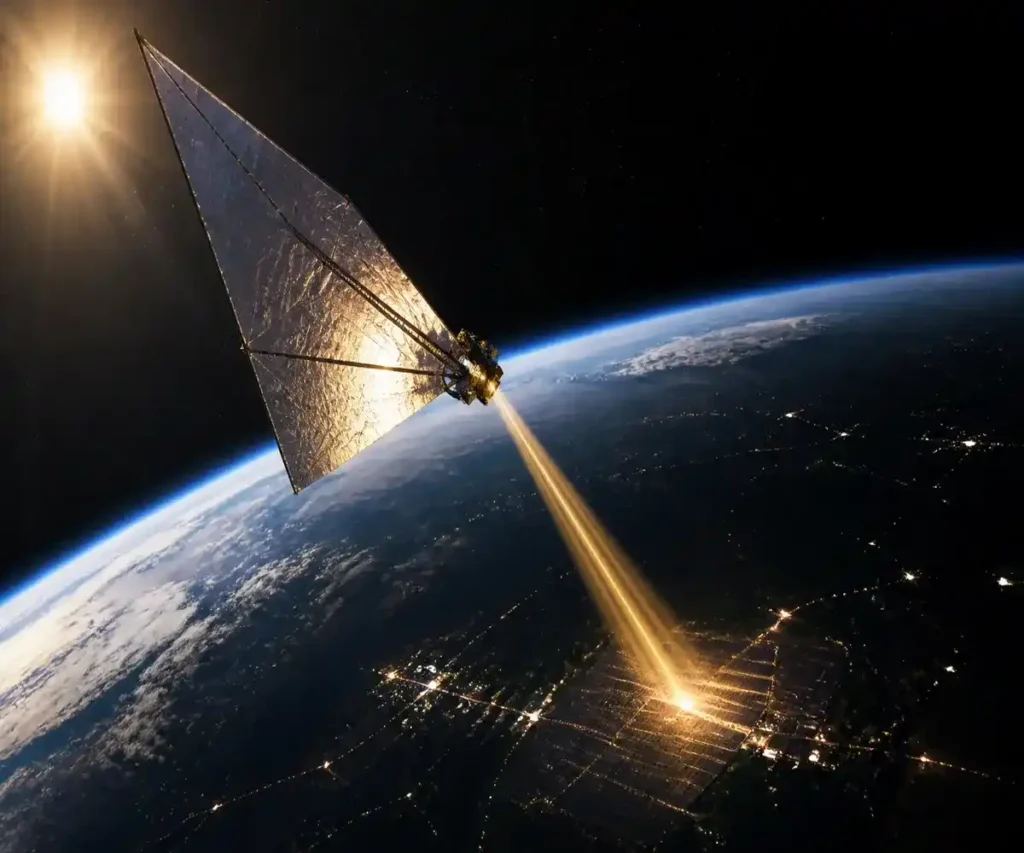
Solar energy has one major limitation that technology companies have struggled to overcome: sunlight disappears when the sun sets. Batteries can store electricity generated during the day, but California-based Reflect Orbital is exploring a very different solution. The startup wants to place large, deployable mirrors in low Earth orbit and use them to redirect sunlight towards specific locations on the planet after sunset. The company announced $73.5 million in new funding on November 10, 2026, taking its total funding beyond $100 million. Returning investors Sequoia Capital, Lux Capital and Starship Ventures participated alongside new investors including Buckley Ventures, Convective Capital, The Uncommon Group and Salesforce Ventures. The capital will support satellite launches, reflector engineering and commercial partnerships across energy and lighting. Rather than building another solar panel or battery, Reflect Orbital is attempting to create an entirely new category of space-based infrastructure.
Turning satellites into mirrors for the Earth
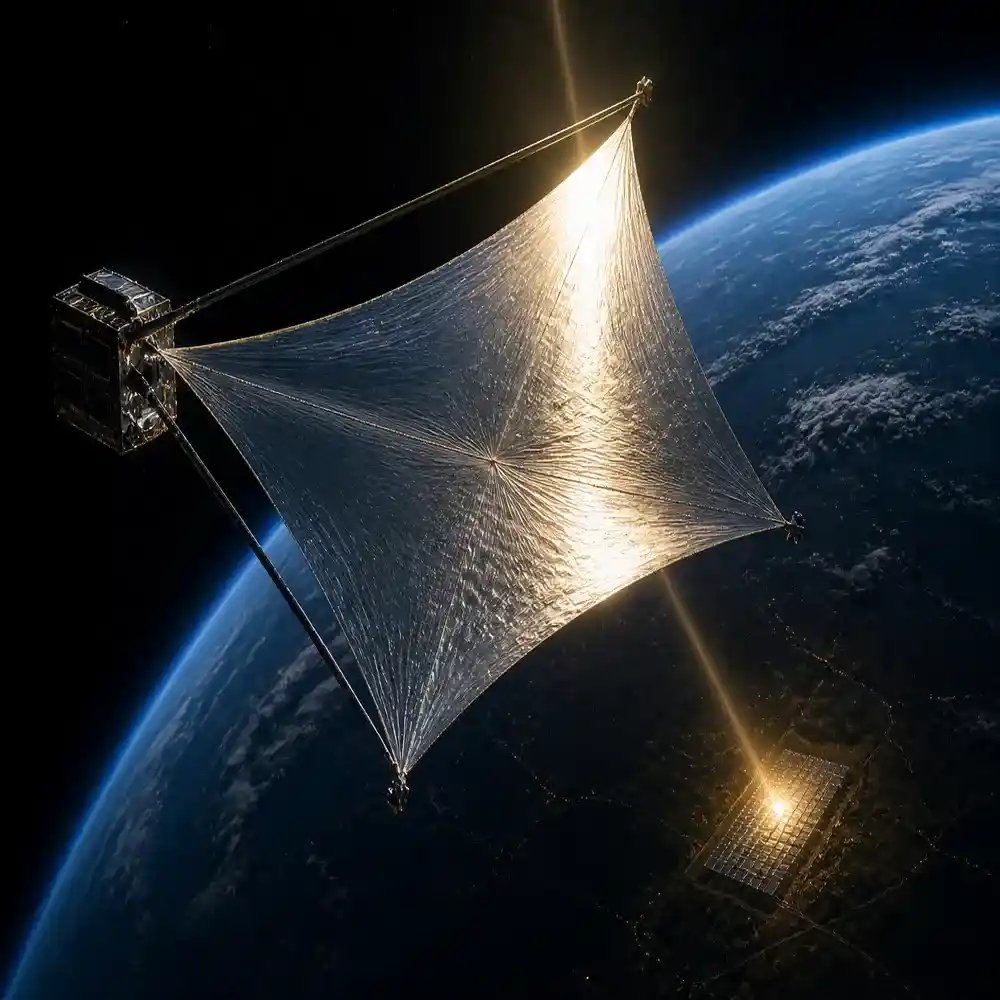
Reflect Orbital’s concept is relatively simple to understand. Its satellites carry large reflective surfaces that unfold in orbit and redirect sunlight towards a selected area on Earth. A solar farm receiving this additional light could potentially continue generating electricity after sunset, while remote locations could receive temporary illumination without installing conventional lighting infrastructure. The company’s system is designed to make the reflected light controllable, allowing customers to request illumination for approved locations and specific periods. Its proposed applications include disaster response, search-and-rescue operations, construction sites, agriculture and industrial facilities. The important distinction is that these satellites do not generate electricity themselves or transmit power through lasers. They redirect naturally available sunlight, while solar panels and other equipment on the ground perform the actual energy conversion.
The engineering challenge is building enormous mirrors that can survive in orbit
Making the idea work requires solving a difficult spacecraft engineering problem: deploying a large, lightweight and sufficiently flat reflective surface in space. Reflect Orbital uses extremely thin reflective film supported by deployable structures that unfold and hold the mirror under tension. According to the company, its reflector quadrants are approximately 28 times thinner than a human hair and can fold down to the size of a shoebox before deployment. A four-boom structure helps tension the reflective material so it can function as a large orbital mirror. The company also says it is building complete satellites containing approximately 12,000 components on a two-month production cycle. These manufacturing milestones show that Reflect Orbital is developing more than an interesting space concept; it is trying to create a repeatable satellite production process. However, the most important proof will come when the reflectors successfully deploy and operate in orbit.
Its first missions are designed to prove the technology step by step
Reflect Orbital is taking a phased approach rather than immediately deploying a large satellite constellation. Its October 2026 update introduced Eärendil-0, a developmental spacecraft designed to test satellite control, communications and operational systems. The company filed an FCC application for this spacecraft, with launch planned no earlier than April 2027; importantly, Eärendil-0 will carry no orbital reflector. Separately, the company says its first reflector demonstration mission, Eärendil-1, has received FCC approval and is expected in the second quarter of 2027. The mission will collect data on reflector deployment and performance in low Earth orbit. Reflect Orbital has also purchased two dedicated launches from India’s Skyroot Aerospace, adding launch capacity to its future deployment plans. These missions matter because the company has not yet demonstrated a commercial orbital sunlight service.

Solar farms are only one part of the commercial opportunity
Reflect Orbital is positioning its technology as an on-demand lighting and energy service rather than limiting its business to electricity generation. For solar farms, the opportunity is to add illumination during periods when panels would otherwise receive little or no sunlight. For emergency services, reflected light could help search-and-rescue teams operate in remote areas after dark. Construction companies, industrial operators and agricultural businesses represent other possible customers. The company already offers a product concept built around adjustable illumination, defined service locations and the ability to switch reflected light off when it is no longer required. Its commercial challenge will be demonstrating that these services deliver enough practical value to justify the cost of manufacturing satellites, launching them and maintaining a reliable orbital fleet. It must also prove that the additional energy delivered to solar farms is competitive with established alternatives such as battery storage.
The physics and economics still present major challenges
The biggest question is whether orbital reflectors can deliver enough useful light to Earth at a commercially attractive cost. Sunlight spreads as it travels from a satellite towards the surface, so the illuminated area becomes large and the light becomes less concentrated. Research by Monash University astrophysicist Michael Brown has highlighted the scale of the problem: based on a 54-metre reflector design and a low Earth orbit, his calculations estimated that approximately 3,000 satellites would be needed to deliver around 20% of midday sunlight to a target area for a short period. A satellite also moves rapidly across the sky, limiting how long it can illuminate a particular location during one pass. These calculations are based on specified design assumptions rather than a completed commercial system, but they demonstrate why satellite count, reflector size, orbit, launch costs and operating time will determine the economics. The technology must prove that it can deliver meaningful additional energy more efficiently than alternatives such as grid-scale batteries.
Light pollution and astronomy could become major obstacles
Reflecting sunlight towards the night side of Earth introduces environmental questions that ordinary satellite companies do not face in the same way. Astronomers have warned that bright orbital mirrors could interfere with telescope observations, while additional artificial illumination could affect wildlife and natural night-time cycles. The American Astronomical Society petitioned the FCC against the proposed test satellite, and dark-sky organisations subsequently requested reconsideration of its approval. Reflect Orbital says it intends to address these concerns through predictable operating schedules, advance satellite-position information, exclusion zones around observatories and protected locations, and the ability to dim or redirect light. Its published approach also promises environmental assessments and engagement with independent researchers. These safeguards are important, but their effectiveness still needs to be demonstrated using real orbital data and independent scientific evaluation.
Reflect Orbital is betting that space infrastructure can become part of the energy industry
Founded by Ben Nowack and Tristan Semmelhack in 2021, Reflect Orbital is pursuing a business model that sits between the space industry and the global energy market. Its $73.5 million financing gives the company additional resources to develop its reflectors, secure launches and build partnerships, but it does not mean the technology is already commercially proven. The next major milestones are successful spacecraft deployment, reliable communications, accurate sunlight redirection, measurable ground-level illumination and evidence that customers are willing to pay for the service. If those tests succeed, orbital mirrors could introduce a new option for temporary lighting and potentially supplement solar generation under specific conditions. If the engineering, energy economics or environmental challenges prove too difficult, large-scale deployment could remain out of reach. Reflect Orbital has attracted substantial investor capital to pursue an unusual idea; the real test will be whether it can turn sunlight from space into a reliable service on Earth.
Sources and further reading
- Reflect Orbital – Official $73.5M Funding Announcement
- Reflect Orbital – Eärendil-0 Mission and Testing Plans
- Reflect Orbital – Two Dedicated Skyroot Aerospace Launches
- Reflect Orbital – Technology, Safety and Deployment Approach
- Reflect Orbital – Founders and Engineering Team
- ABC News – Can Reflect Orbital Sell Sunlight from Space?
- Science News – Space Mirrors and the Night Sky Debate
- Monash University – The Physics and Feasibility of Orbital Reflectors