

Inside the founder logic reshaping how AI companies finance intelligence
Sam Altman’s role at OpenAI increasingly reflects a structural shift in AI: frontier founders are designing capital stacks alongside products. The discussions around a potential $100B OpenAI financing round signal the emergence of infrastructure-first AI funding, where compute capacity, data centers, and long-term supply commitments are secured years before demand fully materializes.
AI funding has historically followed product cycles. Build a model, attract users, raise capital, scale infrastructure later. That sequence is breaking.
From his early work scaling startups through Y Combinator to leading OpenAI’s transition from research lab to infrastructure platform, Sam Altman has increasingly operated at the intersection of capital and computing capacity.
The fundraising discussions around OpenAI and CEO Sam Altman — a potential $100B round at valuations exceeding $850B — mark a structural shift in how frontier AI companies finance compute, data centers, and long-term infrastructure capacity. Capital is no longer supporting growth. It is pre-allocating infrastructure years in advance.
At the center of that shift sits Sam Altman, whose founder role increasingly resembles an infrastructure allocator rather than a product CEO.
This is not a funding event. It is a financing architecture.
The Founder Thesis: Intelligence Is Constrained by Compute
Altman’s operating belief has remained consistent: AI progress is limited less by algorithms than by access to compute, energy, and data center capacity. That assumption explains the scale of the round under discussion.
Reports indicate:
- Potential raise exceeding $100B
- Pre-money valuation around $730B
- Post-money valuation possibly surpassing $850B
- Strategic investors including Amazon, SoftBank, Nvidia, and Microsoft
The structure matters more than the numbers. The capital appears tied directly to chip procurement, cloud commitments, and long-term infrastructure deployment. In founder terms, this converts fundraising into capacity reservation.
Critically, this reflects a deliberate founder trade-off: prioritizing supply certainty and infrastructure dominance over short-term profitability optimization.
From Startup CEO to Infrastructure Orchestrator
Earlier AI founders optimized model benchmarks. Altman is optimizing supply chains. Unlike earlier AI founders focused primarily on model breakthroughs, Altman is prioritizing supply certainty — positioning capital allocation itself as a competitive layer. This mirrors how AI capital is shifting toward infrastructure rather than application velocity.
The shift reflects a broader reclassification of AI companies from software vendors to capacity allocators.
The proposed round reflects three coordinated layers:
- Compute access — securing GPUs and custom chips
- Cloud capacity — long-term hyperscaler commitments
- Capital partners — suppliers investing directly into demand
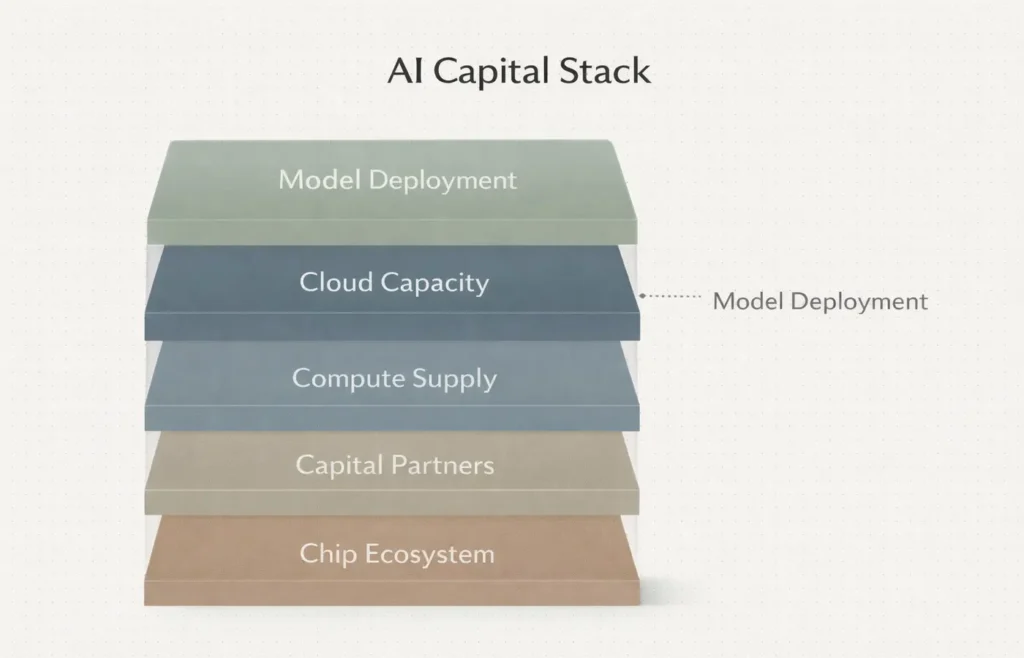
This creates a circular but strategic structure: suppliers fund the company that purchases their infrastructure. That model compresses the traditional timeline between innovation and industrialization.
Why Nvidia’s Role Signals Structural Change
The potential $30B investment from Nvidia, replacing an earlier complex $100B framework, illustrates the evolution of AI partnerships. Chip suppliers are no longer neutral vendors. This dynamic is already visible across enterprise AI infrastructure competition where supplier relationships increasingly define platform leverage. They are equity participants in model development.
This changes incentives:
- Demand visibility improves
- Hardware roadmaps align with model scaling
- Infrastructure risk shifts from startup to ecosystem
The founder becomes the coordinator of these dependencies. Historically, that role belonged to governments or telecom operators. AI founders are now occupying it.
In practice, equity participation from chip suppliers can translate into priority allocation, co-designed hardware roadmaps, and synchronized deployment timelines. These arrangements reduce supply uncertainty while accelerating model scaling cycles, turning supplier relationships into embedded infrastructure partnerships.
The Multi-Tranche Funding Logic
Unlike traditional venture rounds, the OpenAI financing appears structured across phases. Phase one emphasizes strategic corporate investors. Later phases may include venture firms and sovereign wealth funds.
This staggered model serves a founder objective: match capital inflow to infrastructure build cycles rather than growth milestones.
In effect, Altman is financing gigawatts, GPU supply chains, and compute access rather than product features.
In practice, this allows OpenAI to lock multi-year GPU supply, secure data center energy capacity, and coordinate hyperscaler buildouts before demand fully materializes. This aligns with AI control planes emerging as governance infrastructure that sit between model capability and enterprise deployment.
Ads, Profitability, and the Capital Trade-Off
The timing of the raise coincides with experimentation around monetization, including advertising tests inside ChatGPT. That juxtaposition reveals a founder tension.
Operational revenue improves sustainability, yet infrastructure scale still requires external capital measured in tens of billions. Altman’s strategy suggests profitability is a constraint to manage, not the primary objective. Market position is.
This mirrors earlier platform cycles where leaders prioritized capacity dominance before margin optimization.
Founder Psychology: Designing for Irreversibility
Large infrastructure commitments create path dependence. Once compute clusters, energy contracts, and data centers are secured, competitors face structural disadvantages rather than feature gaps.
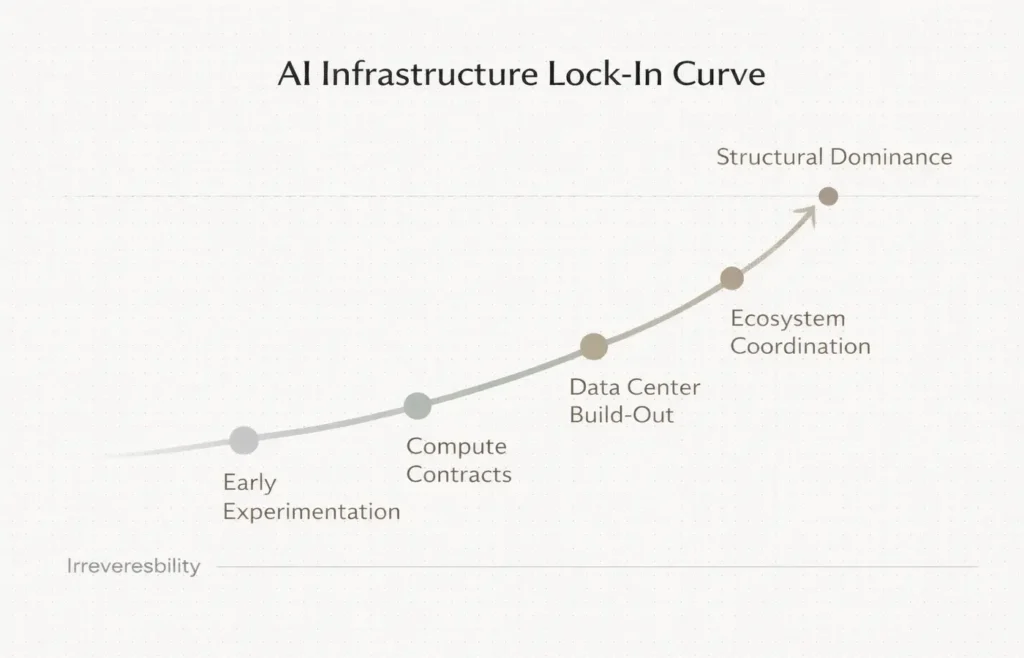
The founder decision is therefore less about growth speed and more about making the trajectory difficult to reverse. Altman’s approach reflects this psychology. The funding round is less about extending runway than locking ecosystem positioning.
In that sense, the founder decision is less about scaling a company and more about selecting an industrial trajectory.
Infrastructure commitments effectively narrow future strategic flexibility, meaning early capital decisions begin to define competitive boundaries years before product differentiation becomes visible.
The Contrarian Insight: Capital May Be the Real Model
Public narratives frame AI competition around architectures and benchmarks. The financing structure suggests a different layer. The companies that control capital allocation to infrastructure may shape which models can exist at scale.
If compute access determines capability ceilings, capital becomes an input to intelligence rather than a consequence of it. That reframes founders like Altman as capital architects.
The model is software. The moat is financing. This structure also concentrates systemic risk, because infrastructure-heavy financing increases exposure to demand cycles, regulatory shifts, and hardware supply shocks that software-led models historically avoided.
Ecosystem Implications
The round’s composition signals deeper industry convergence. Cloud providers, chip makers, sovereign funds, and venture firms are participating in the same infrastructure layer. The coordination is unfolding inside a fragmenting global AI infrastructure landscape shaped by sovereign compute priorities.
This produces several structural effects:
- Supplier relationships become strategic alliances
- Funding cycles synchronize with hardware roadmaps
- Model companies gain quasi-utility characteristics
- Valuation reflects capacity ownership rather than revenue multiples
AI companies begin to resemble infrastructure platforms rather than software startups.
This shift places Altman alongside a small group of frontier founders — including those building sovereign AI stacks and hyperscale model platforms — whose competitive advantage increasingly depends on capital coordination rather than product differentiation alone.
Why This Founder Moment Matters
Technology history contains inflection points where founders redefine how companies are financed. Semiconductors required capital intensity. Telecom required spectrum. Cloud required data centers.
AI now requires coordinated infrastructure funding at unprecedented scale.
Altman’s strategy suggests future frontier founders will need capital strategy alongside technical strategy from day one. The boundary between founder and allocator is dissolving.
The Forward Signal
The defining constraint of frontier AI is shifting from intelligence scarcity to infrastructure scarcity.
If the round closes near reported levels, it will establish a new template for frontier AI companies. Fundraising becomes infrastructure pre-commitment. Partnerships become supply guarantees. Valuation reflects ecosystem gravity.
The question is no longer how quickly models improve. It is how quickly capacity compounds.
The founder shaping that transition is not merely building an AI company. He is designing the financing layer that determines how AI scales.
Research Context: Synthesizes reporting from Bloomberg, Reuters, Financial Times, and industry disclosures on OpenAI’s ongoing mega-round discussions, investor composition, and infrastructure strategy.
Editorial Note: This article reflects independent analysis of founder strategy and capital architecture shaping frontier AI infrastructure.