
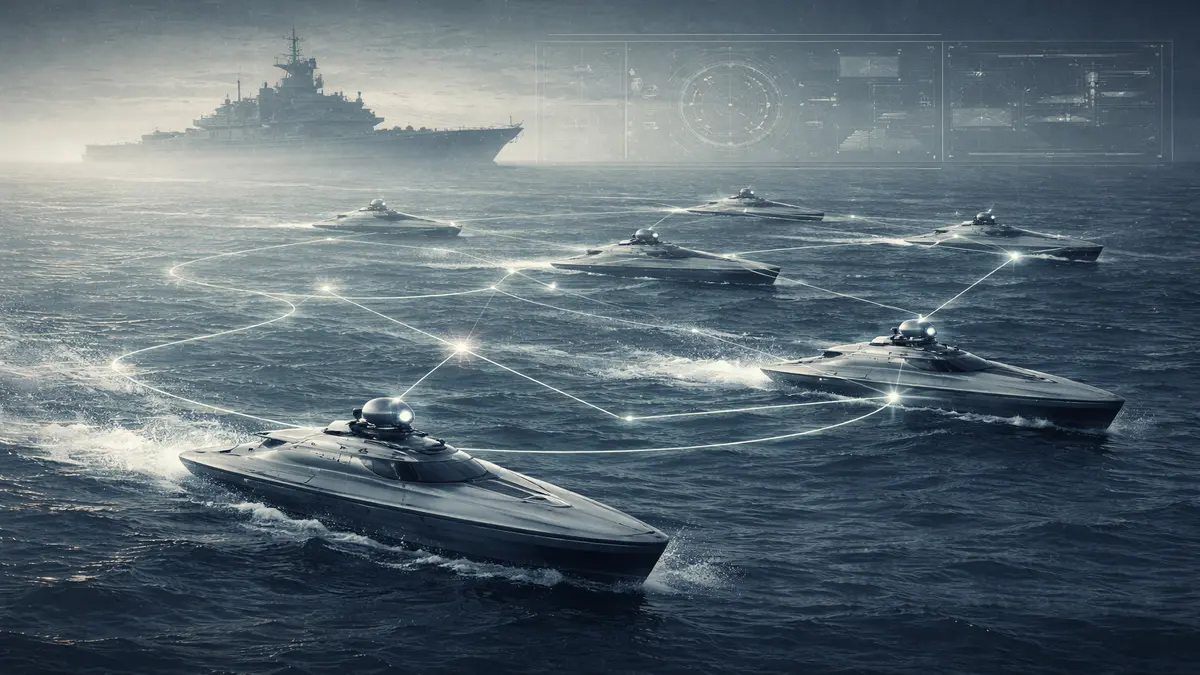
Saronic isn’t building ships. It is rebuilding how naval power is produced, deployed, and scaled.
Saronic Technologies, an Austin-based defense-tech startup building autonomous surface vessels (ASVs), has raised $1.75 billion in a Series D round at a $9.25 billion valuation — positioning itself at the center of a rapidly emerging category where AI, hardware, and manufacturing converge into a new class of military infrastructure.
With backing from Kleiner Perkins, Andreessen Horowitz, 8VC, and Bessemer Venture Partners, the round signals more than capital expansion. It marks a structural shift in defense technology: from slow, capital-intensive shipbuilding toward software-defined, rapidly deployable autonomous fleets.
This is not incremental innovation. It is industrial reinvention at the warfare layer, building on the broader transition toward autonomy infrastructure outlined in Shield AI’s $2B Raise — The Autonomous Warfare Stack Scaling From Simulation to Reality.
The Category Shift: From Warships to Autonomous Fleets
For decades, naval power has been defined by large, manned vessels that require billions of dollars and nearly a decade to design and deploy, creating structural bottlenecks in both cost and speed.
Saronic operates on a fundamentally different model.
Instead of building fewer, more expensive ships, it builds:
- autonomous surface vessels (ASVs)
- modular, software-defined systems
- rapidly deployable fleets
- AI-coordinated swarm architectures
This shifts naval strategy from: platform-centric → network-centric warfare
Where value is no longer concentrated in individual ships, but in coordinated fleets of intelligent, autonomous systems — a transition aligned with broader AI-driven system architectures seen in Apptronik and the Rise of Physical AI Systems.
The Product Stack: A Full Spectrum Autonomous Fleet
Saronic’s advantage is not a single vessel. It is a family of systems designed to operate across mission profiles and scale dynamically based on operational requirements.
Key platforms include:
- Spyglass (6-ft): modular reconnaissance unit
- Cutlass (14-ft): versatile operational platform
- Corsair (24-ft): production-scale vessel (already under a $392M Navy contract)
- Mirage (40-ft) & Cipher (60-ft): extended range + payload capacity
- Marauder (150–180-ft): medium unmanned surface vessel (MUSV) designed for long endurance and large-scale deployment
This layered architecture enables:
- intelligence, surveillance, reconnaissance (ISR)
- mine countermeasures
- distributed maritime operations
- swarm-based tactics
The system is not a product line. It is a fleet architecture.
The Core Engine: AI as Command Infrastructure
At the center of Saronic’s system is its proprietary Echelon platform, a unified command-and-control layer that transforms individual vessels into a coordinated autonomous network.
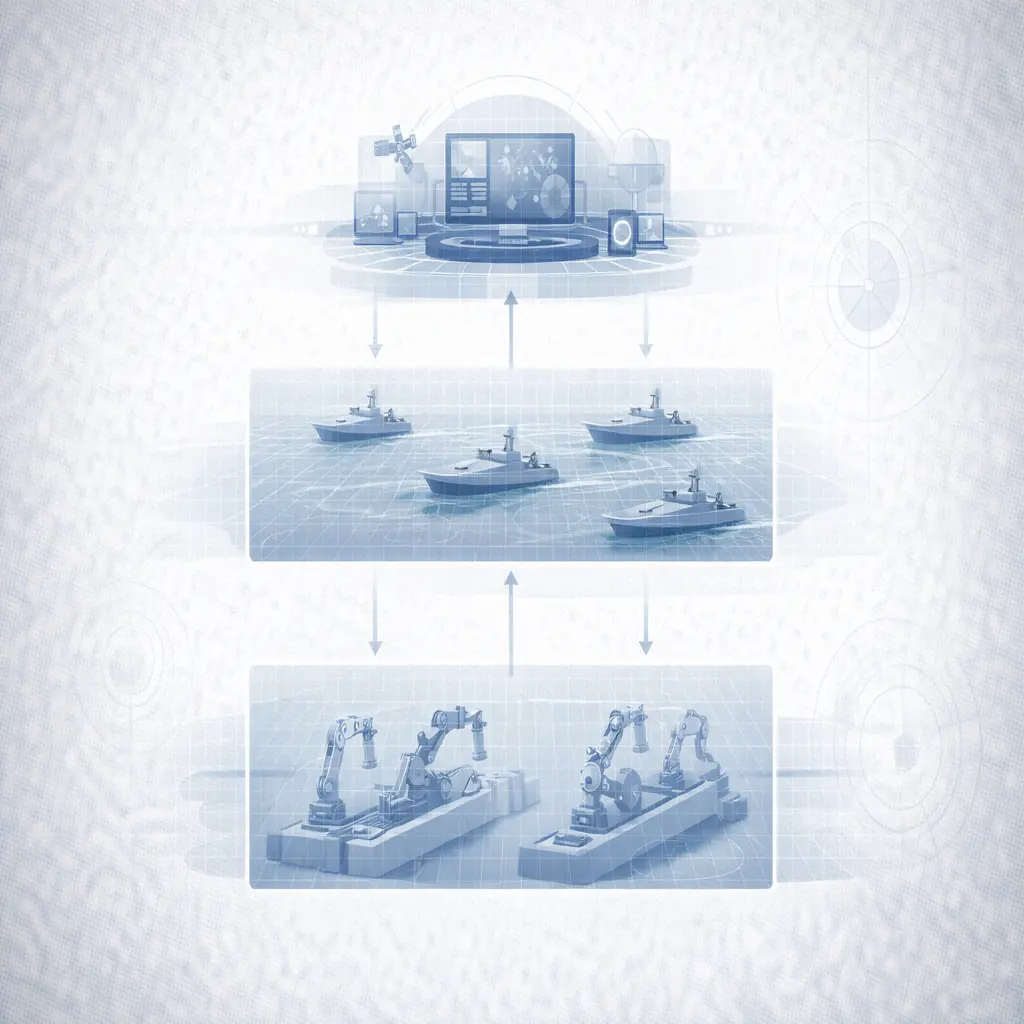
Echelon enables:
- one-to-many control (single operator → dozens of vessels)
- real-time mission planning and execution
- high-fidelity simulation using digital twins
- autonomous operation in GPS- or communication-denied environments
Powered in part by NVIDIA infrastructure, the system combines onboard edge AI with centralized orchestration, allowing vessels to operate independently while still contributing to coordinated mission outcomes.
This is not automation. It is distributed autonomy at scale, reflecting the same control-layer evolution described in Dash0 Hits $1B — Why AI Observability Is Becoming a Control Layer.
The Manufacturing Layer: Shipyards as AI Infrastructure
Saronic’s differentiation extends beyond software into manufacturing, where it is building vertically integrated production systems designed to compress timelines that historically defined defense procurement.
Key moves include:
- acquisition and expansion of a Louisiana shipyard
- development of Port Alpha, a next-generation AI-driven shipyard
- target output of 20+ large vessels annually by 2027
- mass production of smaller ASVs at scale
The result is a radically different production model: years → months
The first Marauder-class vessel, for example, is expected to be built in under a year — a pace not seen in U.S. shipbuilding since World War II.
The Competitive Landscape: A New Defense Stack Is Forming
Saronic is not alone.
A new class of defense startups is emerging, each targeting different layers of the autonomous warfare stack:
- Anduril Industries → autonomous defense systems + surveillance
- Shield AI → AI pilots + aerial autonomy
- Saildrone → ocean data + surveillance platforms
The competitive divide is becoming clear:
- platform builders → hardware-first systems
- AI autonomy players → software-first systems
- integrated players (Saronic) → hardware + software + manufacturing
Saronic’s positioning sits at the deepest layer: end-to-end maritime autonomy infrastructure
That positioning matters. Because infrastructure layers, not point solutions, tend to dominate over time — a pattern also visible in Why AI Infrastructure Is Becoming the Core Battleground.
Why Capital Is Flooding Into Defense Now
The $1.75B round reflects a broader capital reallocation toward defense technology, driven by geopolitical tension and the need for faster, more adaptable military systems.
Three forces are converging:
1. China’s Shipbuilding Dominance
The U.S. faces structural disadvantages in traditional ship production timelines and costs.
2. The “Replicator” Doctrine
The Pentagon is prioritizing cheap, attritable autonomous systems over large, expensive platforms.
3. AI + Hardware Convergence
Advances in AI now allow physical systems to operate autonomously in complex, real-world environments.
Saronic sits at the intersection of all three, within the broader geopolitical AI fragmentation discussed in The Global AI Map Is Fragmenting — Who Controls the Next Layer of Intelligence.
The Founder Layer: Operator-Led Execution
Founded by Dino Mavrookas, a former Navy SEAL Team Six operator, Saronic reflects a broader pattern in defense startups where founders combine operational experience with technical execution.
This matters.
Because defense infrastructure is not just a technology problem. It is an operational systems problem.
The Constraint Layer
The opportunity is significant, but the constraints are equally structural.
- scaling AI in unpredictable ocean environments
- regulatory and military certification hurdles
- integration with existing naval systems
- competition from both startups and legacy defense primes
Most critically: Autonomous systems must prove reliability under real-world combat conditions.
The Structural Shift: From Ships to Systems
Saronic represents a broader transition in defense:
Old model:
- large ships
- long timelines
- centralized capability
New model:
- autonomous fleets
- rapid production
- distributed capability
This is not a product shift. It is a doctrine shift.
What Saronic Is Actually Building
Saronic is not building unmanned vessels.
It is building: a software-defined naval layer
Where:
- fleets replace individual ships
- AI replaces manual coordination
- manufacturing becomes scalable infrastructure
This changes how naval power is created.
Editorial Close
For decades, military advantage was defined by who could build the biggest ships. The next decade will be defined by who can deploy the most adaptive systems.
Because in modern warfare:
Speed matters.
Scale matters.
Coordination matters.
Saronic is building at that intersection. Quietly. But structurally.
Research Context
Based on company disclosures, CNBC and Reuters reporting, defense procurement trends, and analysis of emerging AI-driven military infrastructure systems.
Editorial Note
This article reflects independent analysis of publicly available information and broader structural shifts in defense technology and AI-driven warfare systems.