
Shield AI isn’t just raising capital. It is building the operating system for autonomous warfare.
Shield AI, the defense AI startup behind the Hivemind autonomy platform, has raised $2 billion at a $12.7 billion post-money valuation while simultaneously acquiring simulation leader Aechelon Technology — signaling a structural shift in defense systems from hardware-defined platforms to software-defined, AI-driven autonomy stacks. The round, led by Advent International and co-led by JPMorganChase, represents one of the largest capital infusions in defense-tech history and positions Shield AI at the center of a rapidly emerging category: autonomous military infrastructure.
This is not just a funding round. It is a stack expansion moment.
The Strategic Move: Capital + Simulation + Autonomy
Shield AI’s announcement combines three critical elements that rarely converge at this scale:
- $2 billion in capital
- acquisition of Aechelon Technology
- expansion of the Hivemind autonomy platform
Individually, each of these signals growth. Together, they signal category formation.
Because modern defense systems are no longer being defined by individual platforms like aircraft or drones, but by integrated stacks where software, simulation, and real-world deployment operate as a continuous loop.
Shield AI is building that loop — a pattern increasingly visible across AI systems where execution layers replace isolated tools, as seen in Why AI Is Replacing Dental Front Desks — Inside Patientdesk’s Execution-Layer Bet.
The Core Insight: Warfare Is Becoming Software-Defined
For decades, defense innovation was hardware-first, with software playing a supporting role layered on top of physical systems that were expensive, slow to iterate, and difficult to scale.
That model is breaking.
The new paradigm is emerging around:
- AI-driven autonomy
- simulation-first development
- continuous software iteration
In this system, the aircraft matters less than the intelligence controlling it.
Shield AI’s core thesis reflects this shift:
Defense systems will be built in software, trained in simulation, and refined through real-world deployment.
That is a fundamentally different architecture.
Hivemind: The Operating System for Autonomous Systems
At the center of Shield AI’s strategy is Hivemind, its autonomy software platform that enables vehicles to operate without GPS, communications, or human pilots in contested environments.
This is not experimental technology.
Hivemind has already been deployed across:
- F-16 fighter jets
- UAVs
- helicopters
- multiple autonomous platforms
More than 26 vehicle classes.
That matters.
Because most AI systems remain in controlled environments. Hivemind operates in real-world combat conditions — aligning with the broader shift from model capability to real-world execution systems highlighted in The Next AI Breakthrough Is Expertise, Not Just Models.
The Acquisition: Why Aechelon Changes the Equation
The acquisition of Aechelon Technology introduces a critical missing layer:
high-fidelity simulation infrastructure
Aechelon’s systems are used in:
- U.S. military pilot training
- advanced aircraft testing
- Pentagon’s Joint Simulation Environment (JSE)
This is where the strategic shift becomes clear.
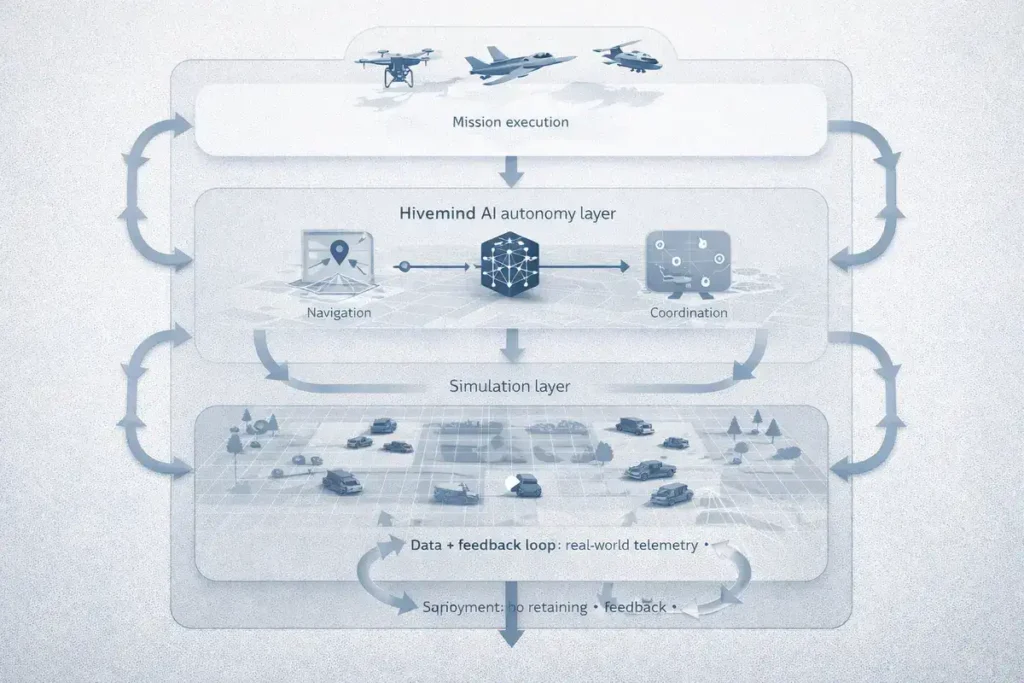
By integrating Aechelon, Shield AI creates a closed-loop system:
- simulation → training → deployment → feedback → retraining
This dramatically accelerates development cycles.
Not months. Not years. Continuous iteration.
The Flywheel: Simulation + Autonomy
This combination creates a powerful flywheel:
- Simulate complex environments
- Train AI agents at scale
- Deploy in real-world missions
- Capture operational data
- Feed back into simulation
Repeat.
This is how modern AI systems improve. And now it is being applied to defense — mirroring the broader infrastructure flywheel logic emerging across AI stacks as outlined in The AI Infrastructure Split — Who Controls the Next Layer of AI.
Why Investors Are Paying Up
The $12.7 billion valuation reflects more than current revenue.
It reflects positioning inside a future-defining layer of defense infrastructure.
Investors are underwriting several key dynamics:
1. Autonomy as the Next Defense Layer
Military advantage is shifting from hardware superiority to intelligent, autonomous systems.
2. Software-Like Economics in Defense
Hivemind introduces licensing, recurring revenue, and high-margin software dynamics into a traditionally hardware-heavy sector.
3. Global Demand for Autonomous Systems
From Ukraine to the Indo-Pacific, modern conflicts are accelerating demand for:
- attritable drones
- autonomous aircraft
- AI-driven decision systems
4. Program-of-Record Momentum
Shield AI’s inclusion in the U.S. Air Force’s Collaborative Combat Aircraft (CCA) program signals institutional validation at the highest level.
The Market Shift: From Platforms to Systems
The defense industry is undergoing a structural transition.
Old model:
- platform-centric (jets, drones, hardware)
New model:
- system-centric (AI + software + simulation + deployment)
Shield AI sits at the center of this transition.
It is not building a drone company. It is building a defense AI system layer — similar to how control layers are emerging across enterprise AI systems, as seen in Dash0 Hits $1B — Why AI Observability Is Becoming a Control Layer.
The Business Model Transition
Historically, defense companies scaled through large hardware contracts with long development cycles and limited iteration once deployed.
Shield AI is shifting toward:
- software licensing (Hivemind)
- OEM integrations with defense primes
- recurring revenue streams
- continuous system upgrades
This changes unit economics.
From one-time sales → to compounding revenue.
The Competitive Landscape
Shield AI is not operating alone.
It is part of a new wave of defense-tech companies including:
- Anduril
- Palantir
- emerging autonomy startups
But its positioning is distinct.
Where others focus on platforms or analytics, Shield AI focuses on:
autonomy as a system layer
That distinction matters.
Because the company that controls autonomy controls how every platform behaves.
The Constraint Layer
The opportunity is massive. The risks are equally structural.
- execution risk at scale
- dependency on government contracts
- hardware + software integration complexity
- competition from vertically integrated defense players
Most critically:
Autonomy must work reliably in real-world conditions.
Because failure is not theoretical.
It is operational.
Why This Matters Now
This is not just a company milestone. It reflects a broader shift in how military systems are being built, deployed, and scaled.
The next generation of defense will not be defined by:
- faster jets
- larger fleets
It will be defined by:
smarter, autonomous systems that operate independently at scale
The Structural Shift: From Hardware to Intelligence
The defense stack is being rewritten:
- hardware → platform
- software → control
- AI → autonomy
Shield AI operates at the autonomy layer.
That is where long-term leverage accumulates — reinforcing the broader trend of infrastructure layers capturing control across the AI stack, as explored in Neysa Is Building the Compute Backbone for AI Infrastructure.
What Shield AI Is Actually Building
Shield AI is not just a drone company or a defense contractor.
It is building:
the autonomy infrastructure layer for modern warfare
Where:
- systems learn in simulation
- deploy in real environments
- improve continuously
This is not a product.
It is a system architecture.
Editorial Close
The most important defense companies of the next decade will not be those that build the best hardware.
They will be the ones that control how that hardware behaves.
Because in modern warfare, intelligence is no longer just an advantage.
It is the system itself.
Shield AI is building inside that layer.
Quietly. But at scale.
Research Context
Based on company disclosures, Business Wire announcement, investor participation data, defense program signals, and analysis of emerging AI-driven autonomy systems.
Editorial Note
This article reflects independent analysis of publicly available information and structural shifts in defense technology and AI infrastructure.