
Subheadline: Jian Peng and Zhenping Zhu are combining AI-driven protein design with decades of biologics expertise—positioning Earendil Labs at the center of a structural shift from discovery-led biotech to execution-driven therapeutic systems.
The Founders Turning AI Into a Drug Production Engine
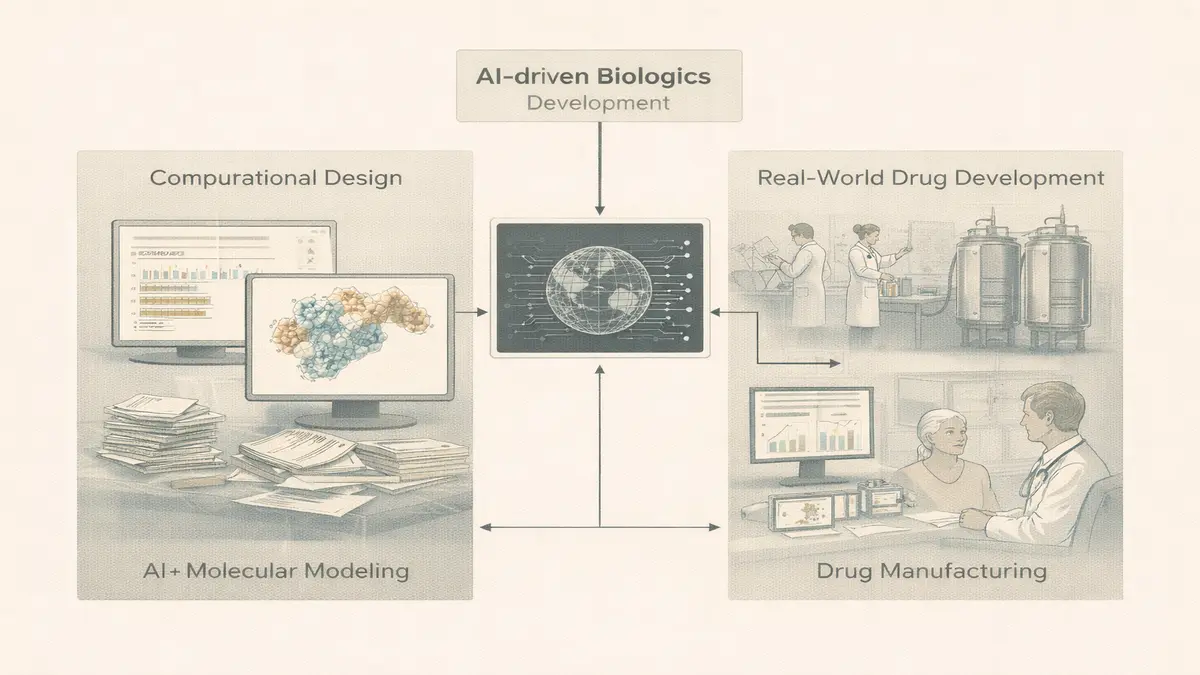
Earendil Labs, a US-based AI-native biotech platform operating in AI-driven biologics discovery and protein engineering, has raised $787 million to scale an end-to-end system for designing, optimizing, and manufacturing complex therapeutics—at a moment when AI is shifting from research augmentation to execution infrastructure inside drug development.
At its core, the company is not simply applying AI to biology.
It is restructuring how biologics are built.
This positions Earendil within a broader transition across the AI economy—one already visible in how AI capital is moving toward infrastructure and execution layers:
from model capability to system-level production control.
At the center of that shift are its two founders: Jian Peng, a computational biologist focused on protein modeling, and Zhenping Zhu, a veteran drug developer with decades of experience commercializing biologics.
Together, they represent a rare convergence:
the ability to design molecules computationally—and make them work clinically.
Two Backgrounds, One System
Earendil’s architecture is not accidental.
It is a direct extension of its founders’ asymmetry.
Peng’s work in machine learning and structural biology focused on predicting protein structure and function—problems that define the limits of modern drug discovery. His academic contributions positioned him at the frontier of computational biology, where models increasingly approximate biological systems.
Zhu operates on a different layer entirely. Across leadership roles at Novartis, ImClone, and Kadmon, he has translated biologics from concept to market—developing therapies such as Erbitux and Cyramza and shaping the evolution of antibody engineering.
Individually, these capabilities are common.
Integrated, they are not.
Their partnership collapses a historical gap in biotech:
the disconnect between computational insight and therapeutic delivery.
From Research Tool to Production Infrastructure
The central thesis behind Earendil is structural:
AI should not assist drug discovery. It should produce drugs.
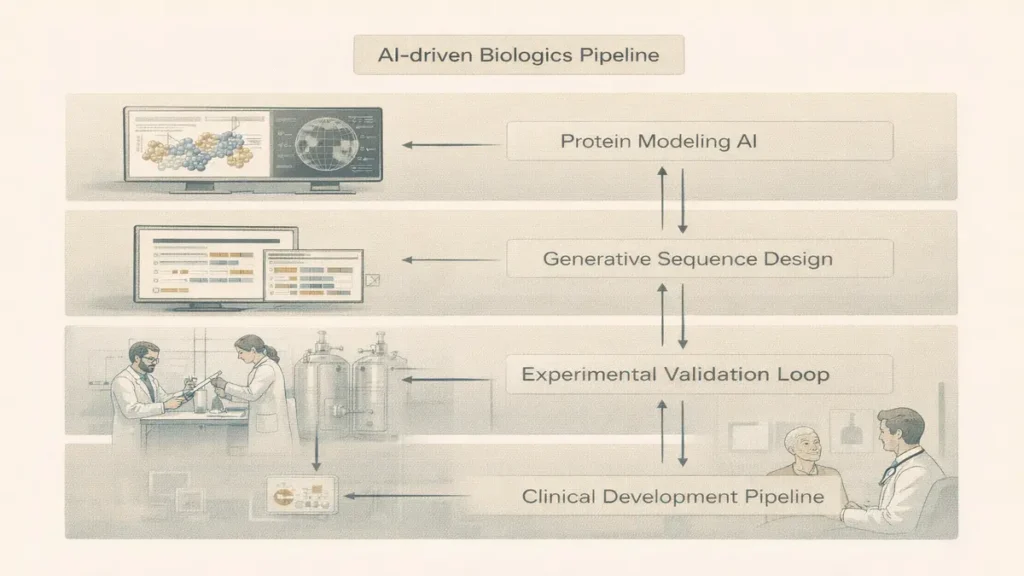
The platform integrates two tightly coupled systems:
- A foundational protein AI layer for predictive modeling, generative design, and multi-parameter optimization
- A high-throughput experimental system that continuously validates and feeds results back into the models
This creates a closed loop:
design → validate → refine → redeploy
The distinction is critical.
Most AI systems in biotech operate as decision-support layers.
Earendil is attempting to operate as an execution layer.
This mirrors a broader shift already unfolding across enterprise AI, where agentic systems are moving from interface to execution layers.
In under two years, this system has produced more than 40 programs, including a Phase 2-ready antibody and multiple partnered assets—compressing timelines that traditionally span a decade.
Why Biologics Became the Entry Point
Earendil’s focus on bispecific and multispecific antibodies is not just technical—it is strategic.
These molecules sit at the edge of current manufacturing and design constraints:
- High structural complexity
- Multi-dimensional optimization requirements
- Significant production challenges
This makes them difficult to scale—and therefore defensible.
AI changes the equation by enabling simultaneous optimization across:
- Structure
- Function
- Stability
- Manufacturability
This reframes complexity from a barrier into an advantage:
the harder the molecule, the stronger the moat.
This approach aligns with a broader pattern explored in how AI is reshaping enterprise infrastructure layers, where complexity becomes a defensible system advantage rather than a limitation.
Capital Is Following Execution, Not Just Discovery
The $787 million raise reflects a broader capital reallocation across both AI and biotech.
Investors are no longer funding discovery platforms in isolation.
They are backing systems that can convert discovery into deployable assets.
Earendil’s partnerships reinforce this shift:
- Sanofi (multi-billion-dollar collaboration pathways)
- WuXi Biologics (manufacturing scale)
- Nvidia (compute infrastructure alignment)
This creates a vertically integrated stack:
compute → design → validation → manufacturing → clinical pipeline
The implication is consistent with trends seen in AI valuation dynamics shifting toward infrastructure control:
AI in biotech is no longer evaluated on insight. It is evaluated on output.
The Competitive Landscape Is Splitting
The generative biology space is fragmenting into distinct system architectures.
- Generate Biomedicines → general-purpose protein generation at scale
- Absci → rapid design–validation iteration loops
- Earendil Labs → production-oriented biologics systems
Earendil’s differentiation lies in where it optimizes:
- Early manufacturability constraints
- Clinical translation readiness
- Complex antibody formats
This shifts competition away from model performance and toward system throughput.
Because in therapeutics:
speed of iteration matters less than success of translation.
The Constraint: Biology Still Moves Slower Than Software
Despite advances in AI, Earendil operates within an immutable constraint:
biology does not scale at the speed of compute.
- Clinical trials require time
- Regulatory processes impose friction
- Biological systems remain probabilistic
This creates an asymmetry:
AI accelerates design cycles exponentially.
But validation remains linear and constrained.
The companies that win will not be those with the best models,
but those that best align:
computational acceleration with biological reality.
Strategic Implications
For Founders
The next generation of AI companies will not be horizontal.
They will be:
deeply vertical, system-integrated, and execution-focused
The opportunity is not building tools.
It is owning outcomes inside complex systems.
For Investors
Capital is moving toward:
- Platforms with embedded execution
- Faster translation cycles
- Partnerships that reduce go-to-market friction
This is a shift from optional technology to essential infrastructure.
For Biotech
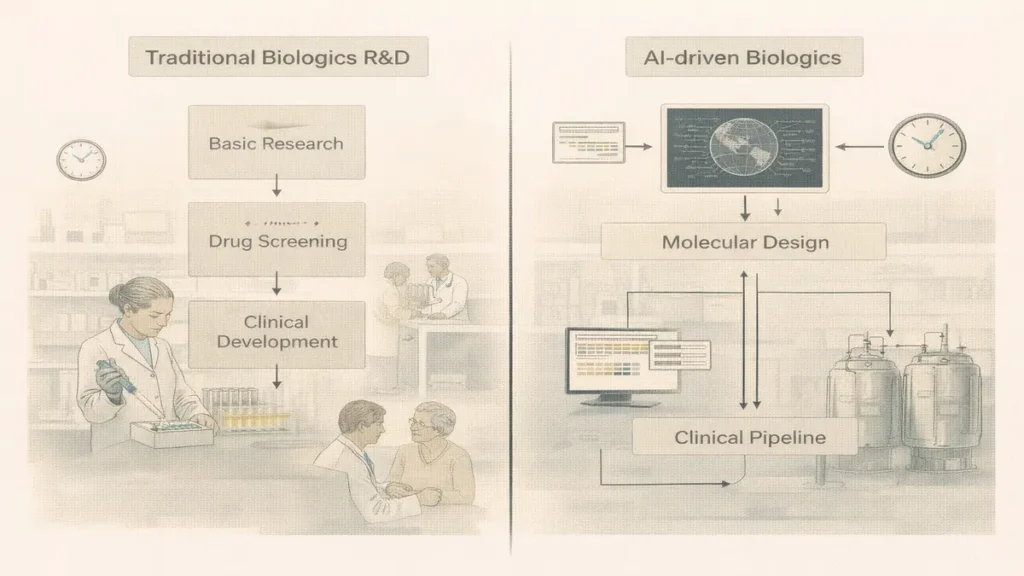
The traditional model—linear, fragmented, and capital-intensive—is being replaced by systems that are:
iterative, integrated, and computationally driven
System-Level Insight: The Real Moat Is Translation
The defining shift behind Earendil is not AI adoption.
It is value migration.
In biotech, defensibility is moving away from:
- Model accuracy
- Dataset scale
- Algorithmic novelty
Toward:
the ability to translate computation into clinical reality
This is the hardest layer to build—and the least replicated.
It is also where:
AI stops being a capability and becomes infrastructure.
Editorial Close
For decades, drug discovery has been constrained not by lack of ideas, but by the friction of turning those ideas into viable therapies.
AI promised acceleration.
Earendil’s founders are attempting something more structural:
to compress discovery, validation, and development into a single continuous system.
If successful, the implication extends beyond biotech.
It connects to a broader transformation already underway across AI systems:
where intelligence no longer supports production—
it becomes the system through which production happens.
Research Context: Synthesis of company disclosures, investor participation, founder profiles, academic research, and generative biology market dynamics as of March 2026.
Editorial Note: This article reflects independent analysis of publicly available information and broader AI and biotechnology ecosystem trends.