
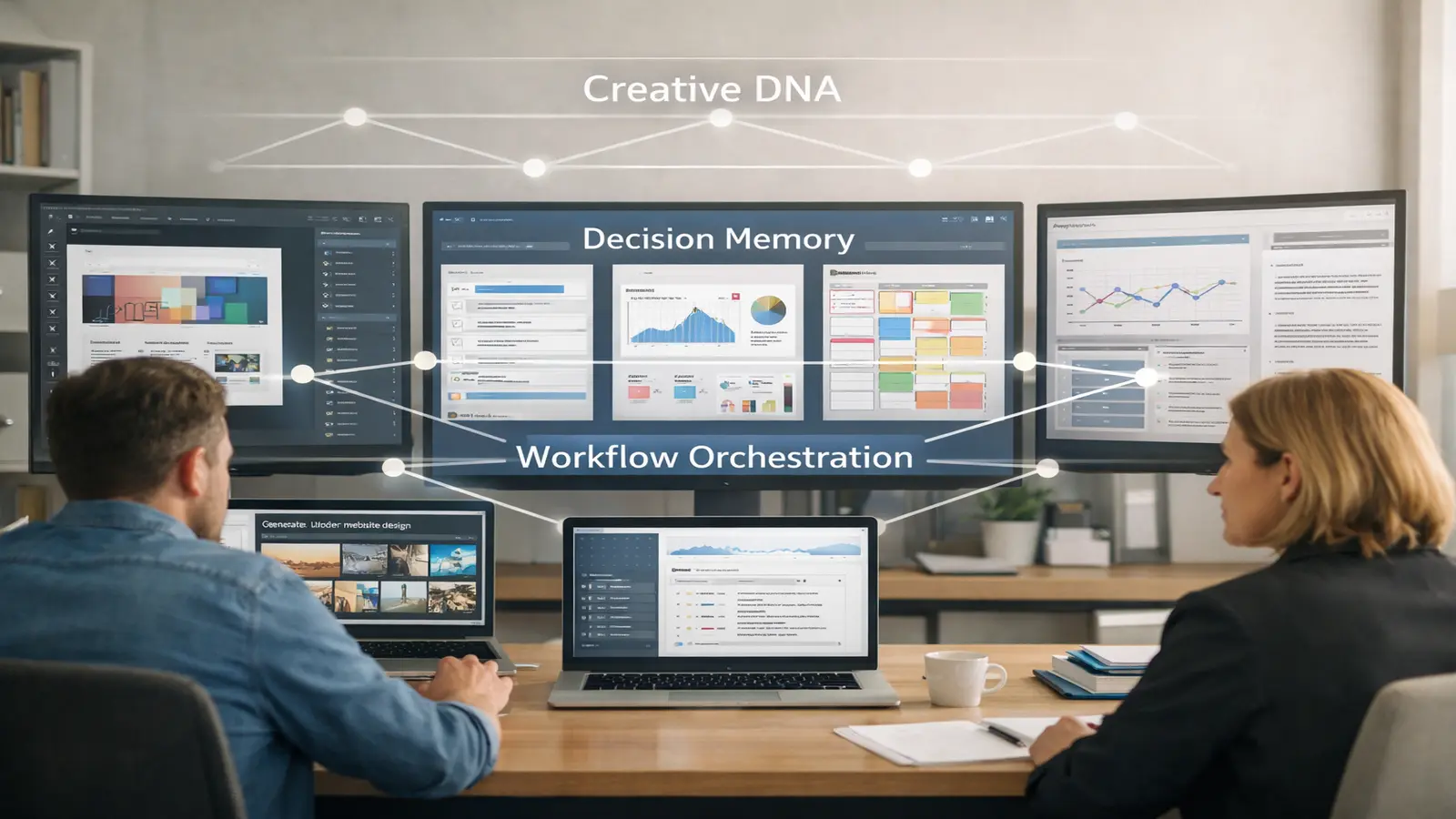
LONDON — March 17, 2026
Creative work is entering a new phase of artificial intelligence — one defined not by generation, but by control over how decisions are made, remembered, and executed.
First Concepts, a London-based AI infrastructure startup, is building a taste-aware AI workspace designed to structure creative workflows, preserve brand identity, and transform fragmented tools into a unified decision layer.
What is changing is not the capability of AI — but the layer at which it operates.
While first-generation AI tools optimized for output, this new class of systems operates at the workflow and decision layer — preserving brand identity, stylistic judgment, and creative memory over time.
The transition from generation to orchestration is already visible across enterprise AI, as explored in Inside the $3B AI Funding Wave Reshaping Infrastructure, Agents, and Robotics.
The underlying logic is straightforward:
AI should not replace creative judgment — it should learn how to operate alongside it.
In practice, this means an agency workflow — spanning briefing, research, design, and AI generation across multiple tools — can now be unified into a single system that remembers every decision.
From Generation to Coordination Failure
Most AI tools in creative workflows focus on generation:
- text-to-image
- text-to-video
- automated design suggestions
But creative work rarely breaks at generation. It breaks at coordination.
Today’s workflows are fragmented across disconnected systems:
- Google Docs (briefing layer)
- (execution layer)
- Pinterest and Cosmos (inspiration layer)
- Midjourney and Kling (generation layer)
- Perplexity (research layer)
Each tool optimizes for a specific function. None preserve context across the system.
The result is not inefficiency — it is context decay.
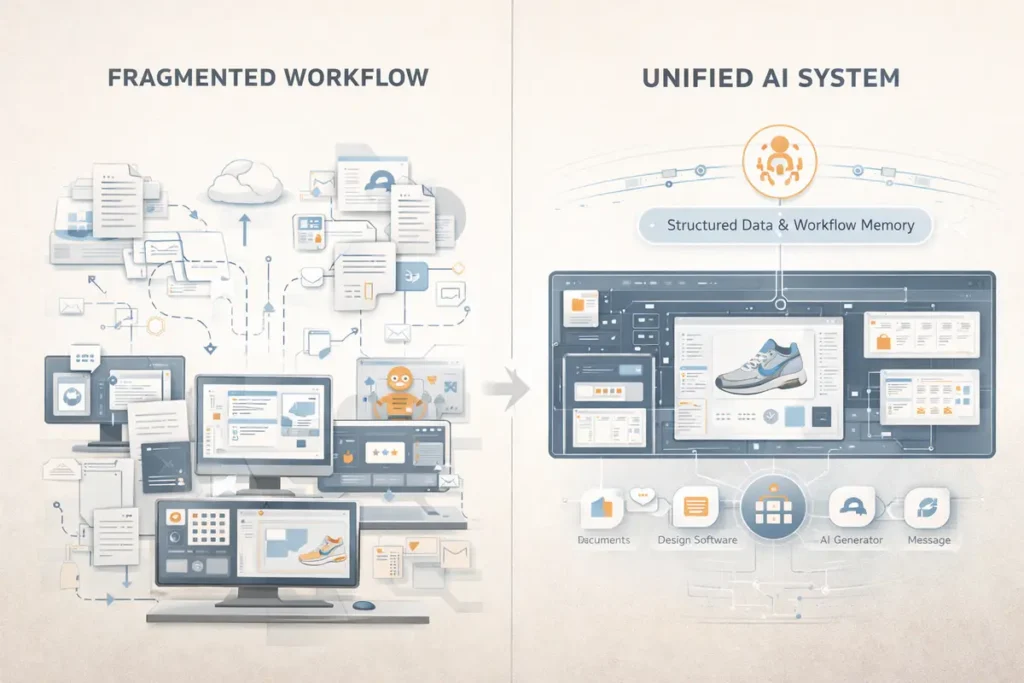
First Concepts is explicitly built around this coordination failure.
Instead of introducing another tool, it inserts a browser-layer intelligence system that sits above the stack — coordinating tools, preserving context, and structuring workflows in real time.
Taste as a System, Not an Outcome
At the center of First Concepts’ architecture is a concept it calls creative DNA.
This is not branding in the traditional sense. It is a memory layer.
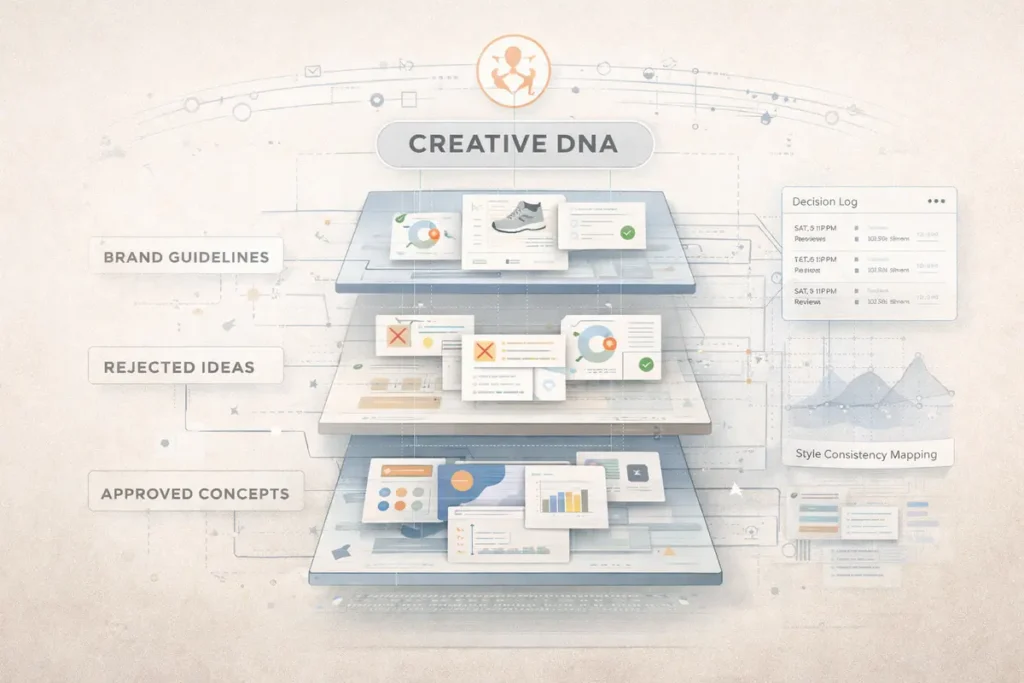
The system captures:
- accepted ideas
- rejected concepts
- stylistic decisions
- brand constraints
- historical judgment patterns
This reframes how AI interacts with creative work.
Traditional systems optimize for better outputs per prompt, a paradigm increasingly being challenged across the industry, as explored in The AI Startup That Doesn’t Look Like a Startup.
First Concepts instead optimizes for consistent judgment across time.
That shift enables:
- prompt orchestration with embedded brand guardrails
- workflow prediction based on past behavior
- decision logging for governance, rights, and provenance
Founder describes the system as:
“A living system that understands your creative DNA, predicts your workflow, and powers you to create the best.”
The consequence is structural:
Taste is no longer subjective input — it becomes structured data.
The Paradox of AI in Creative Work
AI has dramatically accelerated creative output — but it has also introduced a new constraint: quality degradation under speed.
Teams increasingly report that AI-generated outputs feel:
- generic
- stylistically inconsistent
- disconnected from brand tone
This creates a paradox also seen across enterprise AI adoption cycles, where speed often outpaces control — a dynamic analyzed in How AI Startups Are Reshaping Market Power.
The result is a hidden cost: rework at scale.
Industry estimates suggest that up to 40% of creative time is lost to:
- switching between tools
- rebuilding context
- re-aligning outputs with brand identity
This is not a tooling problem. It is a systems problem.
First Concepts addresses this by embedding constraints, memory, and taste directly into the generation process, rather than correcting outputs downstream.
Early Traction Signals a Structural Need
Despite being early-stage, First Concepts is already showing strong adoption signals:
- 30+ London agencies onboarded within weeks
- early users include Mother, R/GA, and FutureBrand
- reported reduction in pitch preparation time of up to 70%
The company also won an AWS Startup Pitch Competition in Málaga, generating over 150 pilot sign-ups.
These signals point to a deeper shift:
Creative teams are not seeking automation.
They are seeking control at scale.
A Fragmented Competitive Landscape
The competitive environment around First Concepts is not crowded — it is misaligned.
Node-Based AI Platforms
represents the closest emerging competitor.
Its node-based system enables:
- multi-model generation
- visual branching
- real-time iteration
But it remains focused on generation and visual workflows, not persistent context or decision memory.
Design-Centric Incumbents
Platforms like and are embedding AI directly into their ecosystems.
They excel at:
- execution
- prototyping
- asset creation
But they remain tool-native systems, not workflow-native systems.
First Concepts operates at a different layer — above the stack, not inside it.
Narrow AI Generators
Ad-focused platforms (e.g., AdCreative.ai) optimize for:
- performance outputs
- rapid asset generation
- A/B testing
But they lack:
- persistent memory
- brand-level intelligence
- workflow orchestration
They optimize for volume, not judgment.
The Emergence of Creative Infrastructure
What is forming is a new category:
AI as infrastructure for creative decision-making
This aligns with a broader structural shift in AI toward invisible system layers — a transformation also reflected in the rise of enterprise AI platforms analyzed in Glean’s Context Platform Strategy.
In this model:
- AI does not replace tools
- AI does not replace humans
- AI organizes the system between them
First Concepts’ browser-layer architecture reflects this shift.
It is not a destination platform.
It is a coordination layer embedded into existing workflows.
The Strategic Control Point
The company’s thesis can be reduced to a single control point:
Creative work will not be automated.
But it will be systematized.
If that holds, the most valuable layer in creative AI will not be:
- model generation
- design tooling
It will be:
context, memory, and workflow intelligence
The Deeper Transition
The rise of taste-aware systems signals a broader transformation in artificial intelligence:
From:
→ generating outputs
To:
→ managing decision systems
This mirrors shifts already visible across enterprise AI:
- coding → AI copilots
- research → AI agents
- operations → workflow automation
Creative work is now entering the same phase.
The Opportunity Ahead
First Concepts remains early:
- $1M pre-seed (March 2026)
- backed by Arāya Ventures and Antler
- small team, actively hiring AI engineers
But its positioning reflects a deeper structural insight:
The next layer of AI will not be defined by what it creates — but by how well it understands human intent, context, and taste.
In creative industries, that may prove to be the most valuable layer of all.
Live Update Signal
This article may be updated as First Concepts expands its product, funding, or enterprise adoption.
Research Context
This report synthesizes information from company materials, firstconcepts.co, LinkedIn signals, investor disclosures, Forbes coverage, and Tech Funding News reporting.