
Subheadline:
Exponent Energy’s offboard thermal architecture signals a deeper shift: EV infrastructure is moving from hardware constraints to execution-layer systems that control performance, cost, and scalability.
The Moment EV Charging Became a Systems Problem
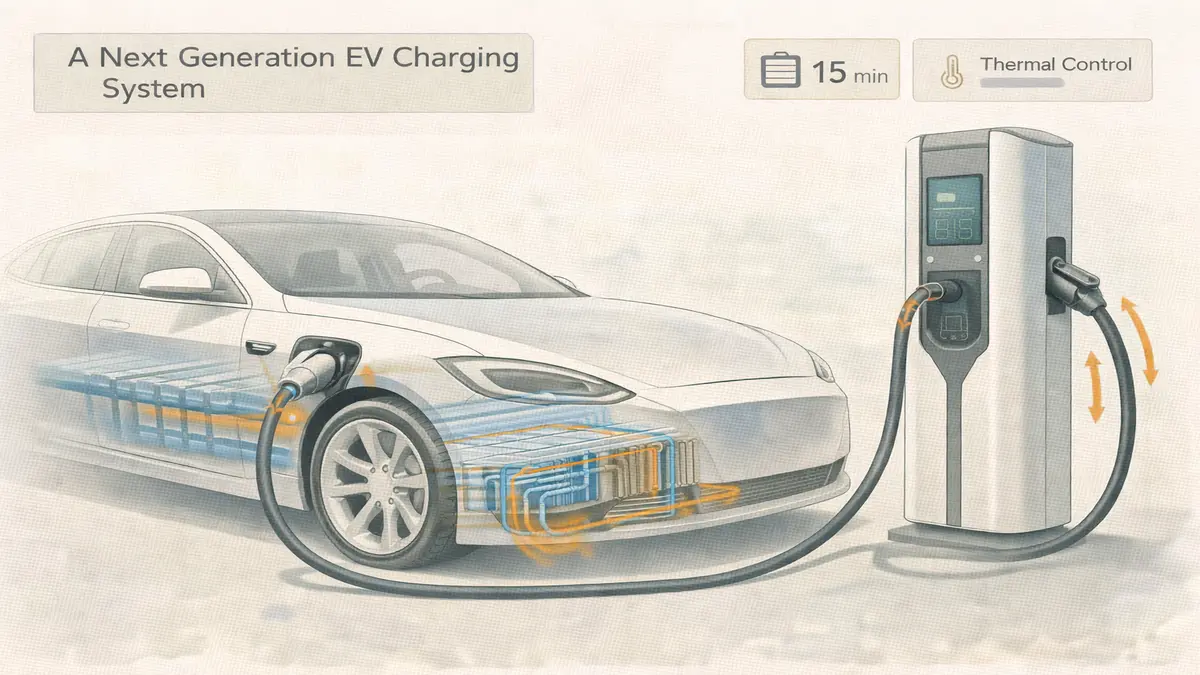
Exponent Energy, a Bengaluru-based EV charging startup operating in rapid charging infrastructure and energy systems engineering, has developed a 15-minute full-charge platform for electric two- and three-wheelers—marking a structural shift from component-level innovation to execution-layer systems that control energy flow, thermal behavior, and battery lifecycle performance.
The system delivers 0–100% charging in ~15 minutes with ~13% degradation after 3,000 cycles, based on internal and certification-backed data.
It sits within a competitive landscape that includes battery-swapping networks like Battery Smart and charging platforms such as Statiq and ChargeZone—but approaches the problem from a fundamentally different architectural layer.
At first glance, this appears to be incremental progress in fast charging.
It is not.
It represents a deeper transition:
from improving components → to controlling system behavior
This mirrors a broader shift already visible across AI and infrastructure markets, where
capital is moving toward execution layers and system control:
the system—not the component—is becoming the unit of value creation.
The Constraint That Defined EV Adoption
Electric vehicles have always been governed by a hard trade-off:
- Faster charging → higher heat
- Higher heat → faster battery degradation
- Degradation → reduced lifespan and higher cost
For high-utilisation segments—logistics fleets, ride-hailing, and commercial 2W/3W vehicles—this constraint is not technical. It is economic.
Downtime erodes revenue.
Battery replacement erodes margins.
This is why the market split early into two imperfect solutions:
- Battery swapping → speed without simplicity
- Standard charging → simplicity without speed
Exponent targets the constraint itself:
make rapid charging viable without compromising battery economics
The Core Breakthrough: Moving Heat Out of the Vehicle
Exponent’s core innovation is architectural:
shift thermal management from the vehicle to the charging system
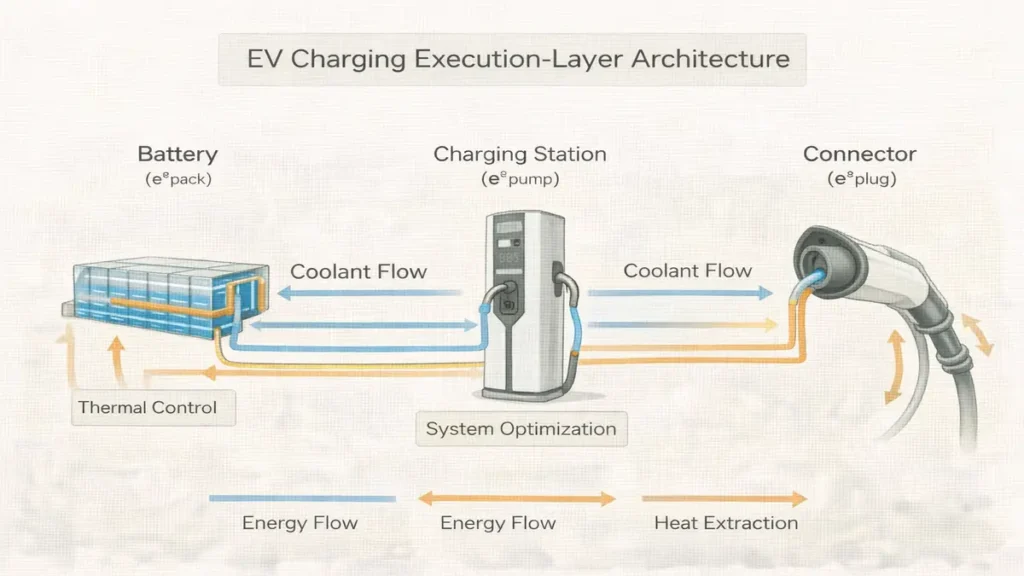
Its stack integrates three components:
- e^pack → vehicle battery
- e^pump → charging station
- e^plug → connector with active cooling
During charging:
- Coolant is pumped from the station into the battery
- Heat is extracted externally
- The vehicle avoids heavy onboard cooling systems
This enables:
- 15-minute full charge (0–100%)
- 3,000-cycle battery life
- ~13% degradation under repeated rapid charging
The implication is not incremental.
Exponent is not accelerating charging—it is redefining the battery–charger interface.
Why This Is an Execution-Layer Innovation
Most EV companies optimize within a layer:
- Battery chemistry
- Charging hardware
- Software tuning
Exponent operates across layers.
It integrates:
- Hardware (battery + charger + connector)
- Software (BMS + charging algorithms)
- Thermal systems (cooling architecture)
This produces a closed-loop system:
energy input → thermal regulation → battery response → performance output
That is the defining characteristic of an execution layer.
Instead of improving individual components, Exponent controls how the system behaves under real-world conditions.
This aligns with a broader shift explored in
how AI agents are moving from interfaces to execution systems:
control, not capability, is becoming the core layer of value.
The Economic Shift: Charging Becomes a Throughput System
Traditional EV infrastructure is asset-driven:
- Value = number of chargers deployed
- Revenue = utilization over time
Exponent reframes the model.
With 15-minute charging:
- Each station serves more vehicles per day
- Fleet uptime increases
- Revenue per asset improves
Charging becomes:
a throughput-optimized system
The key metric shifts from:
- Installed capacity
To:
- vehicles processed per unit time
This mirrors cloud infrastructure economics:
utilization—not hardware—is the primary driver of value
Why India Is the Ideal Environment
Exponent’s model is not globally generic.
It is structurally aligned with India.
The market is:
- 2W/3W dominated
- Fleet-driven
- Cost-sensitive
- Infrastructure-constrained
This creates a different optimization function:
efficiency over peak performance
Unlike Western markets:
- Range is less critical
- Daily economics are dominant
This allows Exponent to optimize for:
total cost of ownership, not theoretical performance ceilings
The Competitive Divide: Three System Architectures
The EV infrastructure market is now dividing into three distinct models:
1. Battery Swapping (Battery Smart, Chargeup)
- Instant turnaround
- Operationally complex
- Dependent on standardization
2. Charging Networks (Statiq, ChargeZone)
- Simple deployment
- Slower charging cycles
- Limited fleet efficiency
3. Execution-Layer Systems (Exponent)
- Integrated architecture
- Rapid charging with lifecycle control
- Optimized for economic throughput
This is not product differentiation.
It is a system design divergence.
The Real Moat: Thermal + Algorithmic Control
Exponent’s defensibility does not lie in speed alone.
It lies in:
control over thermal behavior during energy transfer
Combined with:
- High-precision BMS systems
- Charging algorithms
- Real-world usage data
This creates a layered moat:
- Hardware lock-in
- Software optimization
- Data feedback loops
Together:
a system that improves with deployment scale
The Constraint That Still Remains
Despite its advantages, constraints persist:
- Infrastructure remains capital-intensive
- Grid limitations affect scalability
- Thermal systems require precise deployment
- OEM integration introduces friction
And ultimately:
physics remains non-negotiable
AI and software can optimize systems.
They cannot eliminate thermodynamic limits.
A Broader Pattern: Infrastructure Is Becoming Software-Defined
Exponent reflects a cross-industry transition:
- AI agents executing enterprise workflows
- Autonomous systems managing operations
- Infrastructure becoming software-defined
Across sectors, the pattern is consistent:
From:
- Static hardware
- Isolated components
- Manual control
To:
- Integrated systems
- Real-time orchestration
- Continuous optimization
This is the shift:
from tools → to systems → to infrastructure
As seen in
AI systems evolving into enterprise infrastructure layers.
Strategic Implications
For Founders
The opportunity is no longer component innovation.
It is:
owning system-level behavior in constrained environments
For Investors
Capital is concentrating around:
- Integrated systems
- High technical barriers
- Measurable economic output
For the EV Ecosystem
The next phase will not be defined by:
- More chargers
- Larger batteries
But by:
systems that optimize energy, time, and cost simultaneously
System-Level Insight: Control Is the New Interface
The defining shift is not speed.
It is control.
Control over:
- Energy flow
- Thermal behavior
- Battery lifecycle
- Economic performance
Value is moving:
From:
- building infrastructure
To:
- operating infrastructure
Editorial Close
For over a decade, EV innovation has focused on pushing technical limits—faster charging, longer range, better chemistry.
Exponent takes a different approach.
It does not attempt to break the constraints.
It reorganizes the system around them.
That architectural choice may prove more scalable—not just in EVs, but across any domain where physics, cost, and performance intersect.
Because in the next phase of technology:
the winners will not be those who build better components—
but those who control how systems behave.
Research Context:
Synthesis of Entrackr disclosures, company filings, EV infrastructure data, battery engineering principles, and market dynamics as of March 2026.
Editorial Note:
This article reflects independent analysis of publicly available information and broader AI, infrastructure, and EV ecosystem trends.