

Inside the enterprise AI platform betting that local deployment teams — not just models — will define the next generation of enterprise automation.
The Intelligence Briefing
- Funding: Wonderful raised $150M Series B at a $2B valuation led by Insight Partners
- Total Capital: More than $285M raised since 2025
- Category: Horizontal enterprise AI agent platform
- Global Footprint: Operating across 30+ countries
- Customer Expansion: 70% of enterprises expand to multiple workflows within three months
The Structural Shift Behind the Funding
AMSTERDAM — The funding round highlights a deeper transition unfolding across the artificial intelligence industry — one in which the core challenge is shifting from building AI models to deploying them inside real organizations.
This analysis examines Wonderful, an enterprise AI agent platform, and the emerging infrastructure layer enabling organizations to deploy AI systems in real production environments.
For much of the past decade, the dominant narrative in artificial intelligence revolved around model development — the race to build larger language models and more capable machine-learning systems.
But as enterprises attempt to integrate those models into real operational workflows, a new constraint has emerged.
The hardest problem in artificial intelligence is no longer building the models.
It is deploying them inside complex organizations.
Enterprise systems must integrate AI with legacy software stacks, regulatory frameworks, multilingual interfaces, and operational processes that were never designed for autonomous systems. That challenge is driving demand for a new class of platforms designed to operationalize AI across entire organizations.
Wonderful is positioning itself at the center of that emerging layer.
Why This Matters
Across industries, companies are moving beyond experimental AI pilots toward production-scale deployment.
That transition is creating demand for platforms capable of managing AI agents across multiple operational domains simultaneously — customer support, internal workflows, voice systems, and digital service channels.
Wonderful’s platform attempts to provide a shared operational foundation through which enterprises can deploy AI agents across multiple business functions rather than building isolated tools for each use case.
The rise of such infrastructure platforms mirrors broader shifts across the AI economy, including the surge in capital investment highlighted in The $189B AI Funding Surge Is Reshaping the Deep Tech Venture Map.
If those trends continue, enterprise adoption of artificial intelligence may increasingly depend on deployment infrastructure rather than model innovation alone.
The Bigger AI Infrastructure Trend
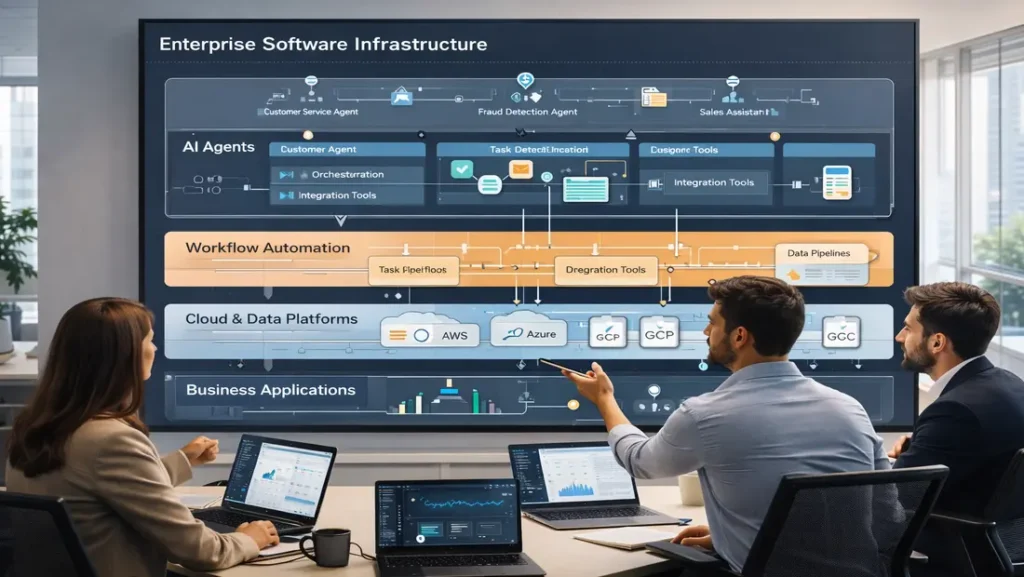
Wonderful’s rapid rise reflects a broader transformation taking place across the artificial intelligence stack.
Enterprises are shifting from experimental pilots toward automation systems capable of operating at production scale.
That shift is creating a new layer of infrastructure — AI operational platforms — positioned between foundational models and real-world enterprise systems.
Just as cloud computing platforms became the foundation of the previous generation of software development, AI deployment platforms may become the backbone of the next generation of enterprise technology.
From Stealth Startup to Enterprise AI Platform
Wonderful was founded in 2025 by Israeli entrepreneurs Bar Winkler (CEO) and Roey Lalazar (CTO).
The company operates from Amsterdam headquarters with Israeli research and development, reflecting the growing role of Europe and Israel as emerging centers of enterprise AI innovation.
Rather than focusing on a single AI product, the company developed a shared agent platform capable of supporting multiple enterprise workflows simultaneously.
The system integrates across:
- voice systems
- messaging platforms
- email automation
- digital customer interfaces
Instead of deploying isolated AI assistants, enterprises can use a single platform to orchestrate AI agents across multiple operational environments.
The Local Deployment Strategy

One of the company’s most distinctive features is its deployment model.
Wonderful pairs its platform with locally embedded engineering teams that work directly with enterprise customers in their regional markets.
These teams support:
- system integration
- regulatory compliance
- workflow customization
- continuous operational optimization
The approach resembles the “forward-deployed engineer” model used by companies such as Palantir, where technical teams collaborate closely with customers to integrate complex technology into real operational systems.
For industries such as banking, telecommunications, logistics, and healthcare, this localized deployment capability could represent a significant competitive advantage.
Early Customer Deployments
Several early enterprise deployments illustrate how the platform is already being used in production environments.
ELTA Hellenic Post (Logistics)
The Greek postal operator deployed Wonderful’s AI agents for customer support operations.
Reported results include:
- 4× increase in handled support volume
- 86% success rate in production
- deployment in under two months
Bank Hapoalim (Financial Services)
The Israeli bank launched a multi-language digital voice agent capable of handling scheduling, support inquiries, and transaction requests.
During a national emergency scenario, the system reportedly maintained instant response times with no wait queues.
Bezeq (Telecommunications)
Israel’s largest telecom provider uses Wonderful agents to resolve technical support requests, coordinate field technicians, and manage billing inquiries.
The system now processes millions of customer interactions without performance degradation.
Across deployments, the company reports:
- 80%+ containment rates
- 60% reductions in handling time
- 70% expansion into additional workflows within three months
Strategic Insight
The rise of companies like Wonderful reflects a broader structural shift in the artificial intelligence economy.
The most valuable AI companies of the next decade may not necessarily be those building the most powerful models.
Instead, they may be the companies building the operational infrastructure that allows organizations to deploy those models at scale.
That pattern is already emerging across other segments of the AI ecosystem, including developer platforms discussed in Cursor’s $2B ARR Explosion Signals the Arrival of Agentic Developer Infrastructure.
Similar infrastructure transitions are also visible in emerging enterprise AI platforms such as those explored in The Invisible Infrastructure Layer Reshaping Enterprise AI.
Artificial intelligence is gradually evolving from a research technology into core enterprise infrastructure.
The Road Ahead
Wonderful’s long-term success will depend on execution.
Scaling a global network of deployment teams while maintaining technological consistency is operationally complex. Competition from hyperscale cloud providers and enterprise automation companies will also intensify as the AI agent market expands.
Yet if the company succeeds, it could become part of a new generation of firms building the operational backbone of enterprise AI adoption.
The race to operationalize artificial intelligence has begun.
And increasingly, the decisive advantage may belong to companies capable of deploying AI faster — not simply building it.
Research Context
This analysis synthesizes information from company announcements, investor disclosures, and industry reporting including Bloomberg, Reuters, PR Newswire, Calcalistech, and TechCrunch. Additional insights were derived from enterprise AI adoption trends and comparative analysis of agent-platform architectures.
Editorial Note
TechFront360 publishes independent analysis on artificial intelligence infrastructure, emerging startups, and the strategic technology shifts shaping the global AI economy. Our coverage focuses on the systems, platforms, and capital flows defining the next generation of technology innovation.