Nearly $56 Million Series A | Huagai Capital & Bayland Capital | Hangzhou, China | November 2026

Eli Radiopharma has raised nearly RMB 400 million in Series A financing, bringing fresh capital into one of biotechnology’s most strategically important emerging fields: targeted radiopharmaceuticals. But the significance of this round extends beyond funding. It reflects a growing conviction that the next generation of precision medicine will combine molecular targeting, radioactive isotopes, and integrated diagnostics and therapeutics to treat diseases that remain difficult to address with conventional approaches.
Founded in 2024, Hangzhou-based Eli Radiopharma is building a pipeline spanning oncology and neurological diseases. With backing from Huagai Capital, Bayland Capital, Boyu Ventures, and a broad group of institutional investors, the company is now preparing to move multiple research programs closer to clinical development.
This is not simply another biotech funding round.

It is a bet on the next infrastructure layer of precision medicine: targeted radiopharmaceutical innovation.
The Deal: Nearly RMB 400 Million Before Clinical Breakthroughs
On November 11, 2026, Hangzhou Eli Radiopharma Co., Ltd. announced the completion of a Series A financing round of nearly RMB 400 million, equivalent to approximately $56 million.
The round was led by Huagai Capital, with Bayland Capital serving as co-lead investor.
Other participating investors included:
– Boyu Ventures
– Delian Capital
– InnoPinnacle Fund
– Haibang Venture
– Bairui Capital
– Shenzhen Angel FOF Management
– Grand Flight Investment
Existing shareholders also participated, including CSPC & Growth Bio Fund, Huaige Capital, KHK Fund, Longfeng Venture, Hongsheng Capital, Bioclub Fund, and Skyfield Capital.
The composition of the investor group is important.
This is not a financing round supported by a single specialist fund. It brings together healthcare-focused investors, institutional capital, and existing shareholders around a company whose primary value remains concentrated in its scientific pipeline.
The proceeds will support:
– Preclinical research and development
– Investigational New Drug (IND) applications
– Early-stage clinical development
– Expansion of research and development platforms
– Recruitment of scientific and technical talent
– Clinical development and business development capabilities
According to the company’s announcement, multiple programs targeting novel molecular targets have completed lead discovery and in vitro and in vivo validation, with several approaching IND submission.
The next milestone is therefore not simply expanding research capacity.
It is demonstrating that the science can progress into clinical development.
The Core Thesis: Radiopharmaceuticals Are Becoming a New Precision Medicine Platform
Traditional cancer treatments often struggle with a fundamental problem: delivering therapeutic effects to diseased tissue while limiting damage to healthy tissue.
Radiopharmaceuticals approach this challenge differently.
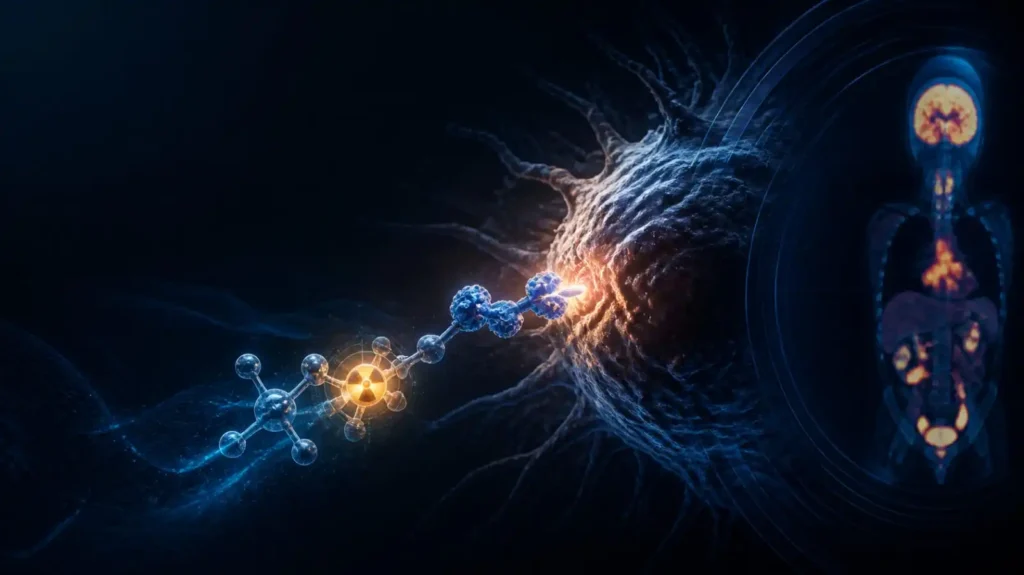
They combine a targeting molecule with a radioactive isotope, allowing the resulting compound to identify specific biological targets and deliver radiation to selected tissues.
The broader category includes two important approaches:
1. Radiopharmaceutical diagnostics
Diagnostic compounds use radioactive isotopes to visualize biological processes through medical imaging, helping clinicians identify disease, assess molecular targets, and evaluate treatment suitability.
2. Targeted radiopharmaceutical therapy
Therapeutic compounds deliver radiation to targeted cells, with the objective of damaging or destroying diseased tissue while limiting exposure to surrounding healthy structures.
The combination of these approaches creates what is known as theranostics.
A diagnostic agent can help identify patients whose disease expresses a particular molecular target. A corresponding therapeutic agent can then deliver radiation to that target.
This creates a more integrated treatment model:
– Identify the biological target.
– Confirm its presence through imaging.
– Select an appropriate therapeutic isotope.
– Deliver targeted radiation.
– Monitor treatment response.
This is the scientific architecture behind much of the current investment momentum in radioligand therapies.
Eli is positioning itself within this transition, with a development strategy covering both oncology and neurological applications.
The Founder Advantage: Nearly Two Decades Inside Radiopharmaceutical Development
One of Eli Radiopharma’s most important assets is the experience of its founder, Dr. Feng Yu (喻峰).
Unlike startups entering radiopharmaceutical development from adjacent biotechnology categories, Eli’s leadership has direct experience across the development lifecycle of radiopharmaceutical products.
Dr. Yu brings nearly 20 years of biopharmaceutical research and development experience.
His professional background includes:
– Approximately 10 years at GlaxoSmithKline’s R&D centre, working on innovative radiopharmaceutical development.
– Serving as China head at XinXu Pharmaceutical, where he advanced an innovative diagnostic radiopharmaceutical program into Phase III.
– Serving as Senior Vice President at Suzhou Borui Chuanghe, overseeing early development, translational research, regulatory affairs, intellectual property strategy, and operations.
– Leading a nearly RMB 300 million Series A financing at his previous company.
He holds a master’s degree from Fudan University and a doctorate from Shanghai University of Traditional Chinese Medicine.
This background matters because radiopharmaceutical development is not a conventional drug-discovery exercise.
It requires coordination across molecular biology, isotope chemistry, radiation safety, imaging, manufacturing, regulatory strategy, and clinical translation.
The founder’s experience potentially reduces the organizational learning curve associated with building such a platform.
Eli’s founder advantage is not simply scientific knowledge. It is experience navigating the journey from research to clinical development.
The Pipeline: Six Disclosed Programs Across Oncology and Neurology
Eli’s pipeline is particularly interesting because it does not rely on a single therapeutic hypothesis.
Instead, it combines neurological diagnostic development with multiple oncology-focused programs using different radioactive isotopes.
The company’s publicly disclosed pipeline includes:
Program| Indication| Isotopes| Development approach
ELI-101| Neurological diseases| ¹⁸F| Co-development
ELI-301| Solid tumors| ⁶⁸Ga / ¹⁷⁷Lu / ²²⁵Ac| In-house
ELI-411| Solid tumors| ⁶⁸Ga / ¹⁸F / ¹⁷⁷Lu| In-house
ELI-601| Solid tumors| ⁶⁸Ga / ¹⁷⁷Lu| In-house
ELI-201| Undisclosed| ¹⁷⁷Lu / ²²⁵Ac / ¹⁶¹Tb| In-house
ELI-501| Undisclosed| ⁶⁸Ga / ¹⁷⁷Lu| In-house
Source: Eli Radiopharma’s publicly disclosed pipeline. Development stages should be interpreted as discovery or preclinical unless subsequently confirmed by the company.
The pipeline reveals three important strategic choices.
1. Multiple Molecular Targets Rather Than One Asset
Eli is developing several programs against different targets rather than depending entirely on a single candidate.
This creates opportunities for scientific diversification, although each additional program also increases development and resource requirements.
2. A Combination of Diagnostic and Therapeutic Isotopes
The company uses several important radionuclides:
– Fluorine-18 (¹⁸F): Widely used in PET diagnostic imaging.
– Gallium-68 (⁶⁸Ga): Used in molecular imaging and diagnostic radiopharmaceuticals.
– Lutetium-177 (¹⁷⁷Lu): An established therapeutic radionuclide used in targeted radioligand treatments.
– Actinium-225 (²²⁵Ac): An alpha-emitting isotope attracting interest for targeted cancer therapy.
– Terbium-161 (¹⁶¹Tb): An emerging therapeutic isotope with potential applications in targeted radionuclide treatment.
These isotopes serve different purposes and require distinct development, manufacturing, and clinical strategies.
3. Oncology and Neurology as Two Separate Opportunities
Oncology provides a more established commercial and clinical foundation for radiopharmaceuticals.
Neurological applications, particularly diagnostic imaging for diseases such as Alzheimer’s and Parkinson’s, offer a different opportunity.
Eli’s dual focus gives it exposure to both areas, although the development timelines and commercial pathways are likely to differ substantially.
The pipeline is promising as a research portfolio, but it remains early-stage. Its ultimate value will depend on target validation, safety, efficacy, and clinical outcomes.
The Competitive Battlefield: Eli vs AdvanCell, Aktis Oncology and Global Radiopharma Leaders
Radiopharmaceutical development is becoming an increasingly competitive global market.
The most important competitors are not necessarily companies pursuing identical molecular targets. They are companies attempting to control different layers of the radiopharmaceutical value chain.
AdvanCell: The Targeted Alpha Therapy Leader
Australia-based AdvanCell is developing targeted alpha therapies, particularly using Lead-212.
Its July 2026 Series D financing of $315 million was led by Ally Bridge Group and co-led by Alpha Wave Global.
The financing is intended to advance its lead program toward Phase III development and expand manufacturing and isotope supply capabilities.
Its development maturity and capital base put it considerably ahead of Eli in clinical progression.
Aktis Oncology: The Public-Market Radiopharma Challenger
US-based Aktis Oncology is developing targeted radiopharmaceuticals for solid tumors.
The company completed an upsized IPO in January 2026, generating approximately $365.4 million in gross proceeds, including the fully exercised underwriters’ option.
Its IPO pricing implied a valuation of approximately $945 million, based on the offering terms reported at the time.
Aktis represents a different financing model: a clinical-stage radiopharmaceutical company accessing public markets to finance continued development.
Novartis: The Commercial Benchmark
Novartis is among the most important established players in radioligand therapy.
Its portfolio includes:
– Pluvicto, a targeted radioligand therapy for prostate cancer.
– Lutathera, a radioligand therapy for neuroendocrine tumors.
These products demonstrate that radiopharmaceuticals can progress beyond experimental biotechnology into commercially meaningful pharmaceutical markets.
Novartis also illustrates the strategic importance of manufacturing capacity, isotope supply, and global distribution.
Bristol Myers Squibb and Eli Lilly: Big Pharma Capital
Bristol Myers Squibb expanded its presence in radiopharmaceuticals through its approximately $4.1 billion acquisition of RayzeBio.
Eli Lilly acquired Point Biopharma in a transaction valued at approximately $1.4 billion.
These transactions demonstrate the strategic interest of major pharmaceutical companies in securing radiopharmaceutical platforms and development pipelines.
The Competitive Comparison
Company| Position| Funding / transaction signal
Eli Radiopharma| Early-stage, China| RMB 400M Series A
AdvanCell| Clinical-stage, Australia| $315M Series D
Aktis Oncology| Clinical-stage, US| $365.4M gross IPO proceeds
RayzeBio| Acquired by BMS| ~$4.1B acquisition
Point Biopharma| Acquired by Lilly| ~$1.4B acquisition
These figures represent different financing and transaction structures, not directly comparable company valuations.
The strategic distinction is clear: Eli is competing at the discovery and early-development layer, while several Western peers have already advanced toward clinical validation, manufacturing expansion, or commercial integration.
Eli’s opportunity is to develop differentiated molecular targets before the market becomes more consolidated.
The China Opportunity: A Domestic Innovation Ecosystem With Global Ambitions
China’s radiopharmaceutical industry is entering an important development phase.
Historically, the global market has been dominated by established pharmaceutical companies and specialized nuclear medicine businesses with access to clinical infrastructure, isotope production, and regulatory experience.
China is now developing a broader domestic ecosystem.
Several factors are supporting this transition:
1. Expanding oncology demand
Cancer diagnosis and treatment represent a major healthcare challenge, increasing demand for more precise diagnostic and therapeutic approaches.
2. Domestic research capabilities
Chinese biotechnology companies are increasingly developing proprietary molecular targets, radioligand platforms, and differentiated therapeutic candidates.
3. Manufacturing investment
Radiopharmaceuticals require specialized facilities, quality controls, radiation-handling capabilities, and reliable isotope supply.
4. International partnerships
Global pharmaceutical companies are increasingly looking at Chinese biotechnology innovators as potential sources of differentiated assets.
A particularly important example emerged in September 2026, when BoomRay Pharmaceuticals announced an exclusive global licensing agreement with Novartis for a preclinical radioligand therapy asset.
The agreement could generate up to $900 million in upfront, development, regulatory, and sales milestone payments, alongside potential royalties.
This is an important signal for China’s radiopharmaceutical ecosystem.
It demonstrates that domestic research programs can potentially create global commercial value through licensing and development partnerships.
Eli’s challenge is to establish comparable scientific and development credibility.
The Strategic Partnership Layer: Connecting Radiopharmaceuticals With Advanced Imaging
Radiopharmaceutical development does not operate independently of medical imaging.
Diagnostic imaging, dosimetry, patient selection, and treatment-response assessment are all important parts of the development process.
Eli’s reported collaboration with the Shanghai United Imaging Healthcare Advanced Research Institute is relevant in this context.
The collaboration focuses on areas including:
– Radiopharmaceutical R&D support.
– Dosimetry research.
– Clinical companion diagnostics.
– Intelligent imaging systems.
– AI-assisted clinical trial and patient evaluation capabilities.
This creates an opportunity to connect drug development with imaging and clinical evaluation infrastructure.
The broader strategic implication is that the radiopharmaceutical industry may increasingly depend on integrated ecosystems rather than isolated drug-development companies.
The companies that can connect molecular discovery, imaging, isotope supply, clinical development, and manufacturing may have stronger long-term competitive positions.
The Hidden Constraint: Isotope Supply Could Determine the Winners
The biggest challenge in radiopharmaceutical development is not necessarily identifying a promising molecular target.
It is ensuring that the entire system can operate reliably.
Radioactive isotopes have specific production, transportation, storage, and handling requirements.
Some have extremely short half-lives, making logistics and distribution particularly demanding.
Others, especially alpha emitters such as Actinium-225, face supply and production constraints.
This creates several challenges:
– Limited availability of certain therapeutic isotopes.
– Specialized manufacturing infrastructure.
– Complex transportation and regulatory requirements.
– Strict quality-control standards.
– High costs associated with clinical development.
– Difficulty scaling production across international markets.
A company can develop an excellent molecule and still struggle to commercialize it if the isotope supply chain is unreliable.
For Eli, isotope access and manufacturing partnerships will therefore be as important as scientific innovation.
In radiopharmaceuticals, the molecule is only one part of the product. The supply chain is part of the technology.
Why This Series A Matters: From Research Capital to Clinical Execution
Eli’s financing history illustrates how rapidly investor commitment has increased since the company’s establishment.
Its reported funding progression includes:
– December 2024: Approximately RMB 100 million angel financing.
– September 2025: More than RMB 100 million Angel+ financing.
– March 2026: Nearly RMB 100 million additional financing.
– November 2026: Nearly RMB 400 million Series A.
Based on these approximate reported amounts, cumulative financing is estimated at more than RMB 700 million.
The latest round is particularly significant because it changes the company’s financial position ahead of its next development milestones.
The investment thesis is no longer limited to establishing research capabilities.
It is increasingly about:
1. Advancing lead candidates toward IND submission.
2. Establishing clinical development capabilities.
3. Expanding proprietary research platforms.
4. Strengthening manufacturing and isotope partnerships.
5. Creating opportunities for international business development.
This financing also fits into a broader venture capital transition toward companies developing defensible scientific and industrial infrastructure rather than short-cycle consumer products.
The Risk Layer: Why Scientific Potential Does Not Guarantee Commercial Success
Despite its substantial financing and experienced leadership, Eli remains an early-stage biotechnology company.
Several challenges will determine its trajectory.
Clinical Translation Risk
Preclinical results do not guarantee safety or efficacy in human trials.
Regulatory Complexity
Radiopharmaceuticals require careful regulatory evaluation involving both pharmaceutical development and radiation-related safety requirements.
Isotope Availability
Dependence on specialized radionuclides can create manufacturing and supply constraints.
Competitive Pressure
Global companies have considerably greater capital, clinical experience, and manufacturing resources.
Commercialization Economics
Even successful clinical candidates must demonstrate commercially viable production, reimbursement potential, and clinical adoption.
Most importantly, Eli has not yet established clinical efficacy for its disclosed pipeline assets.
The next development milestones will therefore matter considerably more than the size of its latest financing round.
What Eli Radiopharma Is Actually Building
Eli is not simply developing a collection of radiopharmaceutical drug candidates.
It is attempting to build a research and development platform around targeted radionuclide technology.
Its strategy combines:
– Molecular targeting.
– Diagnostic imaging.
– Therapeutic radionuclides.
– Oncology and neurological applications.
– Preclinical research and translational development.
The long-term opportunity is to create a portfolio of differentiated radiopharmaceutical candidates that can progress through clinical development and potentially attract global pharmaceutical partnerships.
The company’s real value will ultimately depend on whether its research platform produces clinically meaningful assets.
This is a bet on the ability to translate scientific precision into therapeutic outcomes.
Editorial Close: The Next Radiopharma Leaders Will Be Built Before Their First Commercial Drug
The global radiopharmaceutical market is entering a period of structural expansion.
Established pharmaceutical companies are investing in radioligand therapies. Specialized biotechnology companies are developing new molecular targets. Manufacturing and isotope supply are becoming strategic assets. China is increasingly participating in the global innovation cycle.
Eli Radiopharma enters this environment with substantial early-stage funding, an experienced founder, and a pipeline spanning oncology and neurological applications.
But the company’s next chapter will be defined by execution.
Can it advance its lead candidates into clinical trials? Can it establish reliable isotope supply? Can it generate differentiated clinical evidence? And can it attract the global partnerships needed to scale?
Those questions will determine whether Eli becomes another well-funded research company or a meaningful player in the next generation of precision medicine.
Because in radiopharmaceuticals, capital creates the opportunity.
Science creates the candidate.
Clinical evidence creates the company.
Research Context
Based on Eli Radiopharma’s company disclosures and pipeline information, its November 2026 Series A announcement, investor participation data, public financing disclosures from AdvanCell and Aktis Oncology, pharmaceutical acquisition transactions, and developments in China’s radiopharmaceutical ecosystem.
Editorial Note
This article reflects independent analysis of publicly available information and emerging structural developments in biotechnology, radiopharmaceutical research, precision medicine, and global pharmaceutical investment. Pipeline stages and funding figures are based on disclosed information and may change as further company announcements become available.