Agile Robots has raised $500 million in a funding round led by SoftBank Group, reaching an $8.5 billion valuation. Nvidia and Hitachi also participated, giving the Munich-based robotics company a powerful combination of financial backing, AI expertise and industrial reach.
The investment is significant, but the more interesting story is what Agile Robots has spent the past several years building. Unlike companies whose identity begins and ends with a humanoid robot, Agile has assembled a much broader industrial automation business: force-sensitive robotic arms, dexterous hands, autonomous mobile robots, factory integration capabilities, AI software and now humanoid systems.
Its roots go back to research at the German Aerospace Center (DLR). Its expansion has been shaped by acquisitions, manufacturing investments and relationships with industrial customers. Its latest ambition is to bring these capabilities together under the emerging category of Physical AI: machines that can perceive, reason and act in real-world environments.
The $500 million round gives that strategy additional capital. It also raises a more difficult question: can Agile turn its technical heritage and growing industrial footprint into a repeatable, profitable robotics platform at global scale?

Agile Robots’ 0 Million Funding Round: The Numbers
| Metric | Details |
|---|---|
| Company | Agile Robots SE |
| Headquarters | Munich, Germany |
| Founded | 2018 |
| Latest funding | $500 million |
| Latest valuation | $8.5 billion |
| Lead investor | SoftBank Group |
| Other named participants | Nvidia and Hitachi |
| Reported total capital raised | Approximately $2 billion |
| Core markets | Industrial automation, automotive, electronics, logistics and healthcare |
| Key product areas | Robotic arms, dexterous hands, AMRs, automation systems and humanoids |
Source: Reuters reporting on the November 12, 2026 funding announcement. The $8.5 billion figure is the valuation associated with the financing, not a public-market valuation.
Agile Robots said the new capital will support expansion in the United States and additional production capacity, including in Germany. The company has also been expanding its manufacturing footprint as it prepares to scale its humanoid and industrial robotics portfolio.
The participation of SoftBank, Nvidia and Hitachi is strategically notable. SoftBank brings experience investing in robotics and large technology platforms. Nvidia is central to the computing and simulation infrastructure increasingly used in robotics development. Hitachi adds an industrial technology perspective.
However, investor participation should not be confused with proof of commercial success. The next phase will be judged by production volumes, customer deployments, system reliability and the economics of operating robots in real factories.
What Agile Robots Actually Builds
Agile Robots is best understood as an industrial robotics and automation company rather than a single-product humanoid startup.
Its portfolio covers several layers of factory automation. These systems can operate independently, but their strategic value increases when they work together as part of a coordinated production environment.
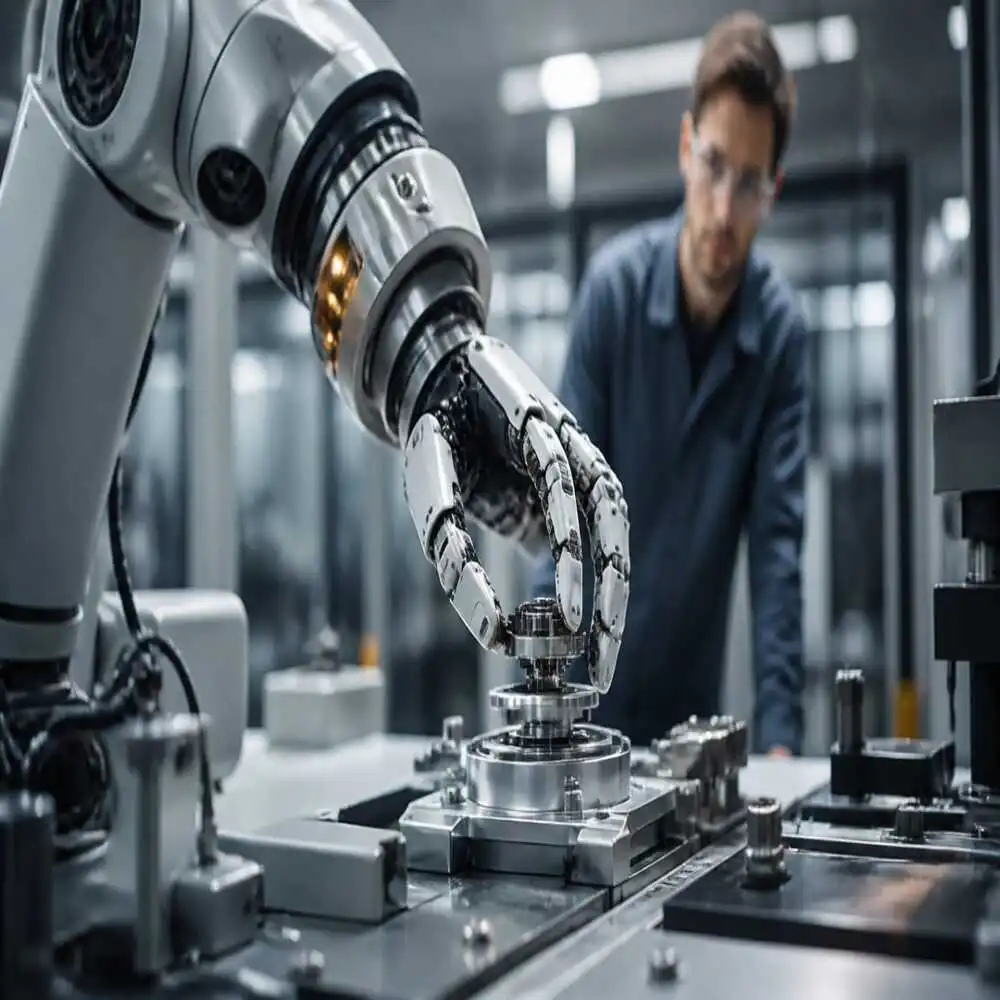
- Force-sensitive robotic arms: Systems such as Diana 7 and the Thor series are designed for assembly, handling and industrial automation.
- Dexterous robotic hands: Agile Hand and related technologies focus on precise manipulation and physical interaction.
- Research and industrial arms: Franka Robotics provides force-sensitive platforms used in research and industrial applications.
- Autonomous mobile robots: The idealworks portfolio supports intralogistics and movement of materials across production environments.
- Factory automation: BÄR Automation and Krause Automation add engineering and integration capabilities.
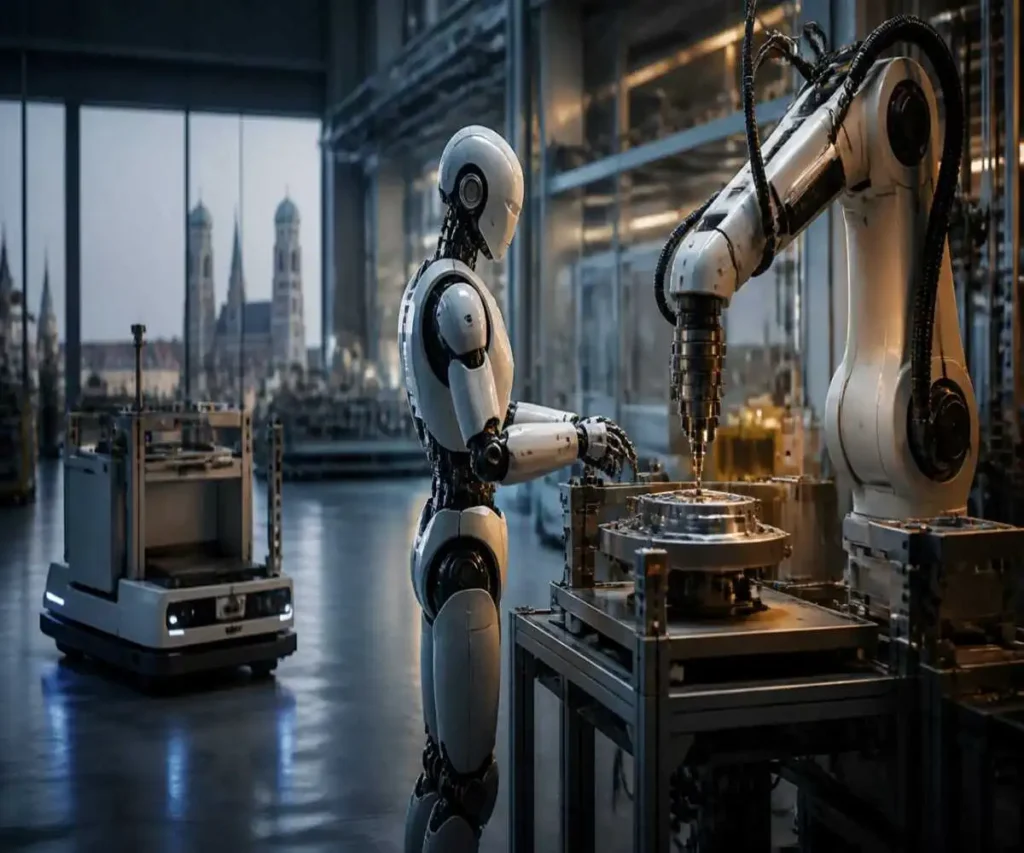
- Humanoid robots: Agile ONE extends the company’s capabilities toward more flexible, human-shaped industrial machines.
- Software and AI: AgileCore and its AI partnerships connect robot hardware, perception, control and production workflows.
This breadth matters because most factories do not need a humanoid robot in isolation. They need machines that can move materials, manipulate components, operate equipment, coordinate with existing systems and perform reliably across multiple shifts.
Agile’s proposition is to provide more of that system through one industrial robotics group.
The DLR Heritage: The Technical Foundation Behind Agile Robots
Agile Robots was founded in Munich in 2018 by Dr. Zhaopeng Chen and Peter Meusel, drawing on expertise developed at the German Aerospace Center’s Institute of Robotics and Mechatronics.
The connection is more than a founder biography. DLR identifies robotic arms and hands, force-torque sensors, artificial intelligence and vision intelligence among the technologies associated with the spin-off.
The research lineage helps explain why Agile Robots has placed so much emphasis on physical interaction. A robot operating in a factory must do more than move to a programmed coordinate. It must detect contact, respond to resistance, handle variation in objects and perform tasks without damaging components or creating unsafe interactions.
Why force and torque sensing matter
Traditional industrial robots are often optimized for repeatable movements in carefully controlled workcells. They can be extremely effective when components, fixtures and operating conditions are predictable.
But many industrial tasks involve contact and uncertainty. A robot may need to insert a component, grip an irregular object, adjust pressure during polishing or work close to a human operator.
Force and torque sensing help a robot understand what is happening at the point of contact. Instead of relying only on a predetermined trajectory, the controller can respond to physical feedback.
Agile’s Diana 7, for example, has torque sensors across all seven axes. Its product specifications list a payload of up to 7 kg, a workspace radius of 923 mm and repeatability of ±0.05 mm. The company also lists force-control accuracy of 0.5 N.
These capabilities are relevant to delicate assembly, machine tending and other tasks where controlled physical interaction is important.
From research laboratories to factory floors
The commercial challenge for research-origin robotics companies is translating sophisticated engineering into equipment that manufacturers can deploy, maintain and operate economically.
Agile’s development reflects that transition. It has moved beyond force-sensitive arms into mobile robotics, automation integration and humanoid systems. Acquisitions have helped it add capabilities that would otherwise take years to build internally.
The DLR connection provides a credible technical foundation. It does not automatically create a permanent competitive advantage. Agile still has to prove that its systems can be manufactured at scale, integrated efficiently and supported across different industrial environments.
Franka Robotics: An Important Acquisition in the Physical AI Strategy
One of Agile Robots’ most strategically relevant acquisitions was the business of Franka Emika, another Munich-based robotics company with deep roots in force-sensitive manipulation.
Franka Emika became widely known for the Panda robotic arm, a seven-degree-of-freedom platform that gained adoption across university laboratories and robotics research teams. Its design emphasized joint torque sensing, compliant control and accessible programming interfaces.
The company faced financial difficulties in 2023 and entered preliminary insolvency proceedings. On November 2, 2023, Agile Robots announced that it would take over Franka Emika’s business operations after approval by the creditors’ committee.
Agile said it intended to continue operations with approximately 100 employees, maintain research and development activities and invest in the business. The company did not disclose the financial terms of the transaction.
Why the acquisition made technical sense
Franka’s research-oriented platform and Agile’s broader industrial ambitions were complementary.
Franka had an established position in research and a recognizable force-sensitive arm platform. Agile brought a wider industrial portfolio, manufacturing resources and an ambition to build integrated automation systems.
The combination also reinforced a common technical theme: robots that can interact with the physical world through sensing and controlled movement, rather than simply executing rigid programmed motions.
For Agile, the acquisition was not just about adding another robot arm. It expanded its access to researchers, developers and an established robotics ecosystem.
Diana 7 vs Franka Research 3: Two Different Approaches to Dexterous Robotics
Agile’s Diana 7 and Franka Research 3 share a broad philosophy of force-sensitive robotic manipulation. But they serve different priorities.
| Feature | Agile Diana 7 | Franka Research 3 |
|---|---|---|
| Degrees of freedom | 7 | 7 |
| Payload | Up to 7 kg | Approximately 3 kg |
| Reach | 923 mm | Approximately 855 mm |
| Joint torque sensing | Yes | Yes |
| Primary positioning | Industrial automation and complex manipulation | Research and physical interaction development |
| Key strength | Higher payload and longer reach | Research ecosystem and low-level control access |
Specifications are indicative and depend on the product version and configuration. The two systems should not be treated as interchangeable based on payload and reach alone.
Diana 7 is positioned for industrial tasks where dexterity, payload and reach must be balanced. Franka Research 3 remains important for robotics research, experimentation and development of manipulation skills.
The strategic opportunity is to connect research capabilities with industrial deployment. A research platform can help develop and validate new robotic behaviours, while industrial systems can bring those capabilities into production environments.
Diana vs Thor: Agile’s Sensitive Specialist and Industrial Workhorse
Agile’s own product portfolio also separates different automation requirements.
Diana 7 is a seven-axis arm designed around dexterity and force sensitivity. Its additional degree of freedom can help it navigate constrained workspaces and approach tasks from different angles.
The Thor family is positioned more broadly around industrial automation, with models designed for different payload and reach requirements. These systems are relevant to applications such as material handling, machine tending and repetitive production tasks.
The distinction is important. Not every factory operation requires the same level of physical sensitivity. Some tasks benefit from dexterous manipulation and careful force control. Others prioritize payload, reach, cycle time and throughput.
A portfolio that covers both requirements gives Agile more opportunities to participate in complete production systems.
Agile ONE: The Move Into Industrial Humanoids
In November 2025, Agile Robots introduced Agile ONE, its first humanoid robot designed for industrial environments.
The launch represented a logical extension of the company’s existing capabilities. Agile already worked on robotic arms, dexterous hands, mobile robots and industrial automation. A humanoid platform brings several of those capabilities together in a body designed to operate in environments built around human workers and equipment.
Agile ONE is designed for applications including:
- Material gathering and transport.
- Pick-and-place operations.
- Machine tending.
- Tool use.
- Fine manipulation.
- Interaction with people and other robotic systems.
One of its central features is its dexterous hand architecture. Agile says the hands include 21 joints and integrated force and tactile sensors, allowing more detailed physical interaction than a simple gripper.
The company also describes a layered AI architecture that separates higher-level planning from faster responses and fine motor control. The objective is to combine reasoning with the real-time precision required for physical tasks.
Why Agile’s humanoid strategy is different
Many humanoid companies are trying to establish a new robot category from the ground up. Agile is approaching the market from an existing industrial automation business.
That gives it a different starting point. It already has experience with industrial customers, automation integration, robotic manipulation and mobile systems. It can position Agile ONE as part of a larger production environment rather than a standalone machine.
This is a meaningful distinction. A humanoid may attract attention, but manufacturers ultimately buy productivity, reliability, safety and predictable operating costs.
The question is not simply whether Agile ONE can walk or manipulate objects. It is whether it can complete economically useful tasks for enough hours per day to justify its cost.
The Factory Strategy: Moving From Demonstrations to Manufacturing Capacity
Agile Robots has been investing in production infrastructure as it prepares to expand its humanoid business.
Reuters reported that the company opened a factory in Fürstenfeldbruck near Munich in 2026, with stated capacity of up to 10,000 legged and wheeled humanoid robots annually.
That figure represents designed production capacity, not confirmed annual shipments or customer demand. The difference matters in a market where manufacturing announcements can run ahead of commercial adoption.
Agile’s broader manufacturing footprint includes sites in Germany, China and India. Its presence across these markets can support production, engineering, customer access and regional expansion.
The new funding is expected to support additional capacity and expansion in the United States. That gives the company more room to develop its international industrial business, although new facilities will also require capital, supply-chain execution and customer commitments.
The Acquisition Strategy: Building an Automation Group, Not Just a Robot Brand
Agile Robots has expanded through a combination of internal development and acquisitions. This has helped it assemble capabilities across the industrial automation value chain.
Franka Robotics
Franka adds force-sensitive robotic arms, research relationships and an established developer ecosystem.
idealworks
Agile acquired the remaining shares of idealworks in September 2025, taking full ownership of the BMW Group spin-off. The business combines autonomous mobile robots, simulation software and an orchestration platform for industrial intralogistics. Agile said more than 850 idealworks mobile robots were operating across BMW Group production sites at the time of the announcement.
BÄR Automation
BÄR Automation adds automated guided vehicles and customized automation and assembly systems. Its capabilities help Agile address factory workflows that extend beyond individual robot arms.
Krause Automation
In April 2026, Agile completed the acquisition of assets from thyssenkrupp Automation Engineering in Europe and North America. The business continues as Krause Automation, adding decades of engineering and production-system integration experience.
These acquisitions create a broader industrial offering. They also bring integration challenges. Different businesses can have distinct software, engineering processes, customer relationships and operating models. The strategic value will depend on whether Agile can make these capabilities work together commercially and technically.
Google DeepMind and Nvidia: The AI Layer Behind the Hardware
Physical AI requires more than mechanical engineering. Robots need systems that can interpret their surroundings, understand tasks, plan actions and respond to unexpected situations.
In March 2026, Agile Robots announced a strategic research partnership with Google DeepMind to integrate Gemini Robotics foundation models with its hardware platform.
The collaboration is intended to combine DeepMind’s robotics models with Agile’s industrial robot systems. The partners described a process involving deployment, data collection, model training and iteration.
Agile has also worked with Nvidia on its robotics development stack. In October 2026, the company introduced Agile ONE SN, a compact humanoid reference platform built on Nvidia’s Isaac GR00T development platform. The system is designed for researchers and developers to build, train and validate humanoid skills before transferring them into real-world environments.
These relationships matter because the robotics industry is increasingly separating into complementary layers:
- Hardware: Arms, hands, actuators, sensors and mobile platforms.
- Perception: Cameras, tactile sensing, vision systems and environmental understanding.
- Intelligence: Models that interpret instructions, reason about tasks and select actions.
- Control: Systems that translate decisions into safe, precise physical movement.
- Deployment: Integration with factory workflows, production software and human operators.
Agile’s opportunity is to connect these layers through its own hardware and industrial deployment capabilities while using external AI ecosystems where they provide an advantage.
Agile Robots’ Scale: Employees, Deployments and Patents
Agile’s industrial footprint is one of the most important parts of its investment story.
Audi reported that Agile Robots had more than 3,500 employees, including more than 2,000 research and development specialists, and had installed more than 20,000 robot solutions worldwide. The company also reported more than 650 patents.
These figures suggest a business with considerably more engineering and deployment infrastructure than a typical early-stage humanoid startup.
However, installed systems should not be confused with humanoid deployments. The installed base includes a broader portfolio of robotic and automation solutions. The company has not disclosed a comparable public figure for the number of Agile ONE humanoids operating in customer facilities.
That distinction will become increasingly important as investors evaluate how much of Agile’s valuation is supported by established automation revenue and how much depends on future humanoid adoption.
Revenue Growth and the Profitability Question
Agile Robots has built its business around industrial automation rather than relying entirely on future humanoid sales.
The company reported reaching approximately €200 million in revenue by 2024. The Wall Street Journal subsequently reported that revenue reached approximately €300 million in 2025 and that the company expected to roughly double revenue in 2026.
These figures point to a substantial commercial business, but they should be treated as reported company figures and expectations rather than a substitute for audited financial statements. Revenue estimates from third-party databases can differ in both currency and methodology.
The financial model also matters. Agile sells physical equipment and complex automation systems, which can involve manufacturing costs, engineering services, installation, maintenance and customer-specific integration.
This is structurally different from a pure software company. Hardware and integration can create large contracts and customer relationships, but they can also constrain gross margins and require substantial working capital.
Agile’s long-term challenge is to improve the economics of each deployment as production volumes rise. Standardized hardware, reusable software, efficient installation and recurring service revenue could all contribute to better margins.
The company has previously indicated an ambition to reach profitability within a two-to-three-year period, according to the Wall Street Journal. Whether it achieves that goal will depend on growth quality, acquisition integration, manufacturing efficiency and the cost of scaling humanoid production.
Competitive Landscape: Agile Robots Is Competing Across Multiple Robotics Markets
Agile Robots does not have a single competitor. Its business spans industrial arms, collaborative robots, mobile automation, factory integration and humanoids. Each category has its own established players and emerging challengers.
NEURA Robotics: The closest European Physical AI challenger
Germany’s NEURA Robotics is one of Agile’s most visible European competitors. It is developing cognitive robots, humanoids and an integrated Physical AI ecosystem.
In June 2026, NEURA announced a Series C financing of up to $1.4 billion, backed by investors including Tether, Qualcomm, Amazon, Nvidia, Bosch and Schaeffler.
NEURA’s strategy emphasizes cognitive robotics and a connected ecosystem of robots and training environments. Agile’s approach is more visibly anchored in its existing industrial automation portfolio, acquired integration capabilities and force-sensitive hardware heritage.
Both companies are attempting to connect intelligence with physical machines, but their commercial execution and product portfolios differ.
ABB, KUKA and Universal Robots: Established industrial competition
Traditional automation companies remain formidable competitors. ABB and KUKA have decades of experience supplying industrial robots and production systems. Universal Robots, part of Teradyne, helped establish the collaborative robot category.
These companies have strong customer relationships, established service networks and extensive experience with industrial safety and integration. Agile must compete not only on technical sophistication but also on reliability, total cost of ownership and support.
Figure AI and Apptronik: The humanoid specialists
Figure AI and Apptronik are among the most visible companies developing general-purpose humanoid robots.
Figure is pursuing a humanoid platform supported by its own AI and manufacturing ambitions. Apptronik’s Apollo is designed for manufacturing and logistics applications, with partnerships that include automotive and logistics companies.
Agile’s difference is its existing portfolio of industrial robotics and automation capabilities. Its humanoid strategy can build on established factory relationships and systems integration experience.
For more context on the industrial humanoid market, see TechFront360’s coverage of Apptronik’s funding and warehouse robotics strategy.
Agility Robotics: A commercial deployment benchmark
Agility Robotics, the US company behind Digit, is an important benchmark for commercial humanoid deployment. Its strategy focuses on logistics and manufacturing environments where robots can perform material-handling tasks.
Agility’s public disclosures around customer deployments and multi-year orders make it a useful comparison for assessing the difference between humanoid production capacity and actual customer demand.
Chinese robotics companies: Cost and manufacturing scale
Companies such as Unitree, UBTech and AgiBot are pushing the market through rapid product development, manufacturing capacity and competitive pricing.
Chinese robotics manufacturers are important competitors because humanoid economics will depend heavily on component costs, actuator supply, manufacturing yields and the ability to produce systems at volume.
Agile’s European engineering heritage and global industrial footprint may help it compete in higher-value industrial applications. But it cannot ignore the possibility that lower-cost competitors will put pressure on pricing.
What Gives Agile Robots a Competitive Advantage?
Agile’s potential advantage is not one individual robot or one AI model. It is the combination of capabilities developed across its business.
1. Force-sensitive manipulation
Its DLR-related engineering heritage and force-sensitive product portfolio provide experience in physical interaction, a difficult area of robotics engineering.
2. An existing industrial business
Agile has an installed base and relationships across manufacturing and automation. This gives it access to real industrial environments where systems can be tested and improved.
3. Broader systems integration
Acquisitions have expanded the company’s reach from robotic arms into mobile robots, automation engineering and production systems. That can make Agile more relevant to customers seeking integrated solutions.
4. Research and AI partnerships
Its work with Google DeepMind and Nvidia gives it access to important AI and robotics development ecosystems. These partnerships may accelerate development, although they do not guarantee a proprietary AI advantage.
5. Manufacturing infrastructure
Production capacity in multiple regions gives Agile a foundation for international expansion. The challenge is converting that capacity into high utilization and competitive unit economics.
The Risks Behind the .5 Billion Valuation
Agile Robots has significant technical and commercial assets, but the latest valuation also embeds expectations about future growth.
Humanoid demand may develop more slowly than expected
Factory customers need reliable machines that deliver measurable returns. Humanoids must demonstrate that they can perform useful tasks consistently, safely and at a competitive cost. Production capacity alone does not establish demand.
Industrial integration is difficult
Robots must work with existing machinery, software, safety systems and human operators. Customer-specific engineering can increase deployment costs and slow expansion.
Hardware economics are demanding
Motors, sensors, actuators, batteries and precision components create substantial costs. Agile must improve manufacturing efficiency while maintaining reliability and performance.
Acquisitions create integration risk
Bringing together multiple companies can expand the portfolio, but it also creates complexity across software, operations, product roadmaps and customer support.
Competition is intensifying
Established industrial suppliers, well-funded humanoid startups and Chinese manufacturers are all investing in robotics. Agile will need to defend its position through execution rather than technical heritage alone.
AI partnerships are not the same as proprietary intelligence
Collaborations with Google DeepMind and Nvidia are valuable, but the long-term advantage will depend on how effectively Agile combines external models with its own hardware, deployment data, control systems and customer workflows.
What Investors Should Watch Next
The next stage of Agile Robots’ development should be evaluated through operational indicators rather than funding announcements alone.
- Humanoid shipments: How many Agile ONE systems reach customers, and how quickly does deployment expand?
- Production utilization: How much of the announced manufacturing capacity is actually used?
- Revenue composition: How much revenue comes from established industrial automation compared with humanoids and newer AI-enabled products?
- Gross margin: Can the company improve hardware economics as production scales?
- Customer repeat orders: Are deployments expanding from pilots into larger production contracts?
- Software contribution: Does AgileCore become a meaningful source of recurring revenue and customer retention?
- Acquisition integration: Can the group turn its broader portfolio into cross-selling and more complete automation contracts?
- Profitability: Can revenue growth translate into sustainable operating performance?
These indicators will help separate the value of Agile’s existing automation business from the expectations attached to the future humanoid market.
Why Agile Robots Matters for Europe’s Robotics Industry
Europe has deep expertise in industrial engineering, precision manufacturing, automation and robotics research. Its challenge has often been turning that expertise into global technology companies capable of scaling production and competing with better-capitalized international players.
Agile Robots represents one approach to that challenge. It has combined research-origin technology with acquisitions, industrial customers, international manufacturing and strategic investment.
The company’s development also illustrates a broader change in robotics. The next generation of industrial automation is unlikely to be defined by one type of machine. Robotic arms, mobile platforms, humanoids, perception systems and AI software will increasingly operate as connected parts of production environments.
That is the larger opportunity behind Physical AI: moving from robots that perform isolated programmed actions toward systems that can understand tasks, respond to changing conditions and coordinate work in the physical world.
Final Analysis: Agile Robots Is Building Beyond the Humanoid Hype
Agile Robots’ $500 million funding round at an $8.5 billion valuation is a major financing milestone for the German robotics sector. But the more durable story is the company’s attempt to build a broad industrial robotics platform.
Its DLR heritage provides a foundation in force-sensitive manipulation. Franka Robotics strengthens its research and arm portfolio. idealworks adds mobile robotics and orchestration. BÄR Automation and Krause Automation expand its factory integration capabilities. Agile ONE brings the company into industrial humanoids, while partnerships with Google DeepMind and Nvidia extend its AI development ecosystem.
This combination gives Agile a different starting position from companies built exclusively around humanoid prototypes. It already operates across several layers of industrial automation and can use those capabilities to develop and deploy more advanced machines.
But the $8.5 billion valuation raises the execution bar. Agile must show that its production capacity translates into customer deployments, that humanoids can deliver measurable economic value, and that its broad portfolio can generate sustainable margins.
The central question is no longer whether Agile Robots can build sophisticated robots. Its technology and industrial footprint are already substantial. The question is whether it can turn those assets into a globally scalable, economically durable Physical AI business.
If it succeeds, Agile Robots could become one of Europe’s most important industrial robotics platforms. If it does not, the gap between technical capability and profitable deployment will remain the defining challenge behind its valuation.
Sources and Further Reading
- Reuters: SoftBank and Nvidia back Agile Robots at an $8.5 billion valuation
- German Aerospace Center: Agile Robots spin-off profile
- Agile Robots: Company history and portfolio
- Agile Robots: Diana 7 product specifications
- Agile Robots: Agile ONE launch announcement
- Agile Robots and Google DeepMind partnership
- Agile Robots: Franka Emika acquisition announcement
- Agile Robots: idealworks acquisition
- Agile Robots: Krause Automation acquisition
- NEURA Robotics: Series C funding announcement
- Audi: Agile Robots workforce, deployment and patent figures