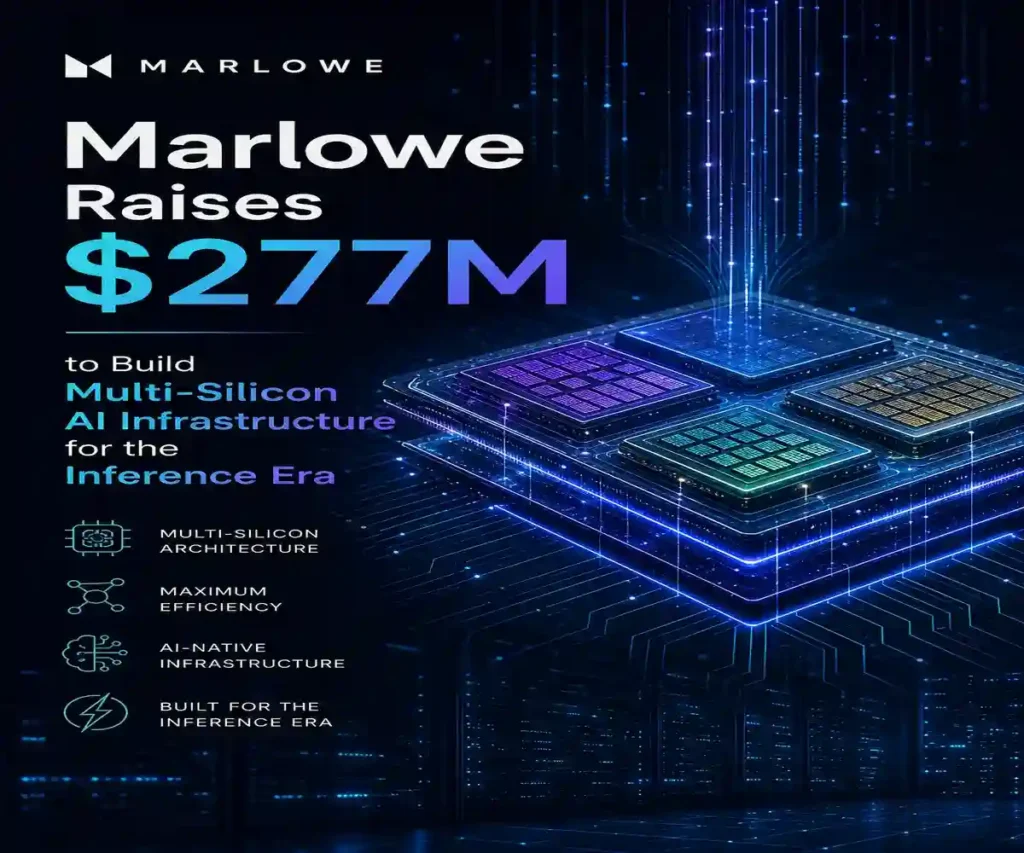
Marlowe has announced $277 million in seed funding to build AI computing infrastructure optimized for inference workloads. Led by Accel, with participation from Bessemer Venture Partners, Altimeter Capital, Atreides Management, Valor, Eclipse, and other investors, the company is developing multi-silicon AI factories designed to make AI computing faster, more efficient, and less dependent on a single chip supplier.
1. Marlowe Raises 7 Million to Address the Growing AI Compute Crunch
Marlowe, an AI infrastructure startup founded in May 2026, has announced $277 million in total seed funding to build computing systems designed specifically for the growing demand for AI inference. Accel led the latest financing, with participation from Bessemer Venture Partners, Altimeter Capital, Atreides Management, Valor, Eclipse, Neo, and other investors. The company is reportedly valued at $1.15 billion, according to coverage of the announcement. Marlowe is targeting a major problem in the artificial intelligence industry: AI applications are being adopted faster than the computing infrastructure required to operate them can expand. As coding assistants, AI agents, voice systems, and enterprise applications handle more requests, businesses need reliable computing capacity that can deliver results without making every interaction unnecessarily expensive. Marlowe wants to solve this problem by designing and operating infrastructure optimized for the specific workloads that customers need to run.
2. The AI Industry Is Moving From Model Training Toward Inference at Scale
The first major phase of the AI infrastructure boom focused heavily on training increasingly powerful models. Training involves processing enormous datasets to teach an AI model how to perform tasks, while inference is the process of running that trained model to generate answers, write code, summarize documents, or execute instructions. As AI products reach more users, inference is becoming an increasingly important part of the computing market. Every conversation, generated image, coding request, and automated agent task requires computing resources. These requests can create substantial ongoing infrastructure costs for companies operating AI applications. Marlowe believes the industry cannot solve this challenge simply by building more of the same large GPU clusters. Instead, computing systems must be designed around the different requirements of each workload, including response speed, model size, energy consumption, and cost per output.
3. Marlowe’s Multi-Silicon Strategy Challenges Dependence on One Chip Ecosystem
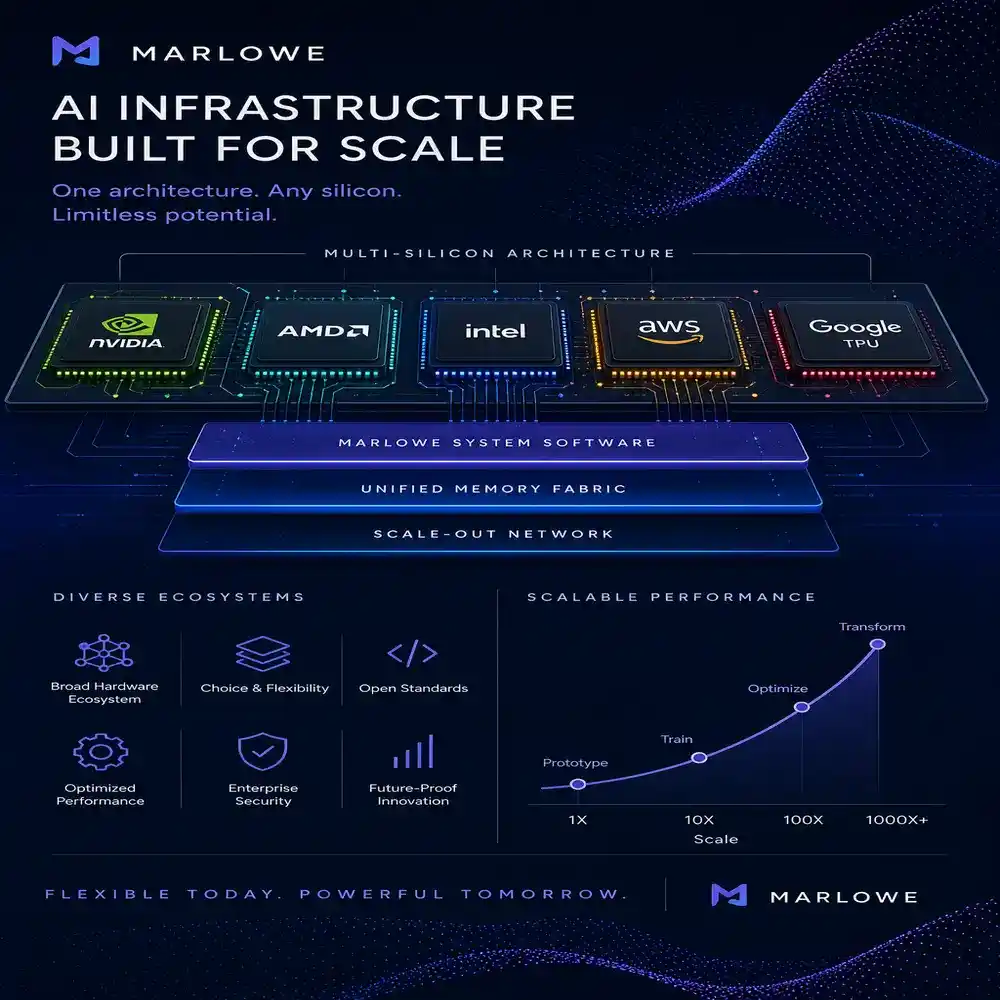
Marlowe is developing what it calls a multi-silicon AI factory, a computing system that can use processors from different chipmakers rather than relying entirely on one hardware supplier. Its initial ecosystem includes chips from AMD and AI chip startup Etched, alongside networking technology and other infrastructure components. The company is not trying to manufacture its own general-purpose AI processor. Its business is to select suitable hardware, build the supporting infrastructure, optimize software, and operate complete computing environments for customers. This approach could create more flexibility for AI companies that want alternatives to conventional GPU-based infrastructure. It also addresses a broader industry concern: relying heavily on a single chip ecosystem can create supply constraints, pricing pressure, and limited choices when demand rises. Marlowe’s opportunity is to make alternative silicon commercially useful by providing the engineering and infrastructure needed to run real workloads on it.
4. Hardware and Software Co-Design Is the Core of Its Business Model
A new AI processor does not automatically deliver strong performance when installed in a data center. It needs compatible software, optimized kernels, efficient networking, memory management, cooling, power delivery, and workload-specific configuration. Marlowe plans to optimize these layers together, from chip selection and data center design to inference engines and model routing. Different applications also have different requirements. A coding agent may need sustained reasoning performance, while a voice assistant may prioritize very low response times. A large enterprise workload may focus more on throughput and cost efficiency. Marlowe wants to match each type of workload with the most suitable combination of hardware and software. The company claims that improvements across these layers can compound into a two-to-three-times advantage in performance and efficiency, although this is a company projection that will need to be demonstrated in real customer deployments.
5. AMD and Etched Partnerships Give Marlowe a Practical Starting Point
Marlowe has established relationships with AMD and Etched as it prepares its first infrastructure deployments. Its initial site, built around Etched processors, is scheduled to become operational in December 2026. The company says the system is intended to serve an AI coding customer, although it has not publicly identified that customer. A second, larger deployment using AMD’s Helios systems is planned for the second quarter of 2027. AMD’s participation is particularly relevant because its data center products provide an alternative to NVIDIA’s dominant GPU ecosystem. Etched, meanwhile, is developing specialized silicon for AI inference workloads. These partnerships give Marlowe access to different hardware architectures and an opportunity to demonstrate whether its system-level optimization can turn alternative processors into dependable commercial computing capacity.
6. A Full-Stack Infrastructure Team Is Behind the Company’s Ambition
Marlowe was founded by Dan Lewis and Kutta Srinivasan, alongside Lior Susan, Ido Susan, and Stanford AI researcher Chris Ré. Lewis previously co-founded logistics technology company Convoy and later worked at Microsoft, while Srinivasan held senior engineering and AI infrastructure roles at major technology companies. Their experience covers enterprise software, AI infrastructure, hardware and software integration, and large-scale computing systems. Lior Susan, founder of Eclipse, serves as Marlowe’s executive chairman. The company is also supported by a wide network of institutional investors and technology executives. Building AI data centers is a capital-intensive business, however, and Marlowe must combine software engineering expertise with financing, construction, hardware procurement, and operational execution. Its ability to manage all these requirements will be as important as its technical architecture.
7. The 7 Million Will Support Chips, Data Centers, and Infrastructure Expansion
Marlowe plans to direct its funding toward computing hardware, networking equipment, data center capacity, engineering talent, and the operational systems needed to support customers. Its initial strategy is to establish smaller deployments and demonstrate the economics before expanding into additional capacity. The company has reported three customer agreements, although it has not publicly named those customers. It is also working with AI application companies that want more efficient computing for their products. This customer-led approach could help Marlowe avoid building large amounts of capacity without sufficient demand. At the same time, the business faces significant challenges, including data center construction costs, electricity availability, hardware supply, financing requirements, and competition from established cloud providers. Success will depend on turning infrastructure commitments into reliable capacity that customers are willing to use over the long term.
8. Marlowe Is Betting That the Future of AI Compute Will Be More Diverse
Marlowe’s emergence reflects a broader shift in the AI infrastructure market. As AI moves into everyday business operations, inference capacity is becoming a strategic resource, and companies are looking for ways to reduce the cost of generating useful intelligence. NVIDIA’s integrated hardware and software ecosystem remains a formidable competitor, but alternative processors from AMD, Etched, and other manufacturers could create opportunities for specialized infrastructure providers. Marlowe believes that no single chip architecture will be ideal for every AI workload. Its strategy is to coordinate silicon, data centers, networks, software, and model execution as one system. The company’s $277 million seed financing gives it substantial resources to test that thesis, but the real proof will come from deployment reliability, customer adoption, and measurable improvements in performance per watt and cost per token. If it succeeds, Marlowe could become an important infrastructure layer supporting the next generation of AI applications.
TechFront360 Analysis: Marlowe is targeting one of the most important structural changes in the AI economy: the shift from building models to operating them at massive scale. Its opportunity is not simply to offer another cloud platform, but to make alternative AI chips commercially useful through hardware-software co-design and workload-specific infrastructure. The $277 million seed round is a substantial commitment to that thesis. The next milestone is execution: getting its first systems online, proving its efficiency claims, and converting early customer agreements into a scalable infrastructure business.