Green Aero Raises $14 Million to Build India’s Jet Engines and Autonomous Combat Aircraft
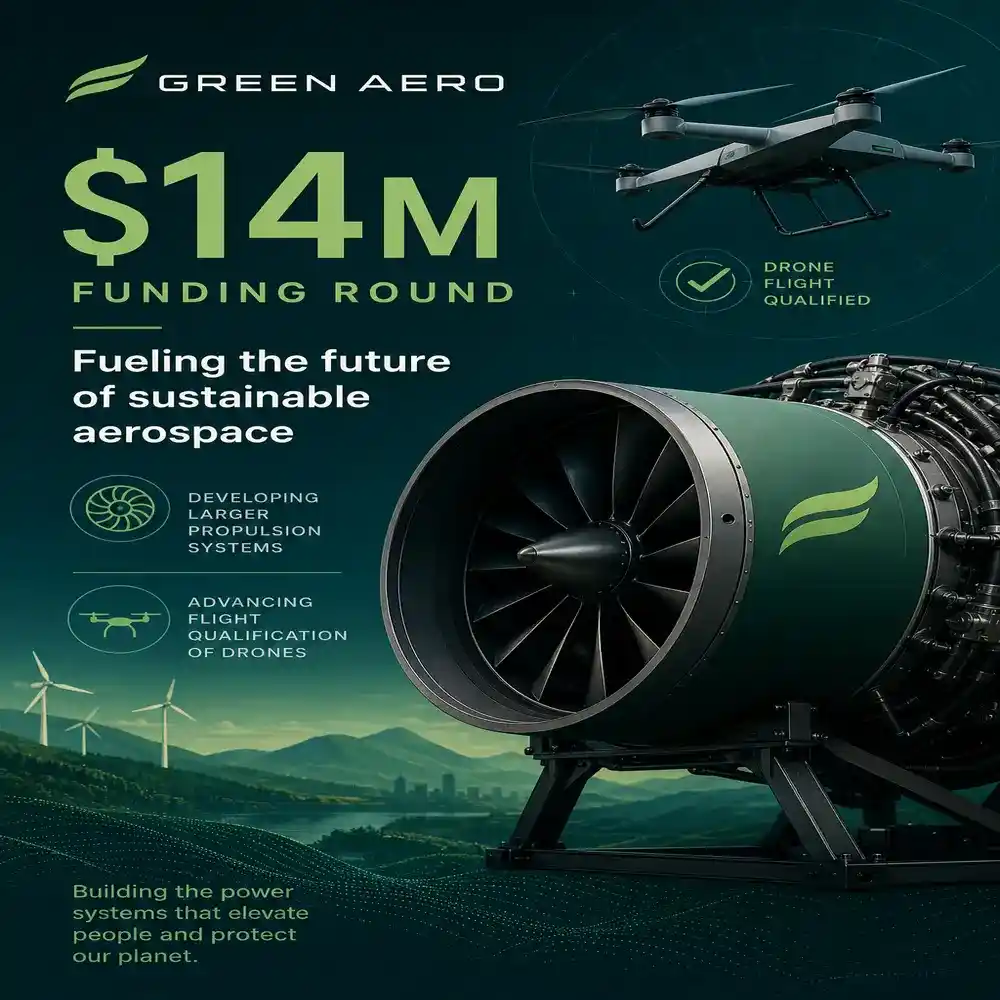
Indian aerospace startup Green Aero has raised $14 million in a Series A funding round led by Crane Ventures, with participation from 3one4 Capital, Antler Elevate, pi Ventures, Antler India and Rebalance. The Bengaluru-based company plans to use the capital to expand jet-engine testing, develop larger propulsion systems and accelerate the flight qualification of high-speed autonomous drones and Collaborative Combat Aircraft.
1. Green Aero Raises Million to Scale Indigenous Aerospace Technology
Green Aero, an Indian deep-tech aerospace and defence startup, has raised $14 million in Series A funding as it moves into a more demanding phase of jet-engine and autonomous aircraft development. Crane Ventures led the round, joined by 3one4 Capital and Antler Elevate, while existing investors pi Ventures, Antler India and Rebalance also participated. Founded in November 2023, the Bengaluru-based company is working to develop critical aerospace technologies within India rather than depending entirely on imported propulsion and aircraft systems. Its approach brings engine development, avionics and airframe engineering together under one organisation. The new funding is expected to support larger engine testing facilities, engineering recruitment and the development and flight qualification of transonic and supersonic drone platforms. The round is significant for India’s private aerospace ecosystem because advanced jet propulsion is among the most technically demanding areas of aircraft manufacturing.
2. Why Investors Are Backing Green Aero’s Jet Engine Ambition
The investor group combines venture capital firms with experience in deep technology and early-stage company building. Crane Ventures led the Series A, while 3one4 Capital and Antler Elevate joined the round alongside returning investors pi Ventures, Antler India and Rebalance. The participation of existing backers is notable because Green Aero is moving from early engine development towards larger systems and aircraft testing, stages that require substantial engineering resources and long development cycles. For investors, the opportunity extends beyond selling individual drones. A company that can develop propulsion, avionics and airframes could potentially supply several components of the aerospace value chain. However, the commercial opportunity depends on whether its prototypes can pass demanding ground and flight tests, meet customer requirements and be manufactured consistently. In aerospace, investor confidence can finance development, but only repeatable technical performance and credible customer demand can establish a durable business.
3. Blue Dragon Shows the Company’s Focus on Building Engines In-House
One of Green Aero’s central technology programmes is Blue Dragon, an aero-engine core developed in India. The company says it has completed more than 100 hot-fire tests in the sub-kilonewton thrust category, an important development milestone for a young propulsion company. Hot-fire testing allows engineers to operate an engine under controlled conditions, study its behaviour and identify problems before moving towards more complex testing. Green Aero’s website describes Blue Dragon as a modular turbojet platform in the 400-newton to 1-kilonewton thrust class and highlights its work on air-blast atomiser technology. These developments demonstrate progress in small-engine engineering, but they should not be confused with the qualification of larger engines for operational aircraft. The next challenge is to scale propulsion performance, durability, manufacturing precision and reliability as the company moves towards higher-thrust systems.
4. From Small Engines to Transonic and Supersonic Drones
Green Aero is using its propulsion work as the foundation for a broader family of high-speed unmanned aircraft. Its near-term development includes transonic drone platforms, which operate close to the speed of sound, while supersonic aircraft represent a longer-term ambition. The company is also developing larger-thrust engines to support heavier and more demanding platforms. Its stated roadmap includes a five-kilonewton engine programme, followed by further work towards supersonic aircraft. Moving from small test engines to larger propulsion systems is a major engineering challenge because thrust, heat, fuel delivery, materials, vibration and endurance become increasingly demanding. The company will need to demonstrate that its engine designs can operate reliably across the conditions required by the aircraft they are intended to power. The Series A gives Green Aero additional resources to pursue this progression, but the roadmap remains a development programme rather than proof that every planned aircraft is ready for deployment.
5. Collaborative Combat Aircraft Could Become a Major Aerospace Opportunity
A major part of Green Aero’s long-term vision is the development of Collaborative Combat Aircraft, commonly known as CCAs. These are uncrewed aircraft designed to operate alongside conventional fighter jets, potentially supporting missions through autonomous or remotely supervised flight. Rather than functioning like ordinary consumer drones, CCAs are intended for complex military aviation environments where speed, navigation, communication and reliability are critical. Air forces around the world are examining how uncrewed aircraft could complement crewed platforms, expand operational options and reduce the exposure of human pilots to certain risks. Green Aero is positioning its engine, avionics and airframe capabilities around this emerging category. Its ambitions are strategically relevant, but development, military qualification, procurement and integration can take years. The company will need to demonstrate dependable aircraft performance and meet demanding customer and regulatory requirements before its CCA ambitions translate into large-scale programmes.
6. The Technology Stack Includes Avionics, Edge Computing and GPS-Denied Navigation
Green Aero’s strategy extends beyond propulsion. The company is developing autonomous flight-control systems, onboard computing, avionics and navigation technologies designed to work in environments where satellite navigation signals may be unavailable or unreliable. This is important because an aircraft’s engine alone cannot deliver autonomous flight. The vehicle also needs to understand its operating environment, maintain control, process information and follow its intended flight plan. Green Aero describes its approach as vertically integrated, with propulsion, airframes and avionics developed together. The company operates an 87,000-square-foot research, development, assembly and testing facility in Bengaluru, according to its public materials. It has also identified partnerships and ecosystem support involving Larsen & Toubro, Boeing’s BUILD programme and SIDBI’s Green-Tech Accelerator. Bringing these engineering capabilities together could help shorten development cycles, although performance under real-world conditions remains the decisive test.
7. The Next 12 to 18 Months Will Test Commercial and Engineering Execution
Green Aero plans to use the funding over the next 12 to 18 months to expand its engine-testing infrastructure, hire additional engineers and accelerate the development and flight qualification of its aircraft platforms. It is also looking to commercialise existing engines, citing early interest from international buyers. This creates two related but different opportunities: generating revenue from propulsion products that are further along in development, while continuing to invest in more complex aircraft programmes. The company must manage both carefully. Engine customers will expect reliable products, consistent manufacturing quality and technical support, while autonomous aircraft programmes require extensive testing and qualification. Larger engines will also bring challenges involving precision manufacturing, advanced materials and specialised testing equipment. The funding can help build these capabilities, but the company’s progress should ultimately be judged by completed tests, qualified products, customer orders and the ability to deliver systems consistently.
8. Green Aero’s Bigger Bet Is Building an Indian Aerospace Platform
Green Aero’s $14 million Series A represents a significant financing milestone for an Indian startup attempting to build advanced jet propulsion and autonomous aircraft capabilities domestically. The company’s ambition is broader than manufacturing a single drone model: it wants to develop the engines, avionics, software and airframes that can form the foundation of multiple aerospace platforms. That integrated approach could create opportunities in defence and potentially other aviation applications if the technology matures and finds commercial customers. Yet the barriers are substantial. Engine qualification, aircraft safety, manufacturing quality, procurement cycles and competition from established aerospace companies all create long timelines and execution risks. The immediate priority is to turn small-engine testing achievements into larger propulsion systems and flight-qualified platforms. If Green Aero can make that transition, it could become an important participant in India’s effort to strengthen its domestic aerospace supply chain. The Series A provides resources for that journey; the engineering results will determine how far it goes.
TechFront360 Analysis: Green Aero is pursuing one of the hardest opportunities in Indian deep tech: building jet propulsion and autonomous aircraft capabilities together. Its advantage could come from controlling more of the aircraft stack, from engine to avionics, rather than relying on disconnected suppliers. But aerospace is a qualification-driven industry. The next meaningful milestones will be larger-engine performance, successful flight testing, dependable manufacturing and paying customers. The $14 million round gives the company room to pursue those milestones, but execution—not the funding headline—will determine whether its ambition becomes an industrial capability.