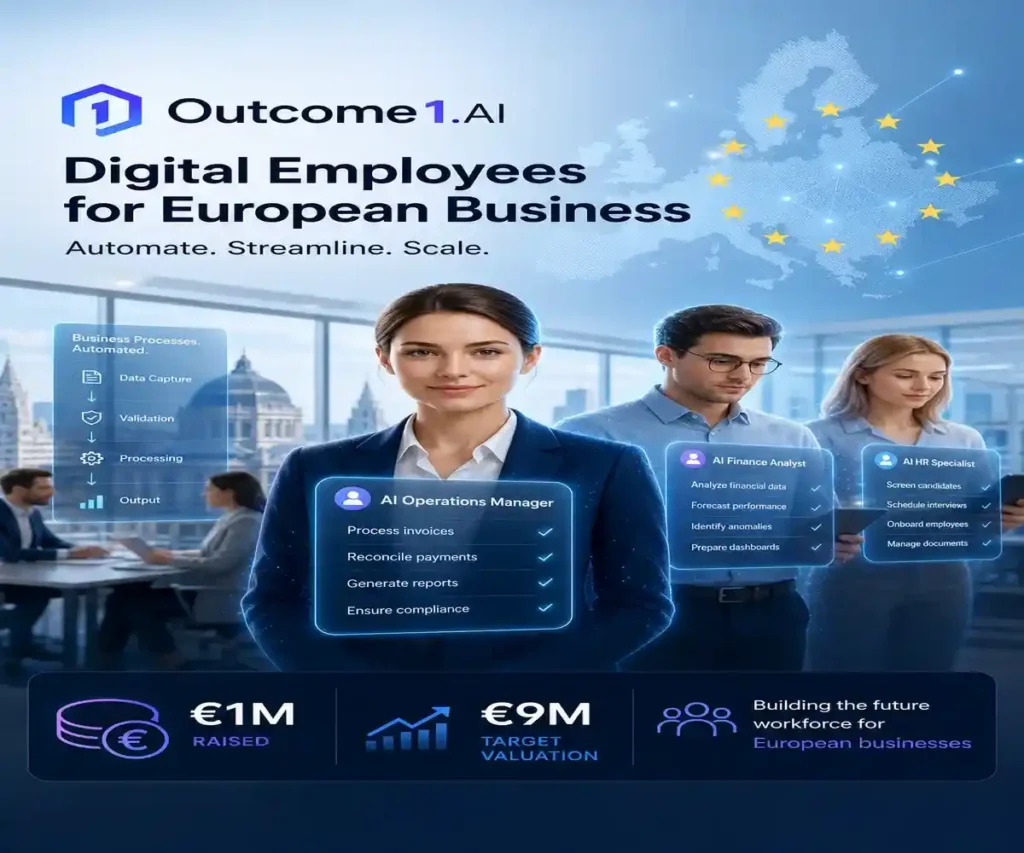
Outcome1.AI Raises €1M to Build Digital Employees for European Businesses, Targeting a €9M Valuation
Romanian AI startup Outcome1.AI has secured €1 million in pre-seed funding led by Catalyst Romania, with the investment potentially increasing to €1.35 million through an additional institutional co-investor. Founded by former Microsoft Romania executive Bogdan Putinică and engineer Alex Balint, the company is developing AI-powered digital employees that perform defined business tasks under human supervision.
1. Outcome1.AI Raises €1 Million to Expand Its Digital Employee Platform
Outcome1.AI, a Romanian artificial intelligence startup, has raised €1 million in a pre-seed investment led by Catalyst Romania as it prepares to expand its AI-powered digital employee platform across Europe. The investment could increase to €1.35 million with the participation of an additional institutional co-investor. The financing forms part of an oversubscribed €2.05 million pre-seed round that also includes €705,000 previously raised from European angel investors. The transaction values the company at €9 million pre-money, equivalent to approximately $10.2 million. Founded by Bogdan Putinică and Alex Balint, Outcome1.AI is developing AI systems that can take responsibility for clearly defined operational tasks inside businesses. Instead of functioning only as chatbots that answer questions, these systems are designed to work through business processes, interact with existing software and complete activities under human oversight. The new investment will help the company improve its platform, expand its engineering and commercial teams and strengthen its presence in Romania before entering additional European markets.
2. Former Microsoft Romania Leader Bogdan Putinică Is Building a New Category of AI Workers
Outcome1.AI was founded by Bogdan Putinică, the former head of Microsoft Romania, and Alex Balint, an engineer with experience in technology infrastructure and software development. The founders believe that the next major stage of artificial intelligence will be defined by the work AI systems can actually complete inside organisations. Many existing AI products help employees write documents, summarise information, search for answers or generate code. However, companies still need people to move information between systems, follow internal procedures, manage repetitive tasks and coordinate different stages of business operations. Outcome1.AI wants to address this gap through what it calls digital employees. These systems are designed around specific business responsibilities rather than acting as general-purpose assistants. The company’s ambition is to build a European business around AI agents that can perform useful work while remaining within boundaries established by their human users. The founders are positioning Romania as the starting point for a wider European expansion strategy.
3. What Are Digital Employees and How Do They Work?
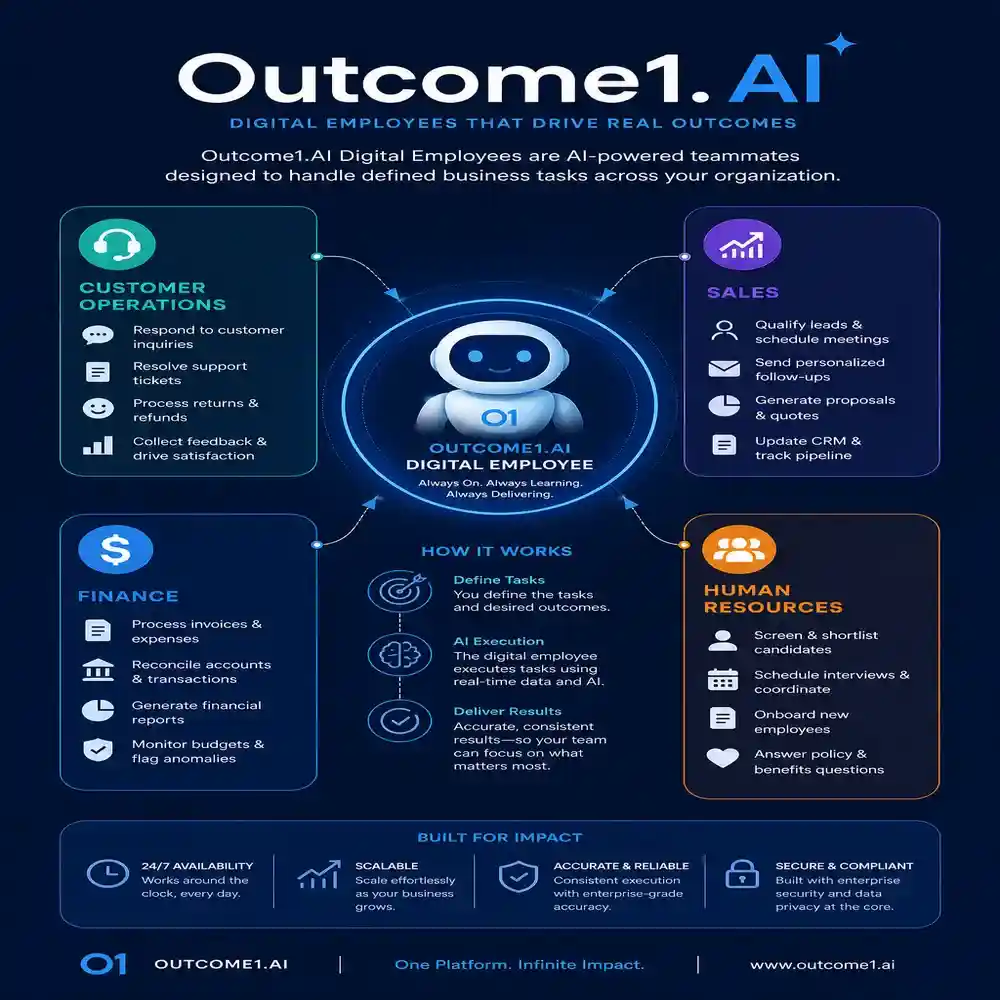
A digital employee is an AI-powered system configured to perform a defined business role. For example, a company could deploy an agent to support customer operations, prepare sales information, organise internal reports or assist with finance and administrative processes. The agent is configured around the organisation’s workflows and connected to the software systems required to perform its assigned tasks. Unlike a traditional chatbot that mainly responds to individual questions, the goal is to let the system carry out a sequence of activities and contribute to an ongoing business process. Human oversight remains an important part of the model. Companies can establish what an agent is allowed to access, which activities it can perform and where human approval is required. This approach is particularly important when AI systems interact with sensitive business information or perform actions that could affect customers, finances or internal operations. Outcome1.AI is trying to make these capabilities easier for businesses to deploy without having to build every agent and integration from scratch.
4. From Sales and Customer Service to Finance and Human Resources
Outcome1.AI is targeting business functions where employees spend significant time handling structured and repetitive operational work. These include customer relations, sales, finance, human resources, IT and compliance. In customer service, an AI agent could help organise incoming requests and support routine customer interactions. In sales, it could assist with preparing information, updating records and coordinating follow-up activities. Finance teams could use specialised agents for administrative processes, while HR departments could explore automation for internal requests and employee support. The company is not presenting these examples as a promise that every business function can be fully automated. Instead, its approach is based on identifying activities that can be handled by a defined AI agent and integrating that system into the customer’s existing processes. This role-specific strategy could make adoption easier for organisations that want measurable operational improvements rather than another general AI tool that employees must learn to use independently.
5. A Few Weeks of Deployment Could Help Businesses Adopt AI Faster
One of the important parts of Outcome1.AI’s business model is its focus on customisation and deployment. The company says its agents are configured around each customer’s requirements, existing software and internal business processes, with implementation taking a few weeks on average. This is important because enterprise AI adoption often involves more than selecting a model and connecting it to a website. Businesses need to understand how work currently happens, identify appropriate automation opportunities, establish access permissions and test how an AI system behaves before allowing it to handle real tasks. Outcome1.AI works directly with organisations to identify suitable activities, configure agents and integrate them into existing systems. Its commercial model is based on subscription payments for digital employees, creating the possibility of recurring revenue as customers add more roles and workflows. The company says it has already signed contracts with medium-sized and large businesses in Romania and is discussing opportunities with prospective customers across several industries. These early relationships provide a starting point, although the company has not publicly disclosed customer names or contract values.
6. Catalyst Romania Makes Its First Investment in Agentic AI
The investment is significant for Catalyst Romania because it represents the fund’s first early-stage investment in the agentic AI category. It is also the 14th investment from Catalyst Romania Fund II. Managing Partner Marius Ghenea highlighted the founders’ combined experience in technology and entrepreneurship, saying the firm believes they can help develop a new ecosystem of digital employees. Catalyst has also indicated that it has allocated additional resources for potential future investment if the company progresses successfully. The funding will support three main priorities: improving the platform and simplifying AI agent deployment, expanding the engineering and commercial teams, and strengthening the company’s position in Romania while entering other European markets. Distribution partnerships are also part of its expansion plans. The investment reflects growing interest among European venture capital firms in AI agents that perform practical business activities rather than simply generate content or provide recommendations.
7. The European Expansion Opportunity Comes With Serious Execution Challenges
Outcome1.AI is entering a competitive market where major technology companies and smaller startups are developing increasingly capable AI agents. Its opportunity is to differentiate itself through business-specific implementation, integration and operational control. However, deploying digital employees across multiple industries creates challenges involving data privacy, access permissions, reliability, regulatory compliance and accountability. European businesses must also consider the requirements of data protection rules and the EU’s evolving AI regulatory framework. An agent that can access customer information or perform finance-related tasks needs clearly defined authority, traceable actions and appropriate human approval. Outcome1.AI will need to demonstrate that its systems can operate reliably across different business environments while maintaining these safeguards. Expanding internationally adds further complexity because customer requirements, languages, regulations and enterprise software systems vary between markets. Its ability to build repeatable deployment processes while maintaining customer trust will be a major factor in determining whether the company can scale beyond its initial Romanian market.
8. Outcome1.AI Is Betting That Businesses Will Hire AI Agents to Get More Work Done
Outcome1.AI’s funding comes at a time when companies are moving beyond experimenting with artificial intelligence and looking for ways to put it into everyday operations. The startup’s central idea is that businesses need more than access to AI models: they need systems capable of completing defined tasks and supporting entire workflows. Its digital employee approach could become valuable if organisations can use AI agents to increase operational capacity without losing control over important decisions. The €1 million investment from Catalyst Romania, the potential additional €350,000 institutional commitment and the wider €2.05 million financing round give the company resources to develop that vision. The reported €9 million pre-money valuation also places expectations on the founders to turn early customer relationships into a scalable business. Outcome1.AI now faces the challenge of proving that its agents can deliver consistent results, integrate smoothly into real companies and expand across different industries. If it succeeds, the company could become part of a growing European market for AI systems that do not simply assist employees but take responsibility for completing specific parts of their work.
TechFront360 Analysis: Outcome1.AI is targeting the execution layer of enterprise AI. The market is moving beyond chatbots and content generation toward agents that can operate inside business systems and complete defined tasks. Its opportunity lies in making those agents practical to deploy, govern and scale across different organisations. The founders’ enterprise technology backgrounds and Catalyst Romania’s backing provide an early foundation, but the decisive test will be whether digital employees deliver measurable business value while remaining reliable and under human control.