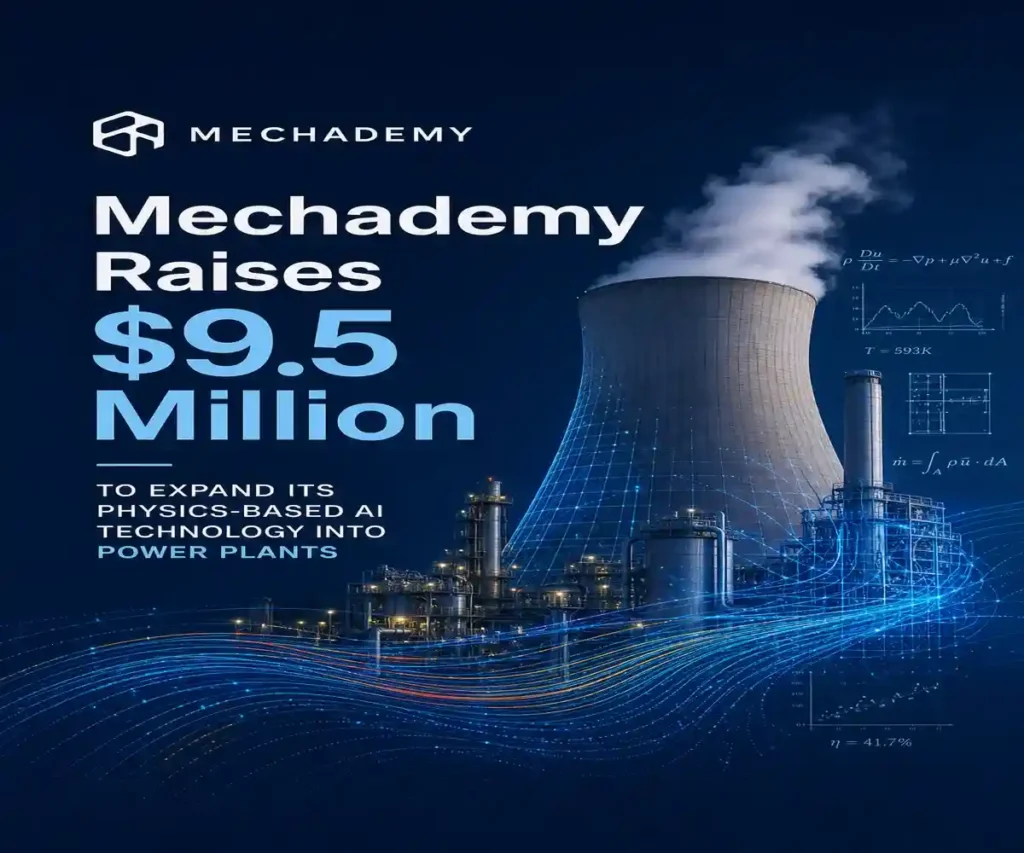
Mechademy Raises $9.5M to Bring Physics-Based AI to Power Plants as Electricity Demand Surges
Houston-based Mechademy has announced a $9.5 million Series A led by Silverton Partners to expand its Turbomechanica industrial AI platform from oil and gas facilities into power generation. The company combines physics-based engineering models, machine learning and equipment expertise to help operators identify developing machinery problems before they cause expensive failures or unexpected downtime.
1. Mechademy Raises .5 Million to Expand Industrial AI Into Power Generation
Mechademy, a Houston-based industrial artificial intelligence company, has announced a $9.5 million Series A funding round led by Silverton Partners. Titanium Innovations Investments and CSL Ventures also participated, with CSL having led the company’s earlier seed financing. The round closed earlier in 2026 but was publicly announced on November 25. Mechademy says its total capital raised now exceeds $12.5 million. The new funding will support the expansion of its Turbomechanica platform from oil and gas production facilities, including liquefied natural gas operations, into power generation plants. The move comes as electricity demand increases and energy operators face pressure to get more performance from existing infrastructure. Rather than developing another general-purpose AI assistant, Mechademy is focused on a specific industrial problem: understanding the condition of expensive rotating machinery and identifying problems before they interrupt operations. Its ambition is to make advanced equipment diagnostics more useful, continuous and accessible to the teams responsible for keeping critical energy facilities running.
2. The Power Industry Has a Costly Problem With Turbine Reliability
Gas turbines, compressors, pumps and motors are essential components of modern energy infrastructure. They help generate electricity, move natural gas, support industrial production and keep complex facilities operating. When one of these machines develops a fault, the consequences can extend beyond the cost of repairing the equipment. An unexpected failure can interrupt production, reduce electricity output, delay operations and create expensive maintenance requirements. The challenge is becoming more important as electricity demand grows from data centres, artificial intelligence infrastructure, electrification and industrial expansion. At the same time, new gas turbines can face long delivery timelines, making it difficult for operators to solve capacity problems simply by purchasing replacement equipment. This creates an opportunity for technologies that help existing machinery operate more reliably. Mechademy is targeting that need by using operational data and engineering models to identify changes in equipment performance. Its approach aims to give plant teams more time to investigate developing problems and plan maintenance before a small fault becomes a major operational disruption.
3. Turbomechanica Combines Industrial Physics With Machine Learning
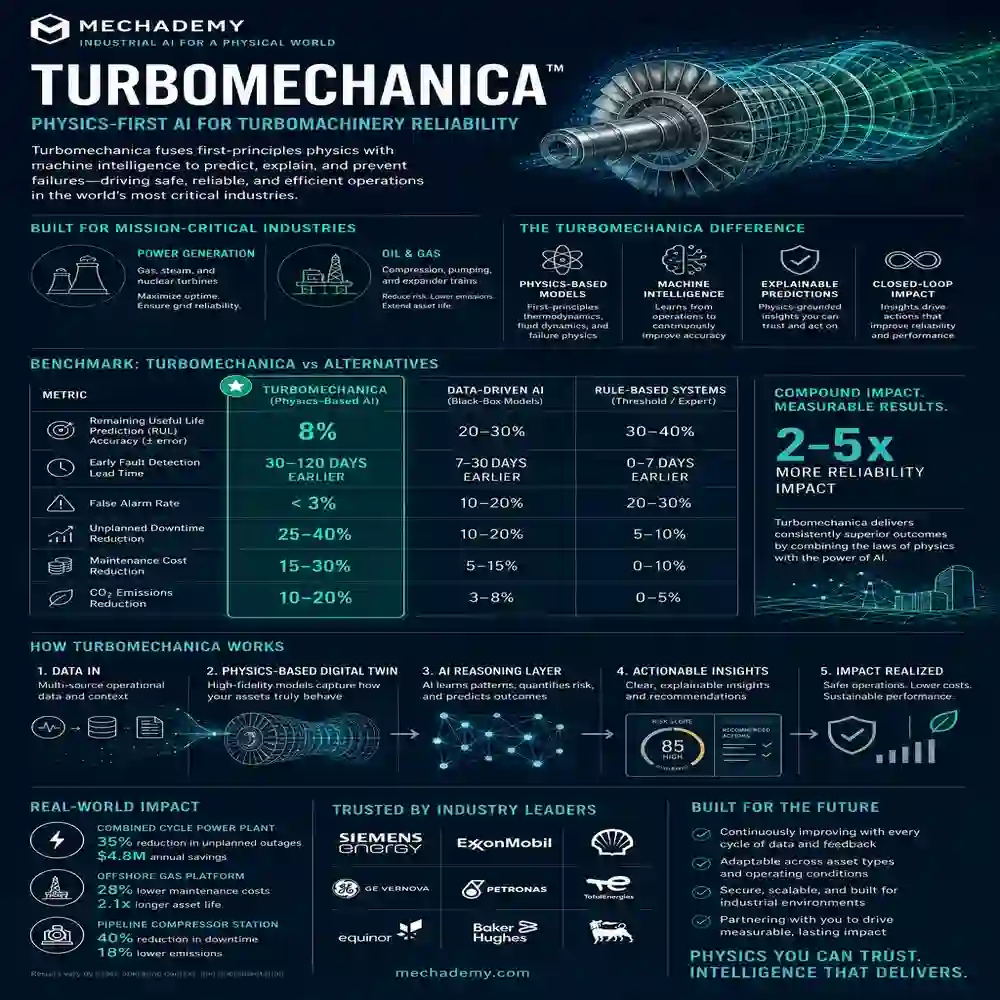
Mechademy’s main product, Turbomechanica, is designed around a combination of physics-based performance models and machine learning. The platform first establishes how a specific piece of equipment should behave under its operating conditions. It then compares that expected behaviour with live and historical plant data collected from sensors and existing monitoring systems. When actual performance begins to move away from the expected model, the system can investigate the difference and identify possible developing faults. Machine learning helps analyse large amounts of operational information, while the physics models provide engineering context that general-purpose AI systems may not understand. This matters because industrial machinery does not behave like ordinary business software. Temperature, pressure, vibration, flow, speed and other operating conditions interact in complex ways. A change in one measurement may be harmless in one situation but an early warning of a serious problem in another. By combining equipment knowledge with data-driven analysis, Turbomechanica aims to produce more useful diagnostics than systems that simply generate alerts when individual sensor readings cross predefined limits.
4. From Early Fault Detection to Actionable Maintenance Decisions
A major difference in Mechademy’s approach is its focus on explaining problems and recommending actions rather than simply displaying unusual sensor readings. Industrial operators often receive large numbers of equipment alerts, but not every alert identifies the underlying cause or explains what maintenance teams should do next. Too many warnings can make it difficult to identify the issues that genuinely require attention. Turbomechanica is designed to analyse relationships across multiple data sources, investigate possible causes and present diagnostic findings with recommended actions. The company’s platform also combines software analysis with a Remote Diagnostics Lab, where specialist engineers help evaluate equipment signals and validate diagnoses. Mechademy says its technology has identified issues involving vibration, dry gas seals, motor insulation, gas contamination and other equipment conditions, in some cases months before potential failures. These are company-reported capabilities and examples, not a guarantee that every failure can be predicted or prevented. Nevertheless, the ability to turn equipment data into earlier and more actionable maintenance decisions is the commercial value Mechademy is trying to deliver.
5. Why Mechademy Is Expanding From LNG Into Power Plants
Mechademy built its initial market around industrial facilities in oil and gas, including LNG operations where turbines and compressors are essential to production. The company now wants to apply its experience to a wider group of power generation assets. This expansion is strategically important because electricity demand is increasing while energy infrastructure operators are under pressure to improve availability and efficiency. The underlying machinery challenges are related across several industries, even though each plant has different operating conditions and equipment configurations. Turbomechanica is designed to work across different manufacturers and connect with existing plant data systems, reducing the need for operators to replace their entire monitoring infrastructure. The platform can also use simulation-based transfer learning, which Mechademy says helps it model new equipment without requiring extensive historical operating data. If the company can successfully transfer its existing engineering knowledge into power generation, it could expand its addressable market beyond its original LNG and oil and gas customer base. The challenge will be proving the platform’s value across different turbine fleets, operating environments and customer requirements.
6. AI Copilot and Agentic Diagnostics Expand the Platform
Mechademy is also adding a more accessible AI layer to its industrial diagnostics platform. Turbomechanica Copilot allows plant and field personnel to ask questions in everyday language and receive answers grounded in their own operational data and the platform’s diagnostic findings. This could help engineers and maintenance teams understand complex equipment information without manually searching through large volumes of reports and monitoring dashboards. The company says the Copilot architecture uses read-only data access, an important design consideration for industrial environments where unauthorised changes to operating systems could create serious risks. Mechademy is also rolling out Diagnostics 2.0, which it describes as a next-generation agentic diagnostics engine. The platform is intended to help automate parts of the process of analysing equipment behaviour and investigating potential faults. These developments show how industrial AI is moving beyond dashboards and basic anomaly detection toward systems that can assist with more complex operational workflows. However, human engineering oversight remains important, particularly when recommendations could influence maintenance or equipment operating decisions.
7. Silverton Partners Leads the Round as Mechademy Scales Its Industrial Business
The $9.5 million Series A was led by Silverton Partners, with Titanium Innovations Investments and CSL Ventures participating. Silverton sees an opportunity in combining specialised turbomachinery knowledge with modern AI, particularly as energy operators seek greater reliability from existing assets. Mechademy says the funding will support its expansion into power generation, accelerate product development and help grow its US team during 2027. The company has also strengthened its commercial organisation, hiring Madhukar “Duke” Puniani as Head of Revenue to lead go-to-market expansion. Its leadership and technical team bring experience from industrial and engineering organisations including Chevron, KBR, Parker Hannifin, GE and Siemens. Mechademy also reports that it holds SOC 2 Type 2 and ISO/IEC 27001 certifications, which are relevant when selling software into organisations that manage sensitive operational information. The company has not disclosed its valuation, individual investor allocations or customer contract values. Its next challenge is to convert the new capital into wider adoption and demonstrate that its platform can deliver consistent operational value across a larger number of power generation facilities.
8. Mechademy’s Bigger Opportunity Is Making Industrial AI Essential Energy Infrastructure
Mechademy’s funding highlights a growing area of artificial intelligence that receives less attention than consumer chatbots and general-purpose models: software designed to improve the performance of physical infrastructure. Electricity generation, LNG production and industrial manufacturing depend on machines that are expensive to replace and costly to operate when they fail. AI systems that understand equipment physics, analyse operational data and help engineers make better maintenance decisions could become increasingly valuable in these environments. Mechademy’s Turbomechanica platform is attempting to build that capability by combining engineering models, machine learning, expert diagnostics and AI-powered tools. The company’s expansion into power generation gives it an opportunity to address a market facing growing demand and pressure on existing assets. However, success will depend on measurable customer outcomes, reliable diagnostics and the ability to scale across different equipment types and facilities. The $9.5 million Series A provides additional resources for that expansion. Mechademy’s larger ambition is to make predictive and prescriptive intelligence a standard part of how critical industrial machinery is monitored, maintained and operated.
TechFront360 Analysis: Mechademy’s opportunity is built around a practical industrial constraint: the world needs more reliable energy infrastructure, but replacing expensive turbines and compressors is not always fast or economical. Its combination of physics-based models and machine learning is designed to help operators understand equipment behaviour before faults become costly failures. The move into power generation could significantly expand the company’s market, especially as data centres and AI infrastructure increase electricity demand. The key measure of success will not be how advanced its AI sounds, but how consistently it improves equipment availability, maintenance decisions and plant performance.