
Stripe’s $200B+ Valuation Bet: How the Collison Brothers Are Building the Financial Infrastructure for the AI Economy
A proposed employee share sale could push Stripe’s valuation beyond $200 billion, but the bigger story is its expansion into AI infrastructure, programmable finance, stablecoins and agent-driven commerce. The payments giant is building a much broader financial technology platform while remaining private.
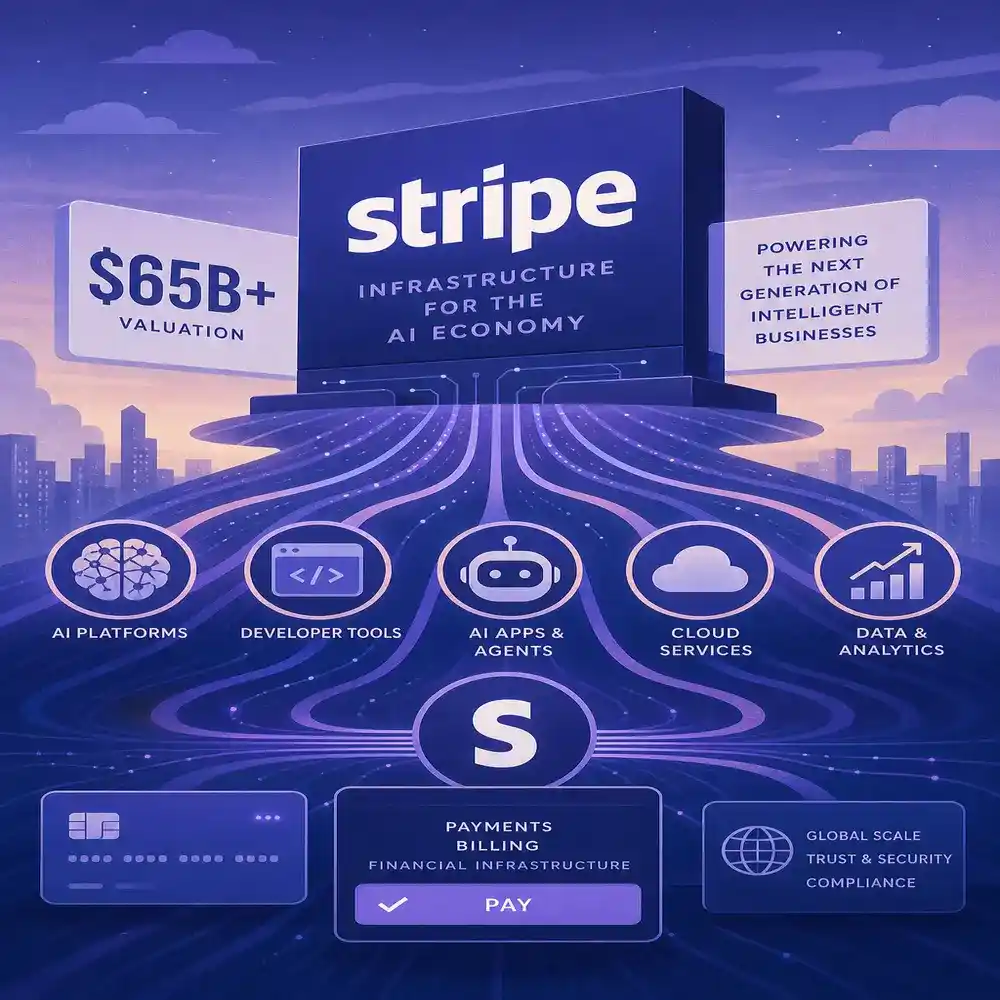
1. Stripe’s Valuation Could Cross 0 Billion in a New Tender Offer
Stripe, the financial technology company founded by brothers Patrick and John Collison, is discussing a new tender offer that could value the business at more than $200 billion, according to The Wall Street Journal. The proposed transaction would represent a significant increase from the $159 billion valuation established in its February 2026 employee share sale. The latest discussions are focused on providing liquidity to shareholders, including current and former employees, rather than announcing a conventional primary funding round. Existing investors are expected to purchase some of the shares, while Stripe could also participate in the transaction. The offer has not been finalised, and its eventual valuation may change before completion. If the proposed terms are achieved, Stripe would become one of the world’s most valuable privately held financial technology companies. More importantly, the potential valuation reflects how investors are viewing Stripe’s expanding role in the infrastructure behind digital commerce.
2. The Company Is Expanding Beyond Traditional Online Payments
Stripe began by making it easier for businesses to accept payments online, but its current platform covers a much wider range of financial operations. Businesses can use its technology for payment processing, subscription billing, invoicing, tax management, fraud prevention, embedded finance and global financial services. This broader product strategy matters because companies increasingly want fewer disconnected systems to manage their financial operations. A business that uses Stripe to accept payments may also need to manage recurring subscriptions, calculate taxes, detect suspicious transactions and collect revenue across different markets. Stripe wants to support more of these activities through one integrated platform. Its 2025 annual letter reported that more than five million businesses use its financial infrastructure directly or through platforms. The company is therefore competing for a larger role in business operations, not simply for a share of online payment transactions.
3. .9 Trillion in Payment Volume Shows the Scale of Stripe’s Network
Stripe’s financial scale is a major part of the story behind its valuation. According to its February 2026 annual letter, businesses using the platform processed $1.9 trillion in total payment volume during 2025, an increase of 34% compared with the previous year. Stripe said this represented approximately 1.6% of global GDP. The company also reported that it remained profitable, allowing it to invest in product development and acquisitions. Its Revenue suite, which includes billing, invoicing and tax products, was on track to reach a $1 billion annual revenue run rate during 2026. These figures help explain why Stripe is increasingly viewed as financial infrastructure for the internet economy. Its scale creates opportunities to sell additional services to existing customers, while its large merchant network gives it a position across payments, subscriptions and business finance. However, payment volume should not be confused with Stripe’s own revenue: it represents the value of transactions processed for businesses.
4. OpenRouter Takes Stripe Deeper Into the AI Infrastructure Economy
One of Stripe’s most significant strategic moves is its agreement to acquire OpenRouter, an AI model gateway and routing platform. OpenRouter helps developers and businesses access hundreds of AI models from different providers and route requests according to their requirements. Reuters reported that the transaction was worth slightly more than $8 billion, although Stripe did not disclose the purchase price in its official announcement. The acquisition connects Stripe to a rapidly growing part of the AI economy: the infrastructure that manages model access, token consumption and AI application costs. As companies deploy AI agents and software products, they need ways to track usage, manage billing and control the cost of model requests. Stripe already provides financial infrastructure for many AI businesses. Adding OpenRouter could strengthen its position across both the financial and operational layers of AI-powered services. This is a notable expansion beyond its traditional payments business.
5. Metronome and Parafin Expand Stripe’s Financial Infrastructure Strategy
Stripe has also expanded through acquisitions in areas that complement its existing financial products. Its acquisition of Metronome strengthens its usage-based billing capabilities, which are increasingly important for software companies that charge customers according to consumption rather than fixed subscriptions. This model is particularly relevant to AI businesses, where customers may pay according to tokens, computing resources or API usage. Stripe completed the Metronome acquisition in January 2026. It has also acquired Parafin, a company focused on providing embedded capital and financing products to small businesses. These moves extend Stripe’s reach into revenue management and business lending. Together, the acquisitions show a consistent strategy: build a platform that helps businesses accept money, charge customers, manage financial operations and access capital. The long-term opportunity is to make Stripe an essential part of how internet businesses operate financially.
6. Stablecoins and AI Agents Could Create Stripe’s Next Growth Markets
Stripe is also positioning itself for changes in how money moves across the internet. Its acquisition of Bridge strengthened its stablecoin infrastructure capabilities, while its work on the Tempo blockchain reflects an interest in payment-focused digital infrastructure. Stablecoins could support faster cross-border settlement and new forms of programmable payments, particularly for businesses operating across multiple countries. At the same time, AI agents are beginning to influence how people discover products, compare services and complete purchases. Stripe is developing agentic commerce tools that allow businesses to participate in shopping experiences powered by AI assistants. Its Link checkout product is also being integrated into emerging AI shopping experiences, including Meta’s Muse. These initiatives point towards a future where software agents may initiate transactions on behalf of users. Stripe’s opportunity is to provide the payment, identity and financial infrastructure that makes those transactions possible. Adoption, security and consumer trust will determine how quickly this market develops.
7. Staying Private Gives Stripe More Flexibility for Acquisitions and Liquidity
Stripe’s latest tender discussions also highlight its unusual approach to remaining private while providing liquidity to employees and investors. A tender offer allows eligible shareholders to sell some of their existing shares without requiring the company to list publicly. Stripe completed a previous tender offer at a $159 billion valuation in February 2026, following an earlier employee share sale at a $91.5 billion valuation in 2025. These transactions have helped create opportunities for shareholders while allowing Stripe to avoid the immediate demands of a public listing. Remaining private can give management more flexibility over long-term investment decisions, acquisitions and corporate strategy. The company has also been pursuing large strategic opportunities, including an unsuccessful reported effort with Advent International to acquire PayPal. Its ability to use capital for acquisitions while maintaining private-market liquidity is becoming an important part of its strategy. A valuation above $200 billion would raise expectations even further.
8. Stripe Is Becoming Financial Infrastructure for the Next Internet Economy
Stripe’s potential move beyond a $200 billion valuation reflects a larger transformation in the financial technology industry. The company is no longer focused only on helping online stores accept card payments. It is building a broader system for moving money, managing business revenue, supporting AI consumption, providing financial services and enabling new forms of digital commerce. Its $1.9 trillion payment volume, expanding product portfolio and acquisitions give it a substantial foundation. The next opportunity could come from businesses built around AI agents, programmable payments and global digital services. However, a valuation above $200 billion also creates a demanding test. Stripe must continue growing its revenue, integrate acquisitions effectively and defend its position against banks, payment networks and competing financial infrastructure providers. The proposed tender offer is not an IPO announcement or a completed financing round. It is another signal that private investors increasingly see Stripe as a central infrastructure company for the next generation of internet commerce.
TechFront360 Analysis: Stripe’s potential $200 billion-plus valuation is not simply a story about a payments company becoming more expensive. It reflects a shift in how investors value financial infrastructure in an economy increasingly shaped by AI, software subscriptions, stablecoins and automated commerce. Its acquisition strategy is connecting payments with model routing, usage-based billing and embedded finance. The biggest opportunity is to become the financial operating layer beneath digital businesses and AI agents. But the company must prove that this broader platform can sustain profitable growth while integrating increasingly ambitious acquisitions. Stripe’s next chapter may be less about processing payments and more about controlling the financial infrastructure through which the internet economy operates.