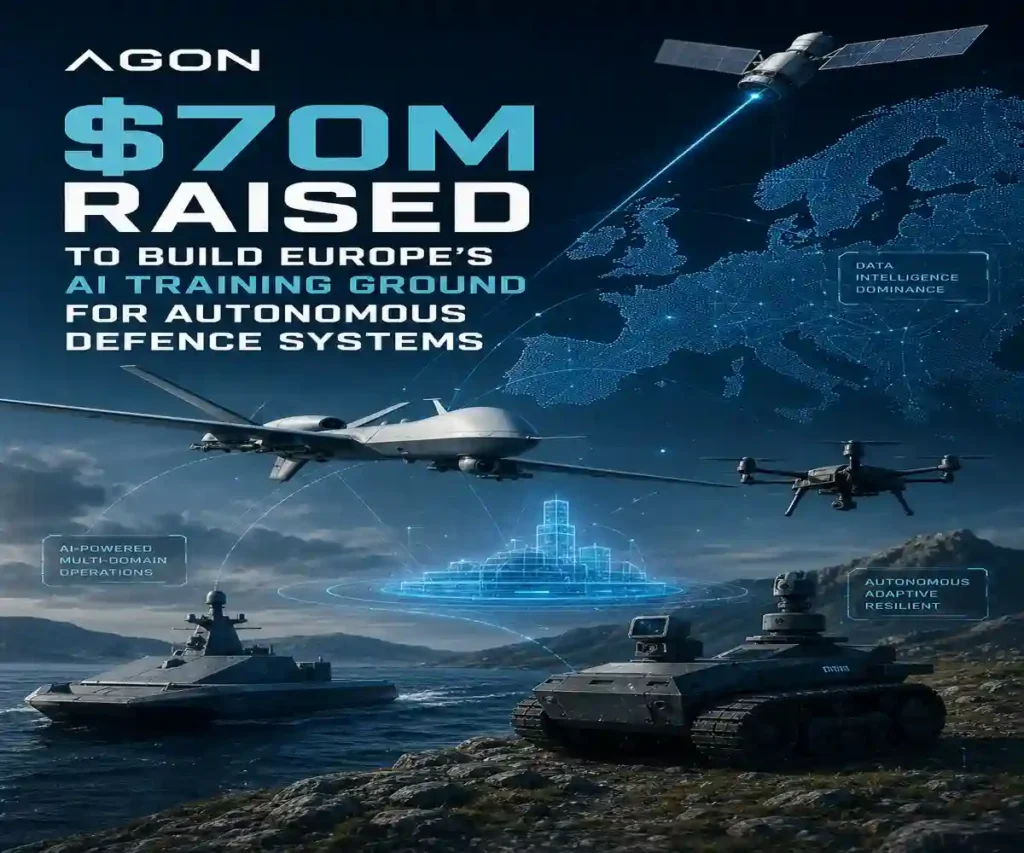
Agon Raises $70M to Build Europe’s AI Training Ground for Autonomous Defence Systems
The London-based defence technology startup has reached a $450 million valuation after a Series A led by Northzone, with two UK government-backed investment funds joining the round. Its ambition is to build the simulation infrastructure behind Europe’s next generation of autonomous defence technology.

1. Agon Raises Million as Europe Invests in Sovereign Defence AI
Agon, a London-based defence AI startup, has raised $70 million in a Series A funding round at a reported $450 million valuation. The round was led by Northzone, with participation from existing investors including Lakestar, XYZ, Lux Capital, Global Founders Capital and Speedinvest. The UK Government’s Sovereign AI Fund and National Security Strategic Investment Fund (NSSIF) also joined the financing, marking their first direct joint investment in a company. New investor Roelof Botha, former head of Sequoia Capital, participated, while Agon chairman David Helgason increased his investment. The financing takes Agon’s total capital raised to approximately $100 million, following an earlier $30 million funding round. The announcement is significant not only because of the valuation, but because it brings private venture capital and government-backed investment together around a strategic European defence technology company.
2. The Company Is Building a Virtual Battlefield for AI Training
Agon’s central product idea is a simulated environment where autonomous defence systems can be trained, tested and evaluated without relying exclusively on expensive physical trials. The company describes this as a virtual battlefield: a digital environment designed to reproduce difficult operational conditions and allow AI systems to encounter a wide range of simulated situations. For example, developers may need to assess whether an autonomous system can continue operating when communications are disrupted, navigation becomes unreliable or the environment changes unexpectedly. Testing every possible condition in the physical world can be costly, time-consuming and difficult to reproduce consistently. Simulation offers a way to repeat controlled tests, compare performance and identify weaknesses earlier in development. Agon is developing the infrastructure to make this process more scalable for defence organisations and technology companies.
3. Agon Wants to Build the AI Infrastructure Behind Autonomous Systems
Agon is positioning itself as an infrastructure and AI company rather than a manufacturer of drones, aircraft or other military hardware. Its platform is intended to help defence developers train, validate and orchestrate autonomous systems across different environments and applications. This distinction could give the company a broader addressable market than a startup focused on one particular vehicle or weapon platform. Different manufacturers and defence organisations may need ways to evaluate their systems under realistic conditions, while retaining control over their own hardware and operational requirements. Agon’s ambition also includes developing reusable AI models that can support multiple autonomous platforms. Its first product, built around the Agon Engine, is designed to provide the simulation foundation for this work. The commercial opportunity will depend on whether the company can make its technology useful across different customers, systems and national requirements.
4. Former Military and Technology Experience Shapes the Founding Team
Agon was founded by Tristam Constant and Junaid Hussain, combining military experience with backgrounds in defence technology and company building. Constant served for 13 years in the British Army before working at defence technology businesses including Anduril and Applied Intuition. Hussain has previously founded technology ventures, including Cambridge Aerospace and Iconic. The company is headquartered in London and also has an office in Berlin, reflecting its ambition to build a European technology business. Its team brings together talent from several countries and areas of expertise, including AI research, software engineering and defence. This combination matters because building reliable autonomous-system infrastructure requires more than machine-learning capability. It also requires an understanding of the operational environments, testing standards and technical constraints that defence organisations face.
5. Government Investment Makes Sovereign AI a Central Part of the Story
The participation of the UK Sovereign AI Fund and NSSIF is one of the most important elements of Agon’s Series A. The two government-backed funds are investing together for the first time, highlighting the UK’s interest in developing strategically important AI capabilities within its own technology ecosystem. Sovereign AI is designed to help promising British AI companies scale domestically, while NSSIF backs technologies relevant to national security and defence. Their involvement reflects a wider European concern that critical defence technology should not depend entirely on infrastructure and suppliers based outside the region. For Agon, the support could offer more than capital: it may strengthen access to government and defence networks, research resources and national technology programmes. The government has not disclosed the exact amount contributed by either fund, so their individual investment sizes should not be assumed.
6. Access to Advanced Computing Could Support Its Research Ambitions
Developing large-scale simulation environments and training advanced AI models requires significant computing resources. Agon is expected to benefit from access to the UK’s Isambard-AI supercomputer in Bristol through its relationship with the Sovereign AI initiative. Such access could support research and development by providing computing capacity for complex simulation workloads and model training. The value of this resource is not simply the number of calculations a system can perform. Developers also need suitable data, realistic environments, reliable evaluation methods and ways to compare model performance. For defence applications, the quality of testing is particularly important because a system that performs well in a limited simulation may behave differently in unfamiliar conditions. Agon’s challenge is to build a testing environment that is realistic and useful enough for defence customers to trust its results.
7. A 0 Million Valuation Comes Before Public Product Validation
Agon’s funding momentum is substantial, but the company is still at an early stage of commercial validation. Reporting on the round indicates that it has not yet publicly launched its product or disclosed named customers. The company has said it is working with defence industry partners, but detailed customer agreements and independent performance results have not been made public. This distinction matters because a large funding round does not automatically prove that a technology is ready for operational use. Simulation platforms must demonstrate that their environments represent relevant real-world conditions and that their evaluations provide meaningful information to developers. Agon will need to turn its funding into a working product, establish customer relationships and show that its technology can support demanding defence requirements. Its $450 million valuation reflects investor expectations about the market opportunity, not independently verified product performance.
8. Agon’s Bigger Opportunity Is to Become Europe’s Defence AI Laboratory
Agon is targeting a strategic layer of the defence technology market: the infrastructure used to develop and evaluate autonomous systems before they are deployed. As European governments invest in defence modernisation, the demand for locally developed AI models, simulation environments and advanced computing capabilities could increase. Agon wants to become a platform where defence organisations and technology companies can train and test systems while maintaining greater control over sensitive data and infrastructure. Its $70 million Series A provides significant resources to expand research, engineering and product development. But the next phase will be judged by tangible progress: a publicly available product, credible defence partnerships, measurable testing capabilities and evidence that customers are willing to pay for the platform. If Agon can deliver those milestones, it could become an important part of Europe’s emerging defence AI ecosystem.
TechFront360 Analysis: Agon’s funding round highlights a change in the defence AI investment landscape. The opportunity is no longer limited to companies building autonomous hardware; investors and governments are also backing the software, simulation and computing infrastructure needed to train and evaluate those systems. The participation of the UK Sovereign AI Fund and NSSIF gives Agon strategic backing, while Northzone’s leadership provides private-market validation. However, its next challenge is product proof. A $450 million valuation creates high expectations, and Agon will need to demonstrate that its virtual battlefield can deliver reliable, repeatable value to real defence customers.