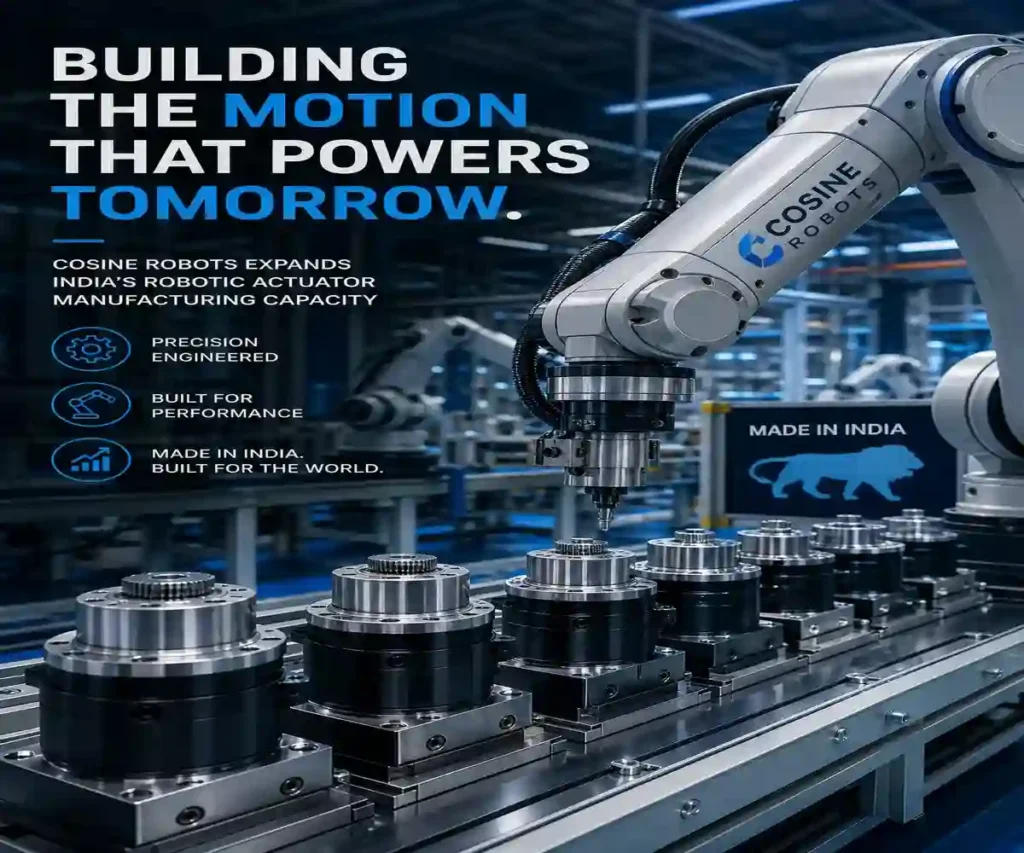
The Bengaluru deep-tech startup will use the funding to establish a research and production facility, expand its engineering team and bring its integrated servo actuator portfolio closer to commercialisation.
1. Cosine Robots Raises ₹22.36 Crore to Scale Robotics Hardware
Cosine Robots, a Bengaluru-based robotics hardware startup, has raised ₹22.36 crore in a funding round led by Avaana Capital, with participation from WEH Ventures and angel investors. The company plans to use the capital to establish a dedicated research and production facility in Bengaluru, expand its engineering team and increase the commercial readiness of its robotic actuator products. Founded by Kiran Mathew Koshy and Delip Thomas, Cosine is developing precision motion components for robot arms and humanoid robots. The investment is significant because it targets a part of the robotics industry that often receives less attention than complete machines: the hardware responsible for making robots move. Rather than competing only in the market for finished robots, Cosine is building components that other robotics developers may need to create their own machines. Its ambition is to make precision robotic movement more accessible through locally developed hardware.
2. Why Actuators Matter in the Robotics Industry
An actuator is a component that converts energy into controlled movement. In a robot, actuators function much like muscles and joints in the human body. They determine how a robotic arm bends, how much force a machine can apply and how accurately it can position an object. A robot with several moving joints requires multiple actuators, making these components essential to its overall performance and cost. If actuators are expensive, difficult to source or poorly suited to a particular application, building an affordable robot becomes harder. This is particularly important as manufacturers develop humanoid robots, industrial automation systems and robotic arms for more complex tasks. Cosine is focusing on this underlying hardware layer, where improvements in precision, reliability and cost could benefit several types of robotic machines rather than just one finished product.
3. Cycloidal and Planetary Actuators Form Its Initial Product Portfolio
Cosine Robots has focused its initial product portfolio on cycloidal and planetary actuators. These are different mechanical approaches used to transmit torque and control movement in robotic systems. Cycloidal mechanisms are often valued for their ability to deliver high torque and handle demanding loads in a compact design. Planetary gear systems use multiple gears arranged around a central gear to transmit motion efficiently. The company lists products across these actuator categories, including different sizes intended for different mechanical requirements. Its approach is to offer hardware that engineers can integrate into their own robotic projects instead of forcing every developer to design critical motion components from the beginning. This could be useful for robotics startups, research teams and manufacturers looking to shorten development cycles. The long-term commercial opportunity will depend on product performance, reliability, pricing and the ability to support customers at scale.
4. Integrated Servo Actuators Are the Next Commercial Milestone
The funding will also support Cosine’s move towards commercialising an integrated servo actuator portfolio, with the company targeting a launch around February, according to its co-founders in reporting by The Economic Times. Integrated servo actuators bring several motion-control elements together into a more complete unit, potentially simplifying the work required to build a robotic joint. Depending on the design, such systems can combine a motor, gearing, sensing and control electronics in one package. This integration can reduce the complexity of assembling and calibrating separate components. For robotics developers, easier integration can be as important as raw mechanical performance because engineering time and system reliability influence the final cost of a machine. Cosine’s next challenge is to turn its product development into a dependable commercial offering that customers can evaluate, purchase and integrate into real applications.
5. Avaana Capital’s Investment Supports India’s Deep-Tech Manufacturing Opportunity
Avaana Capital’s decision to lead the round places Cosine within a broader investment interest in Indian deep technology and domestic manufacturing capabilities. Robotics requires more than software and artificial intelligence. It also depends on motors, gears, sensors, electronics, precision engineering and manufacturing processes that can deliver consistent performance. These components form a critical part of the supply chain behind industrial automation and emerging humanoid systems. WEH Ventures and angel investors also participated in the financing, giving Cosine additional capital to develop its engineering and production capabilities. The investment comes as Indian startups explore opportunities across robotics, automation and advanced manufacturing. For investors, companies building essential hardware can offer exposure to several end markets, although manufacturing businesses also face longer development cycles and greater capital requirements than many software startups.
6. Local Production Could Address a Key Robotics Supply-Chain Gap
One of the larger opportunities for Cosine is the possibility of building a more accessible domestic supply of precision robotic components. Robotics developers often need to source specialised hardware from multiple suppliers, which can create challenges around cost, delivery times, technical support and customisation. A local manufacturer could potentially make it easier for Indian robotics companies to test new designs, obtain replacement parts and work directly with engineers on product improvements. However, domestic production alone does not guarantee a competitive advantage. Actuators must meet demanding standards for torque, accuracy, durability, thermal performance and repeatability. Customers will also compare products with established international alternatives. Cosine will need to demonstrate that its components can deliver dependable performance while remaining commercially attractive. If it succeeds, the company could become a useful supplier within India’s developing robotics ecosystem.
7. The Road Ahead Depends on Manufacturing Quality and Customer Adoption
Building a robotics hardware business is different from launching a software product. Manufacturing requires investment in equipment, quality control, testing, component sourcing and production processes. A design that works in a prototype may still need substantial engineering before it can be produced consistently at commercial volumes. Actuators also operate under repeated mechanical loads, meaning reliability over time is essential. Cosine’s new facility and expanded engineering team are intended to support this next stage, but the real measure of progress will be customer adoption. The company will need to show that its products can perform in actual robotic systems, that manufacturing costs remain competitive and that it can deliver units reliably. Commercial partnerships, repeat orders and evidence of long-term product performance will be important indicators to watch as the business moves beyond development.
8. Cosine Robots Is Betting on the Hardware Beneath the Robot Revolution
Cosine Robots is pursuing a part of the robotics market that could become increasingly important as automation expands across factories, logistics, research and other industries. The industry often focuses on the visible machine: a humanoid robot, a robotic arm or an autonomous system. But every moving machine depends on components that translate software instructions into physical action. By concentrating on actuators, Cosine is targeting this foundational layer of robotics. Its ₹22.36 crore funding round gives the company resources to strengthen product development, build manufacturing capacity and prepare its integrated servo actuator range for commercialisation. The opportunity is meaningful, but execution will determine its position. If Cosine can combine precision engineering, competitive pricing and dependable production, it could become part of the component supply chain supporting the next generation of Indian and global robotics companies.
TechFront360 Analysis: Cosine Robots is building in a strategically important but technically demanding part of the robotics industry. Its actuator-first approach gives it a potential route into multiple robotics markets without having to compete immediately as a manufacturer of complete robots. Avaana Capital’s investment provides resources to move from product development towards production. The key milestone now is commercial proof: reliable hardware, repeat customers and manufacturing economics that can compete with established suppliers. India’s robotics ambitions will need strong domestic component makers, and Cosine is positioning itself to serve that requirement.